
Tower Cranes for Municipal and Infrastructure Projects: Configuring QTZ Models for Site Fit
Municipal and infrastructure projects rarely fit a standard tower crane specification. A bridge abutment may sit beneath live power lines. A city-centre residential block may be surrounded by occupied buildings on three sides. A water treatment site may sit on the edge of a flood plain with restricted foundation options. In each case, the correct response is not a bigger crane — it is a better-configured one.
QTZ tower cranes are the dominant top-slewing platform used across these project types. Their defining advantage is configurability: jib length, mast height, lifting capacity and electrical systems can each be adjusted to match site conditions. This guide explains how those four levers work, how to sequence a configuration decision, and which documented QTZ models in the Dahan Technology range are matched to which kinds of municipal and infrastructure scope.
Problem Definition: Why Off-the-Shelf Specifications Fail on Municipal Sites
Municipal and infrastructure projects introduce constraints that commercial building projects usually do not: irregular site boundaries, work inside occupied urban blocks, clearance conflicts with public roads and utilities, and the need to keep climbing capability available across weeks or months of programme.
Three recurring mismatches appear when procurement teams select a tower crane purely on maximum lifting capacity:
- Over-configuration. Jib length longer than the site requires adds counterweight and foundation cost without adding usable reach.
- Under-configuration. Free height that cannot support the project's climbing schedule forces mid-project re-erection and standing time.
- Site mismatch. A fixed installation specified where a climbing or travelling arrangement is what the programme actually needs.
The failure point is rarely the product — it is the configuration decision, and that decision belongs in the procurement contract rather than on site after the crane arrives.
Industry Background: What Is Driving Tower Crane Demand on Public Work
The global tower crane market was estimated at USD 5.9 to 6.44 billion in 2025, driven by urbanisation and high-rise construction. China was the leading exporter of tower cranes in 2024, accounting for USD 694 million in export value, reflecting sustained international demand for configurable tower crane platforms.
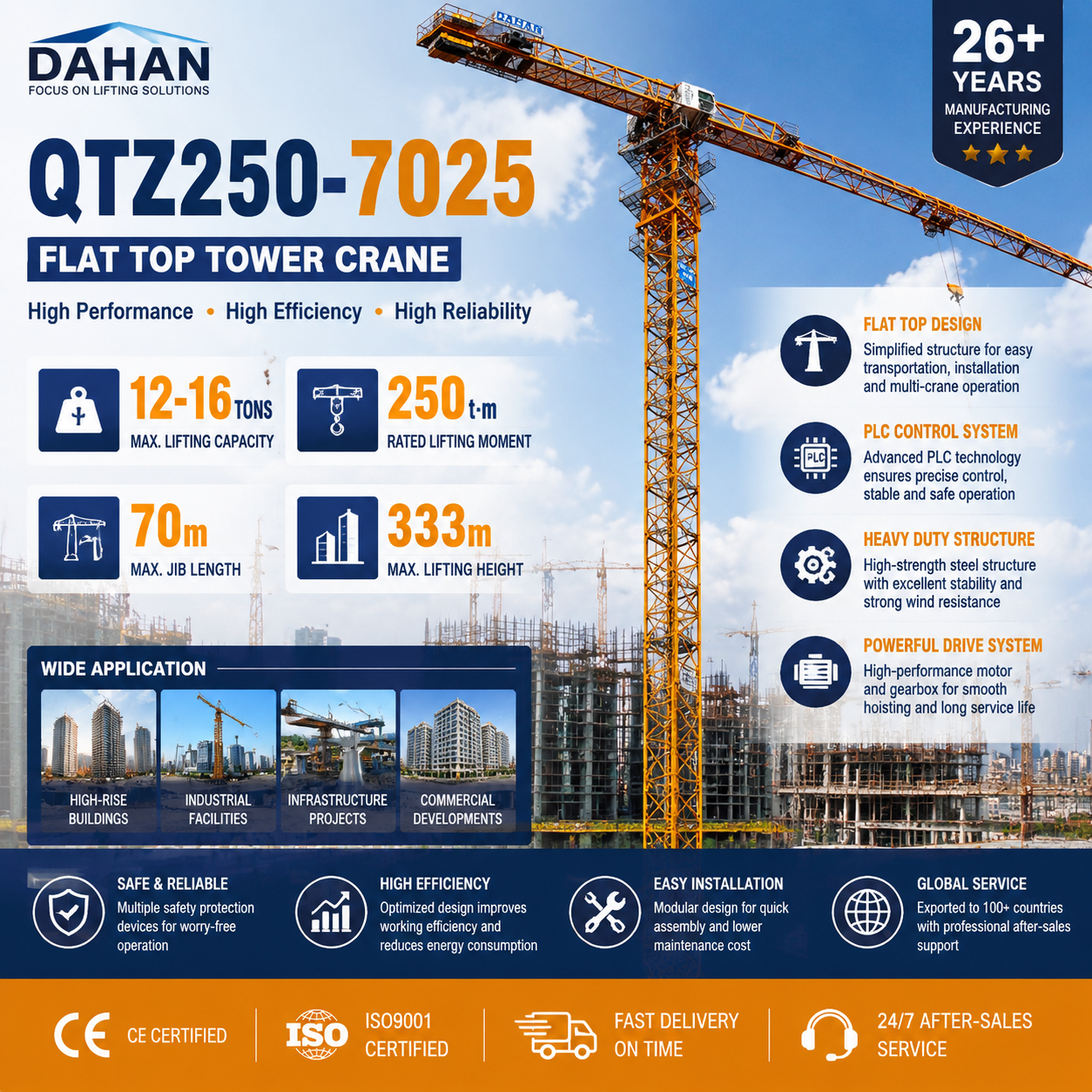
By product type, hammerhead tower cranes held the largest share at 42.8% in 2025, while flat-top (topless) designs accounted for 46.37% of tower crane revenue, reflecting their efficiency in dense urban airspace — precisely the condition municipal projects frequently present. In China, the standard GB/T 13752-2017 defines the design rules and safety specifications for tower cranes, superseding the 1992 version.
Looking further ahead, wind power specialised tower cranes with 200+ ton capacity are projected to grow at 8–10% CAGR through 2032, indicating continued movement toward configurable heavy-duty lifting platforms.
Detailed Solution: The Four QTZ Configuration Levers
Lever One — Jib Length Configuration
Jib length determines the working radius a crane can cover. On municipal work, jib length is usually driven by coverage rather than capacity: the crane must reach the material lay-down area, the furthest building corner and the loading point without extending past the site boundary or interfering with adjacent property.
Dahan Technology's QTZ platform supports jib length customisation on a per-project basis. Shortening the jib reduces the slewing envelope, lowers clearance risk against adjacent buildings or public roads, and reduces counterweight demand. Extending the jib expands coverage where the site is long and linear — roads, bridges and elevated corridors.
Lever Two — Mast Height, Free Height and Climbing
Free height — the maximum unsupported height before anchoring is required — often determines whether a climbing schedule is even feasible. For high-rise work with multiple climbing stages, choosing a crane whose free height matches the construction programme reduces the number of anchor points and the risk of interference with the structure.
Dahan Technology tower cranes are documented as supporting both fixed installation and climbing (mast-adding) modes for long-term operation. Mast height and standard section configuration can be customised; specifics require confirmation with the engineering team.
Lever Three — Lifting Capacity and Working Envelope
Maximum lifting capacity is a single data point. The more useful figure is rated capacity at a specific radius — the working envelope curve. A tower crane lifts substantially less at its maximum radius than at its nominal maximum capacity.
For municipal work, that means configuration should be driven by the heaviest actual lift the project requires — a precast beam segment, a reinforcement cage, a formwork set or a piece of MEP plant — and by the radius at which that lift must be made, not by the theoretical ceiling.
Dahan Technology's QTZ series offers rated lifting capacities from 5 ton to 220 ton, with documented configurations of 5, 6, 8, 10, 12, 16, 18, 25, 32, 45, 64, 125, 200 and 220 ton.
Lever Four — Electrical System and Control Options
The electrical system governs control precision, speed smoothness and maintenance access. On municipal sites, where tower cranes frequently operate close to public infrastructure and occupied buildings, control response and speed regulation directly affect both lifting safety and the level of disturbance to the surrounding area.
Dahan Technology offers electrical system options for different project conditions. Concrete selections require confirmation with the engineering team.
Modular Design and Safety Protection Systems
Beyond the four levers, two structural characteristics of the Dahan Technology QTZ platform are directly relevant to municipal and infrastructure work.
The first is modular design. A modular tower crane allows faster assembly and dismantling, convenient transport, flexible height adjustment and reduced installation time — factors that matter on phased projects where the crane may need to be relocated or removed mid-programme.
The second is the safety protection system. Each platform is documented with an overload protection system, a moment limitation system, height and travel limit protection, and an emergency stop system. On municipal sites, where a crane may work alongside public space, utility corridors or live traffic, these are not optional features.
Step-by-Step Breakdown: Configuring a QTZ Model for a Specific Site
- Map the site plan and required coverage. Mark building footprints, material storage, loading points, public roads, adjacent structures and any overhead restrictions. This sets the jib length range and foundation position.
- Establish lifting capacity from the real heaviest lift. Identify the heaviest component the project must actually lift, and the radius at which it must be lifted. The working envelope matters here — a 10-tonne crane may lift considerably less at its maximum radius.
- Plan the vertical scheme. Work out free height, anchoring requirements and the climbing sequence. On high-rise work, confirm that the crane's climbing scheme matches the structural construction programme.
- Select the slew and configuration type. The QTZ platform offers flat top, topkit, luffing jib and derrick configurations. Flat top suits dense urban sites and overhead-constrained airspace; topkit suits conventional high-rise; luffing jib suits sites where adjacent buildings restrict the slewing path.
- Specify electrical and control options. Match the electrical system to the required level of speed control, maintenance access and integration.
- Lock the configuration into the contract. State jib length, mast height, lifting capacity and electrical system options in the procurement documents, and confirm the engineering sign-off.
Use Cases: Where QTZ Configurations Fit
Municipal Roads and Bridges
Linear projects need wide horizontal coverage, and foundation placement is often constrained by road red-lines. Long-jib configurations combined with fixed or travelling installation suit this scope, subject to confirmation of transport and erection conditions.
High-Density Urban Residential and Commercial
Sites surrounded on three sides typically suit a flat top crane with a controlled jib length, which reduces the slewing radius and the risk of clearance conflicts with adjacent property. Climbing schemes need to match the structural programme.
Water Treatment and Municipal Utilities
These sites often sit on flood-plain edges or against restricted ground conditions. Foundation scheme, counterweight and mast height need to be customised against the actual ground conditions.
Industrial and Infrastructure Works
Large-span plants, bridges and elevated corridors call for greater jib length and higher lifting capacity, generally through long-jib configurations with climbing or anchored schemes.
Comparison Table: Documented QTZ Models and Their Capacity Options
The table below lists documented QTZ models in the Dahan Technology range together with their rated lifting capacity options and the configuration types documented for the line.
| Documented QTZ Model | Rated Lifting Capacity Options | Documented Configuration Types |
|---|---|---|
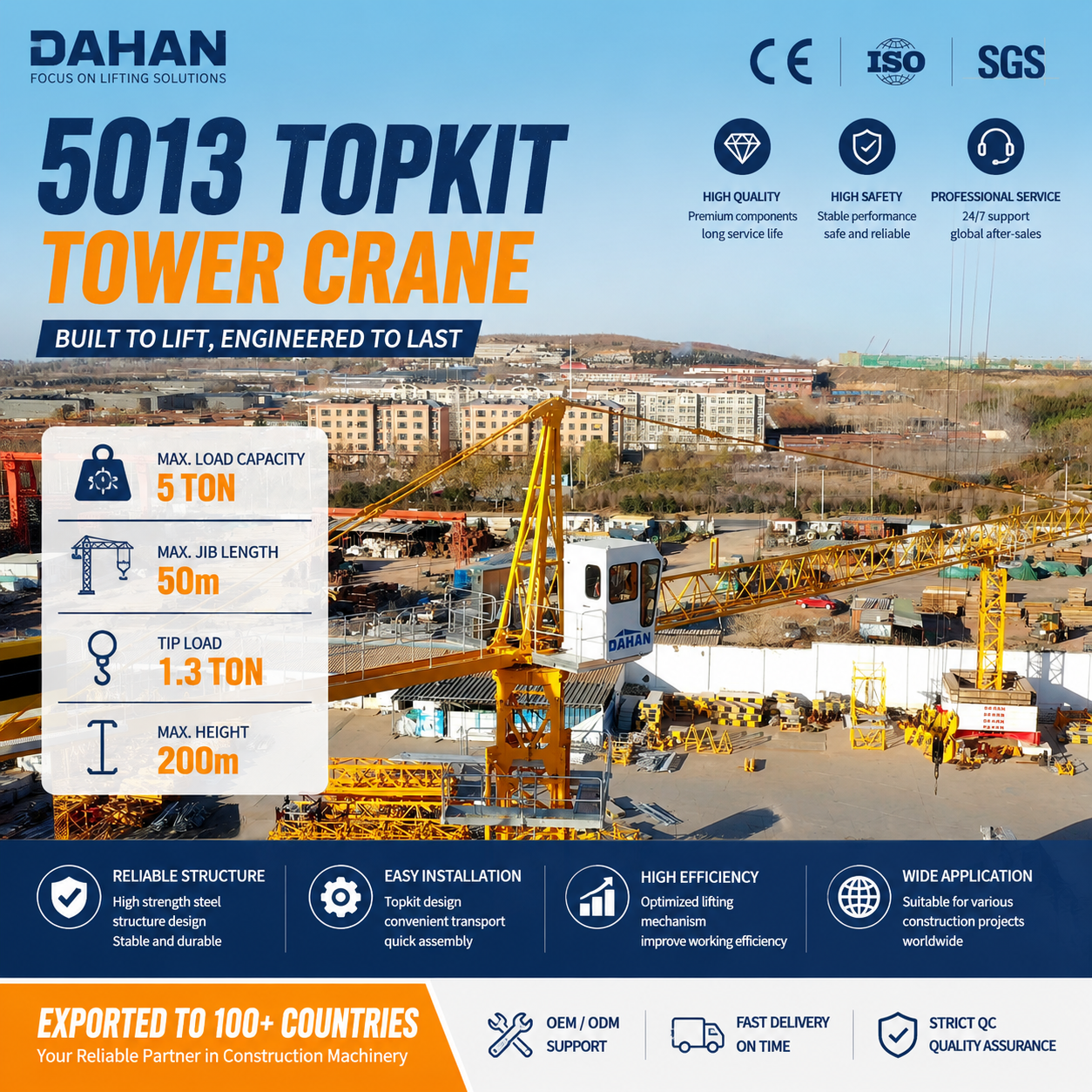
| QTZ63 (5013)-5T/6T | 5 t, 6 t | Flat top, topkit, luffing jib, derrick |
| QTZ80 (5211)-5T | 5 t | Flat top, topkit, luffing jib, derrick |
| QTZ100 (6013)-8T | 8 t | Flat top, topkit, luffing jib, derrick |
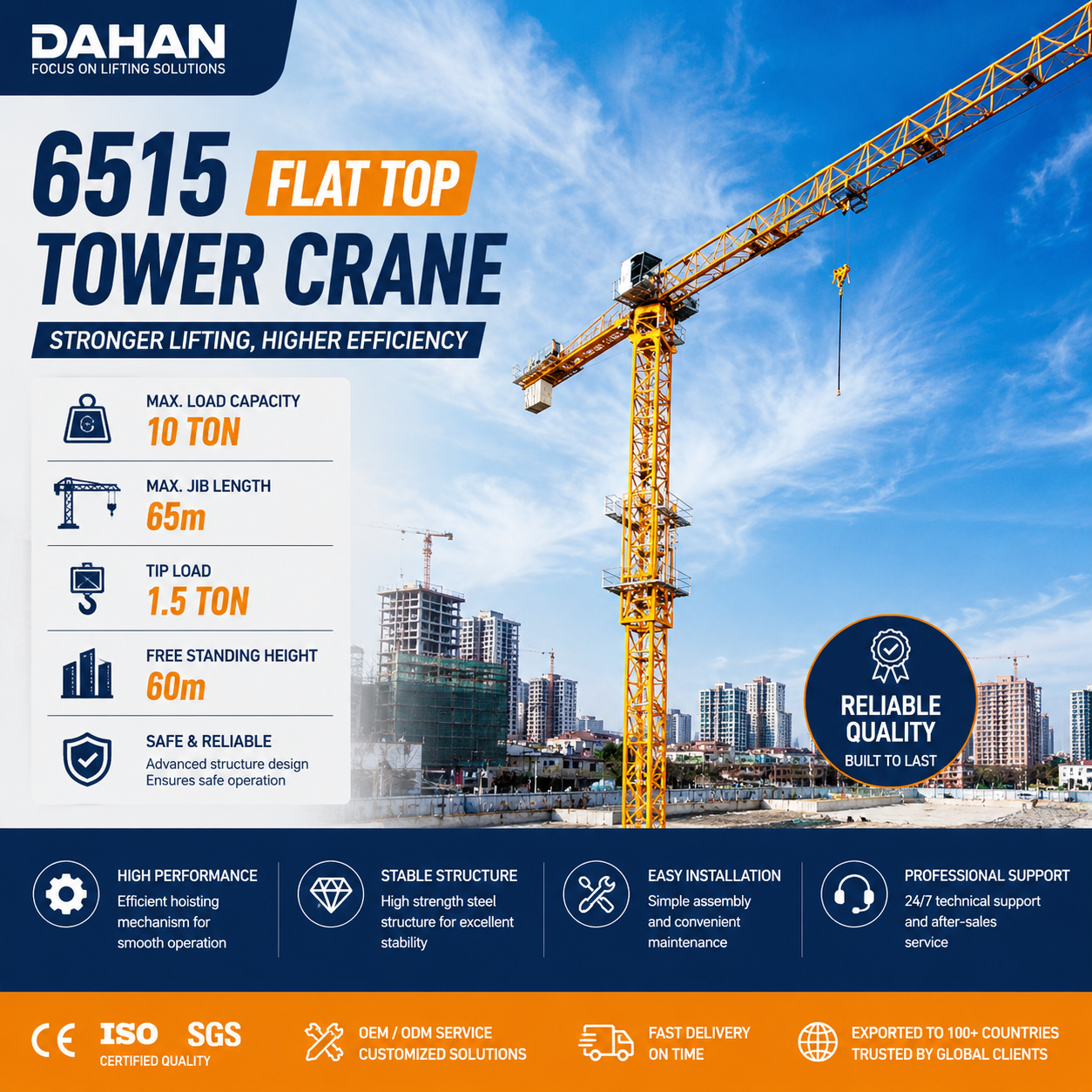
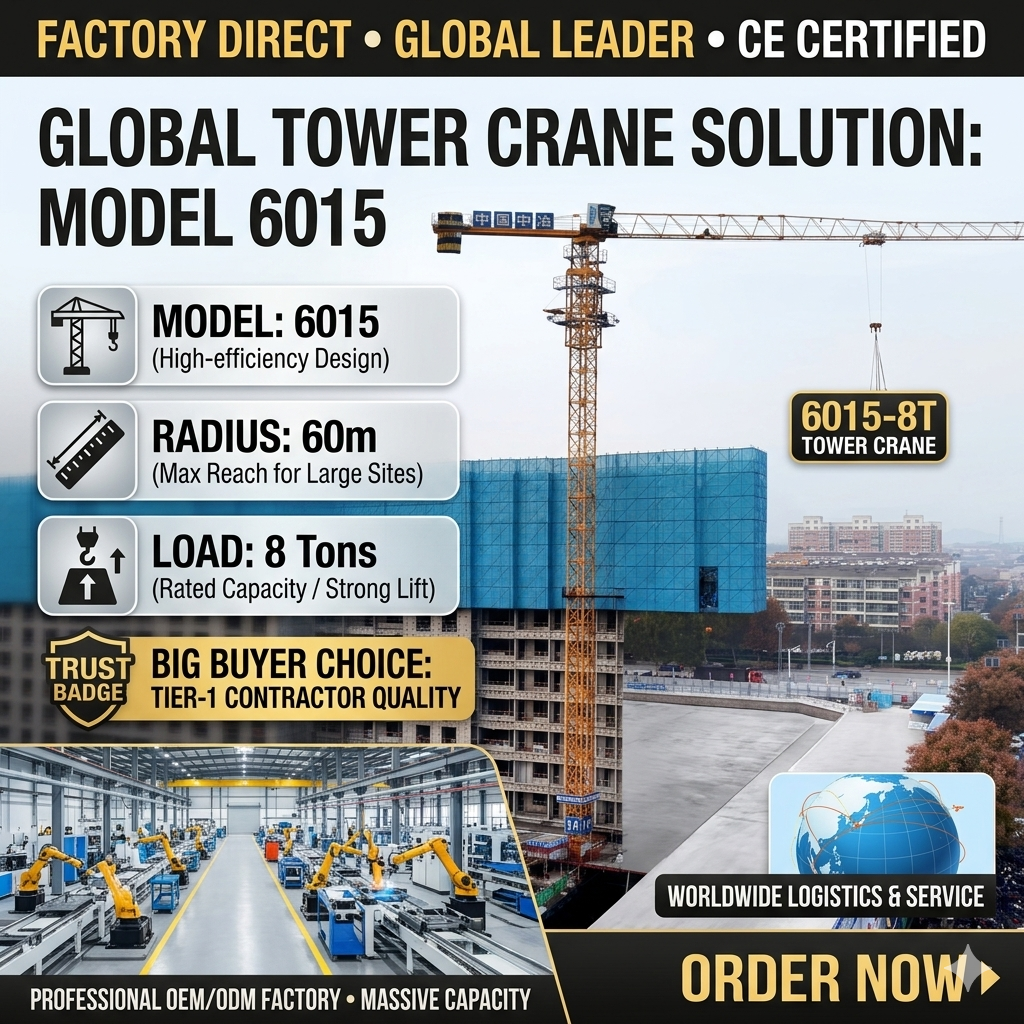
| QTZ125 (6015)-8T/10T | 8 t, 10 t | Flat top, topkit, luffing jib, derrick |
| QTZ160 (6515)-8T/10T | 8 t, 10 t | Flat top, topkit, luffing jib, derrick |
| QTZ250 (7025)-12T/16T | 12 t, 16 t | Flat top, topkit, luffing jib, derrick |
| QTZ250 (7520)-10T/12T/16T | 10 t, 12 t, 16 t | Flat top, topkit, luffing jib, derrick |
| QTZ315 (7527)-12T/16T | 12 t, 16 t | Flat top, topkit, luffing jib, derrick |
Across the platform, lifting capacity options range from 5 ton to 220 ton. The documented configurations are 5, 6, 8, 10, 12, 16, 18, 25, 32, 45, 64, 125, 200 and 220 ton. Every model listed is intended for building construction, real-estate engineering, infrastructure projects and municipal engineering.
Configuration note. Jib length, counterweight and erection schemes can be customised for site constraints. Specific dimensions, radii and capacity curves require confirmation with Dahan Technology's sales and engineering team before the procurement documents are finalised.
Frequently Asked Questions
1. What compliance and certification standards apply to QTZ tower cranes?
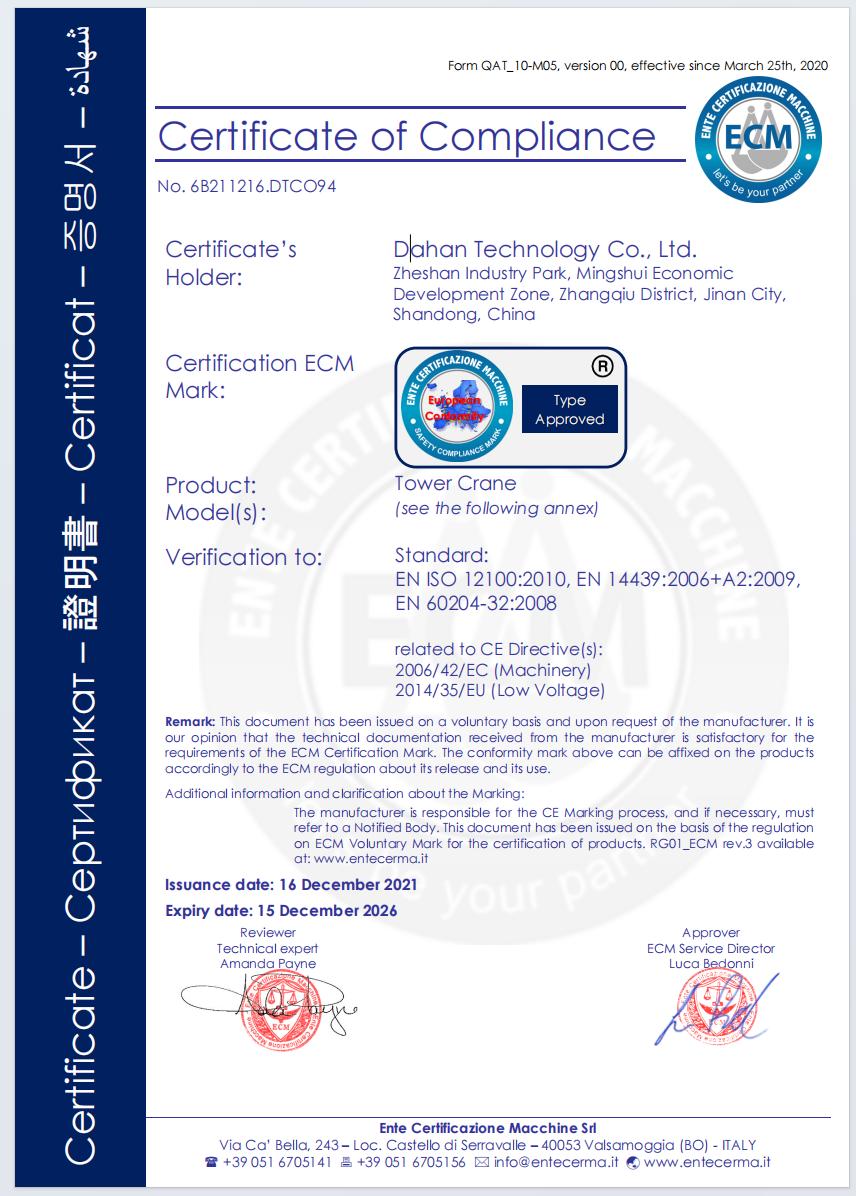
In China, the design rules and safety specifications for tower cranes are defined by the standard GB/T 13752-2017, which superseded the 1992 version. Dahan Technology Co., Ltd. holds a CE certificate, an EAC certificate, an SGS certificate and an ISO 9001 certificate. Export projects frequently require additional market-specific documentation, and that requirement should be confirmed at the start of the procurement process rather than after the order is placed.
2. Can jib length, mast height and lifting capacity be customised for a specific site?
Yes. Dahan Technology's QTZ platform is documented as supporting jib length customisation, mast height configuration, lifting capacity adjustment and electrical system options. Jib length, counterweight and erection schemes can be adapted to site constraints. The specific values depend on project conditions and require confirmation from the sales and engineering team. Documented rated capacities across the platform range from 5 ton to 220 ton.
3. What factors affect the configuration cost of a QTZ tower crane?
Lifting capacity class, jib length, mast height and climbing or anchoring scheme, and electrical system options are the main configuration variables that shape the specification. Matching each of these to the actual project requirement — rather than sizing for unused headroom — is what keeps the specification aligned with the construction scope. Pricing is quoted against a confirmed configuration.
4. What technical documentation is available before committing to an order?
Dahan Technology provides technical support and installation guidance for overseas tower crane customers, and supplies tower cranes to international markets with spare parts supply. Configuration review and technical documentation can be arranged ahead of a purchase commitment. To discuss a specific project scope, contact the sales team directly or download the company brochure to review the product range.
5. How is delivery and support handled for overseas projects?
Dahan Technology Co., Ltd. supplies tower cranes to Asia, Europe, the Middle East, Africa, North America and South America, providing spare parts supply and installation guidance for overseas customers. Delivery scheduling depends on the confirmed configuration and destination market; specific lead times are confirmed as part of the procurement contract. To begin a configuration discussion, request a quote or submit a project enquiry with your site parameters.
Conclusion
On municipal and infrastructure projects, the difference between a well-configured QTZ tower crane and a stock unit usually comes down to four decisions: jib length, mast height and climbing scheme, lifting capacity at the working radius, and the electrical system on board. Getting those four levers right is what turns a general-purpose crane into a site-fit one.
Dahan Technology Co., Ltd. was established in 2000 and manufactures tower cranes and construction hoists. The company covers an area of over 500 acres with a manufacturing facility of 330,000 square metres, employs over 1,000 staff including a research and development team of 100 engineers, and serves markets across Asia, Europe, the Middle East, Africa, North America and South America.
The QTZ range covers flat top, topkit, luffing jib and derrick configurations, with rated lifting capacities from 5 ton to 220 ton. Projects that need jib length, mast height, counterweight and erection schemes adapted to a specific site can bring those parameters to the engineering team for confirmation.
Plan Your Tower Crane Configuration
Send Dahan Technology your site parameters — building height, maximum lift weight, working radius and site constraints — and the engineering team will review the configuration for your project.
Website: www.chinatowercranes.com · Email: sunshuoaa8958@outlook.com · WhatsApp: +86 178-5257-1895 · Tel: +86 150 9883 0510
Download the company brochure: Dahan Technology Company Profile (PDF)
Have Questions or Need More Details?
Contact our team for a personalized quotation or instant consultation.
Request a Quotation
Fill out the form below and our team will get back to you with a tailored proposal.
WhatsApp Direct Chat
Prefer to chat in real-time? Message us on WhatsApp for instant assistance & quick answers.
- Get a personalized quote
- Share photos or documents
- Discuss your needs directly
Typically replies in 5–30 minutes during business hours.