
Tower Crane Safety System Selection: Overload, Moment, Limit, and Emergency Stop
A tower crane's safety systems are defined at the same moment as its lifting capacity, jib length and mast height — not added afterwards. Overload protection, load moment limitation, height, trolley, slew and travel limits, and the emergency stop function all depend on how far the load travels, how high the hook must reach, and which electrical and control architecture the project uses. Buyers who select a crane by maximum lifting capacity alone make most of their safety decisions by accident.
This guide is written for procurement managers, project engineers and rental fleet owners at the decision and execution stage of a tower crane purchase, who need to treat protection functions as part of the specification rather than as standard accessories. It explains what each protection group controls, how each one maps to a parameter that can be read on a catalogue or technical file, and how the whole set should be verified before shipment and supported across a multi-year project.
Problem Definition: Why Safety Configuration Is Usually Decided Too Late
In most enquiries the first question is tonnage, the second is jib length, the third is mast height and the fourth is price. Protection functions are assumed to be included and are rarely specified. That sequence produces four recurring problems.
- Selection by maximum capacity hides the duty point. Maximum lifting capacity normally applies at the smallest working radius. As the trolley moves outward, the load the crane can lift decreases. A project that lifts its heaviest component far from the mast is not protected by a large maximum-capacity figure; it is protected by the lifting moment curve and by the limiter that enforces it.
- Protection requirements follow geometry, and geometry is fixed first. Where the hoist height limit must be set, how far the trolley may travel, whether slewing must be restricted and whether travel limits are required are all consequences of jib length, mast height, site boundary and track layout. If those are locked before the protection concept is discussed, the protection concept is retrofitted onto a machine that was not configured for it.
- The climbing phase moves the settings, not only the steel. A mast-adding or internally climbing crane has height limit set points that move as the building rises. A long-term project therefore needs a documented, repeatable procedure for re-setting limits rather than a one-time commissioning step.
- Documentation gaps appear at handover. An offer may describe "full safety devices" while the technical file needs a key component list, inspection records and installation guidance. Cross-border procurement amplifies this gap, because the buyer's engineer may be checking a document set in a different language and format from the one used on site.
Industry Background: Configuration Diversity Is Increasing
The commercial context supports the same conclusion. The global tower crane market was estimated at roughly USD 5.9 billion to USD 6.44 billion in 2025, driven by urbanisation and high-rise construction (Fortune Business Insights; Grand View Research). China remained the leading exporter of tower cranes in 2024, with an export value of USD 694 million under HS code 842620 (OEC, using UN Comtrade data).
Within the product mix, flat-top (topless) designs accounted for 46.37% of tower crane revenue in 2025 (Mordor Intelligence), a share generally explained by their efficiency in dense urban airspace, while wind-power specialised cranes above 200 tonnes are projected to grow at 8–10% CAGR through 2032 (Future Market Insights). In China, tower crane design rules and safety specifications are defined by GB/T 13752-2017, which superseded the 1992 version (Standardization Administration of China).
The practical consequence for a buyer is that the protection package is configuration-dependent. A flat-top crane on a city plot, a luffing jib crane working beside an occupied building, a rail-mounted travelling crane and a heavy-duty crane assembled for wind power components do not carry the same protection logic, because the risks are not in the same place.
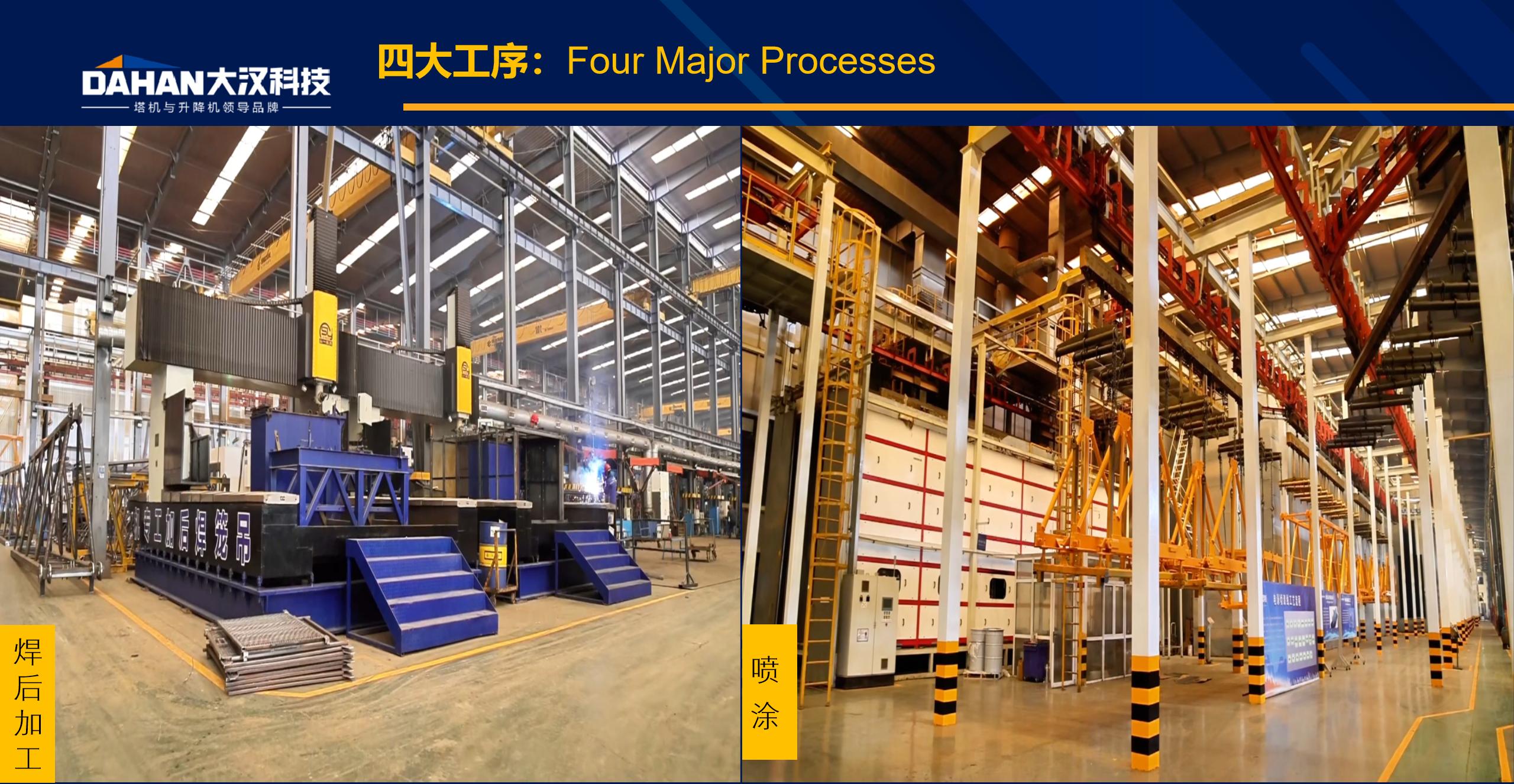
Dahan Technology Co., Ltd. is a tower crane and construction elevator manufacturer established in 2000, based in the Zheshan Industrial Park, Mingshui Economic Development Zone, Zhangqiu District, Shandong Province, China. The company operates a 330,000 m² factory with more than 1,000 employees, an annual production capacity of 5,000 units and an R&D team of 100 engineers, and it is a national standard revision unit in the tower crane industry in China. Its range covers flat top, topkit, luffing jib and derrick tower crane types in tonnage classes from 5 t to 220 t.
Detailed Solution: The Four Protection Groups and What They Interact With
1. Overload protection
Overload protection prevents the hoist from lifting a load beyond what the crane is rated to carry at the working radius in use. It is often described as a load limiter or rated capacity limiter, and it should not be read as one maximum number. Because rated capacity falls as the trolley moves outward, overload protection has to be specified against the capacity curve — the permitted load at each radius — rather than against a headline figure. In selection terms, request the capacity curve and confirm the radius at which each of the heaviest lifts must be made.
2. Load moment limitation
The load moment limiter monitors load and radius together and prevents operation outside the crane's rated moment envelope. Lifting moment expresses the comprehensive lifting capacity of a tower crane at different working spans and is usually measured in tonne-metres (t·m). As the working span increases, the load a tower crane can lift usually decreases, which means a crane can be inside its capacity limit and still outside its moment limit if the trolley is far out with a moderate load. This function protects the jib, mast and slewing structure, and the rated lifting moment is the parameter to compare first when two models share the same nominal tonnage.
3. Height, trolley, slew and travel limits
Limit protection is positional rather than load-based, and it is where geometry decisions become safety decisions.
- Hoist height limit: stops the hook block at a defined upper position. On a climbing crane this setting must be re-established as the mast is extended, so the project needs a documented procedure and an assigned responsibility.
- Trolley limit: restricts trolley travel at the inner and outer ends of the jib. The outer limit is tied to jib length and to the outermost rated radius; the inner limit keeps the trolley clear of the mast and cab area.
- Slew limit: restricts rotation to a defined arc where the site demands it, for example beside occupied buildings, overhead lines, adjacent crane zones or public space.
- Travel limit: applies to rail-mounted travelling cranes, where rail length, end stops and buffers define part of the operating envelope.
4. Emergency stop and the electrical system
The emergency stop is the function that brings motion to a halt independently of the normal control signal. Because it interrupts the drive rather than the operator's input, it belongs to the electrical and control architecture of the crane rather than to the mechanical structure. During selection it is worth clarifying where the emergency stop devices are located, which motions they interrupt, how the machine behaves if power is lost or a fault appears, and how the stop interacts with the braking system.
Control architecture also influences how smoothly the protection functions act. Variable-frequency control is used on tower cranes to match drive behaviour to the load and to support operating efficiency, and the same control platform is where soft-stop behaviour and the emergency stop path are defined. Buyers comparing similar tonnage classes should therefore compare the electrical and control configuration, not only the mechanism ratings.
Where the protection devices sit in the documented equipment set
It helps to see where protection devices sit in a manufacturer's own configuration list. In Dahan Technology's documented equipment set for a tower crane installation, the supporting devices comprise counterweights, mast sections, electrical traction systems, wire ropes, cabs and safety limit devices. Jib length, counterweight arrangements and erection schemes can be customised for site constraints, with the specific configuration confirmed by sales and engineering for each project. That point matters at the execution stage: the safety-related items are part of a configured package, and the package is project-specific.
The parameter set that decides the safety configuration
A tower crane model is normally determined by building height, maximum lifting capacity, maximum working radius, lifting height, construction site conditions and the specific lifting conditions, and the key parameters are maximum lifting capacity, maximum working radius, rated lifting moment, lifting height, lifting speed and working class. Selection cannot be decided solely on maximum lifting capacity; the lifting moment curve and the rated capacity at different spans must be combined with it. For high-rise and super-high-rise projects, the attachment scheme, free height, standard section configuration and foundation conditions are added to that list.
Those parameters are also the inputs to the protection configuration. Capacity drives overload protection; moment and radius drive moment limitation; lifting height and the climbing plan drive height limits; site layout and jib length drive slew and trolley limits; and the drive and control choice determines how the emergency stop is arranged.
Step-by-Step Breakdown: A Selection Sequence for Safety-Related Configuration
- Define the load case before the model. Record the heaviest single component, the radius at which it must be lifted and the height it must reach. This is the duty point the load moment limiter will enforce.
- Fix the geometry. Decide jib length and working span, mast height and free-standing height, the climbing or attachment plan, and whether the crane will be fixed, travelling or internally climbing.
- Translate geometry into protection requirements. State where the height limit must be set, what trolley travel is needed at both ends, whether slewing must be restricted to an arc and whether travel limits are required.
- Choose the electrical and control architecture. Confirm the drive and control option, how the emergency stop path is arranged, and where control positions such as cab or ground pendant are located.
- Map every requirement to a document. Request the technical documents and parameter sheet, the key component list, factory inspection records and installation guidance, and confirm which documents travel with the shipment and in which language.
- Verify before shipment. Pre-shipment testing is performed for each batch to support long-term supply quality control, and pre-shipment test is the stated acceptance criterion, so the list of parameters covered by that record should be agreed before the order is placed.
- Plan the long-term configuration. Define who re-sets height limits after each climb, which spare parts are held, and how warranty and technical support will be delivered through the life of the project.
Use Cases: How the Same Four Functions Are Weighted Differently
Dense-city high-rise residential and commercial towers
Flat-top and topkit cranes are commonly used where airspace above the site is restricted. Slew limits and trolley limits carry more weight here, and the height limit must be re-set at every climbing stage. Emergency stop positions at both cab and ground level suit the mixed crew patterns typical of urban sites.
Super-high-rise with internal climbing
When a crane climbs inside the building core, the hoist height limit and the attachment scheme move together. The protection concept then has to be documented as a sequence of stages rather than a single setting, and the buyer should expect stage documentation rather than a single commissioning sheet.
Bridges, infrastructure and rail-mounted applications
Travelling cranes operate along a defined track, so travel limits, rail ends and buffers form part of the safety envelope. Luffing jib machines are used where the working radius has to change without sweeping a fixed outer envelope, and moment limitation becomes the primary load-related protection.
Wind power and heavy-duty lifting
Cranes in the 200-tonne class and above exist for components that are both heavy and lifted at significant radius. Here the rated lifting moment, not the tonnage figure alone, decides whether the machine can perform the lift. Dahan Technology provides project-oriented solutions for wind power, thermal power, road and bridge, port and nuclear power applications.
Industrial plants, precast yards and medium or small projects
For 5 t to 10 t machines the protection set is usually simpler, but the same rule applies: the moment curve, jib length and lifting height should be checked before the model is chosen, and the electrical option should be matched to the duty cycle.
Comparison Table: Safety Function, Selection Parameter and Document to Verify
| Safety function | What it controls | Selection parameter it must match | Document to verify |
|---|---|---|---|
| Overload protection | Load lifted at the working radius in use | Rated capacity curve; maximum lifting capacity | Parameter sheet and capacity curve |
| Load moment limitation | Load and radius combined (t·m) | Rated lifting moment; maximum working radius | Technical documents and moment data |
| Hoist height limit | Upper position of the hook block | Lifting height; free height; climbing plan | Installation guidance; stage plan |
| Trolley and slew limits | Trolley travel and arc of rotation | Jib length; site boundary and obstruction layout | Configuration drawing; commissioning record |
| Travel limits (rail-mounted) | Travel along the track | Track length; end stops and buffers | Site layout and crane configuration list |
| Emergency stop | Motion interruption independent of normal control | Electrical system and control options; control positions | Control system description; factory inspection record |
The table maps protection functions to parameters that appear in a tower crane specification. It describes what to check and where to check it; model-specific values must come from the manufacturer's documents for the exact configuration ordered.
Frequently Asked Questions
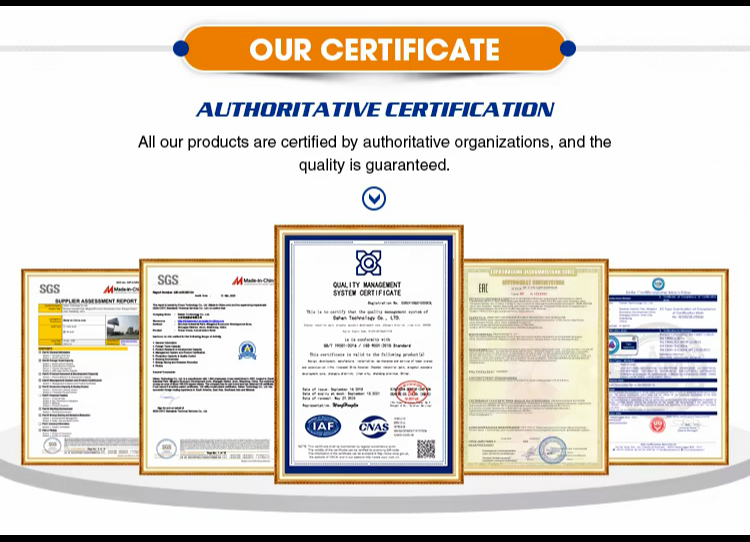
Request the technical documents and parameter sheet covering maximum lifting capacity, maximum working radius, rated lifting moment, lifting height, lifting speed and working class, together with the key component list, factory inspection records and installation guidance. For export projects, Dahan Technology provides CE documentation, holds CE, EAC, SGS and ISO9001 certificates, and supports third-party inspection requirements; these documents support factory audit and supplier verification processes. They cover the compliance and verification side of the purchase — the safety configuration itself is defined by the design documents for the specific model, so the buyer's load case should be mapped against the moment curve and the rated capacity at each working span before the order is confirmed.
Yes, within the limits of the selected model. Jib length, counterweight arrangement and erection schemes can be customised for site constraints, with the specific configuration confirmed by sales and engineering. The Dahan Technology range includes flat top, topkit, luffing jib and derrick tower cranes in tonnage classes from 5 t to 220 t, and matching drive and control systems can be equipped for different models and project requirements using variable-frequency control and reasonable power matching to support operating efficiency. Where a project needs restricted slewing, a particular climbing sequence or a defined control position, those requirements should be stated at the enquiry stage rather than after the model has been frozen.
Tower crane purchase cost is affected by the model, lifting capacity, load moment, working radius, lifting height, basic configuration, electrical system and control system. Because these factors differ between models and between brands, a single unified price ratio cannot be applied across different machines. For overseas projects the full-life-cycle cost should also be evaluated, including equipment price, transportation, installation and commissioning, spare parts supply and after-sales service. On the commercial side, a 30/70 payment structure applies to framework and long-term supply agreements, which matters when protection-related spare parts and support are planned across several project phases rather than a single delivery.
Pre-shipment testing is performed for each batch to support long-term supply quality control, and pre-shipment test is the stated acceptance criterion. The minimum order quantity is 1 unit, and delivery terms include FOB, CIF, EXW and CFR. Buyers should agree the test list in advance — which parameters are covered, which documents are produced and how they are signed off — because the pre-shipment record is the buyer's main evidence that the crane matches the ordered configuration.
Supply capacity and long-term support are the two constraints. Dahan Technology has an annual production capacity of 5,000 units, which supports long-term supply contracts and bulk orders, and a track record of more than 85,000 tower cranes and elevators sold, which supports reliable long-term spare parts and warranty support. Export business accounts for 60% of sales, with distributors in more than 60 countries and regions across Asia, Europe, the Middle East, Africa, North America and South America. For a multi-phase project, confirm the spare parts list, the responsibility for height limit re-setting after each climb and the service route before the first unit ships. Configuration documents, the company brochure and a project-specific proposal can be requested directly from the technical team.
Conclusion
Safety system selection is a configuration exercise, not a checkbox. Overload protection is only meaningful when it is read against the rated capacity curve at the working radius. Load moment limitation is the function that keeps a light load far from the mast inside the crane's structural envelope. Limit protection — height, trolley, slew and travel — is a direct output of jib length, mast height and site layout. The emergency stop belongs to the electrical and control architecture chosen for the project and should be clarified in the same conversation as the drive options.
Read together with maximum lifting capacity, maximum working radius, rated lifting moment, lifting height, lifting speed and working class, these four protection groups form a checklist that should be answered before a model is frozen. For long-term or multi-phase work, add two more items to that checklist: the documentation package that proves the configuration, and the support plan for re-setting limits, spare parts and warranty over the life of the equipment.
Next Step: Review the Configuration for Your Load Case
Send your building height, heaviest component, lifting radius and site constraints, and the technical team will return a configuration proposal with the matching parameters, protection functions and document list.
Download the company brochure (EN/CN): Dahan Technology company profile and product catalogue
Website: www.chinatowercranes.com | Contact: Ray | Email: sunshuoaa8958@outlook.com | WhatsApp: +86 178-5257-1895 | Tel: +86 150 9883 0510
Address: Zheshan Industrial Park, Mingshui Economic Development Zone, Zhangqiu District, Shandong Province, China.
Have Questions or Need More Details?
Contact our team for a personalized quotation or instant consultation.
Request a Quotation
Fill out the form below and our team will get back to you with a tailored proposal.
WhatsApp Direct Chat
Prefer to chat in real-time? Message us on WhatsApp for instant assistance & quick answers.
- Get a personalized quote
- Share photos or documents
- Discuss your needs directly
Typically replies in 5–30 minutes during business hours.