
Evaluating Tower Crane Suppliers: DAHAN Technology's Manufacturing, QC, and Delivery Capabilities
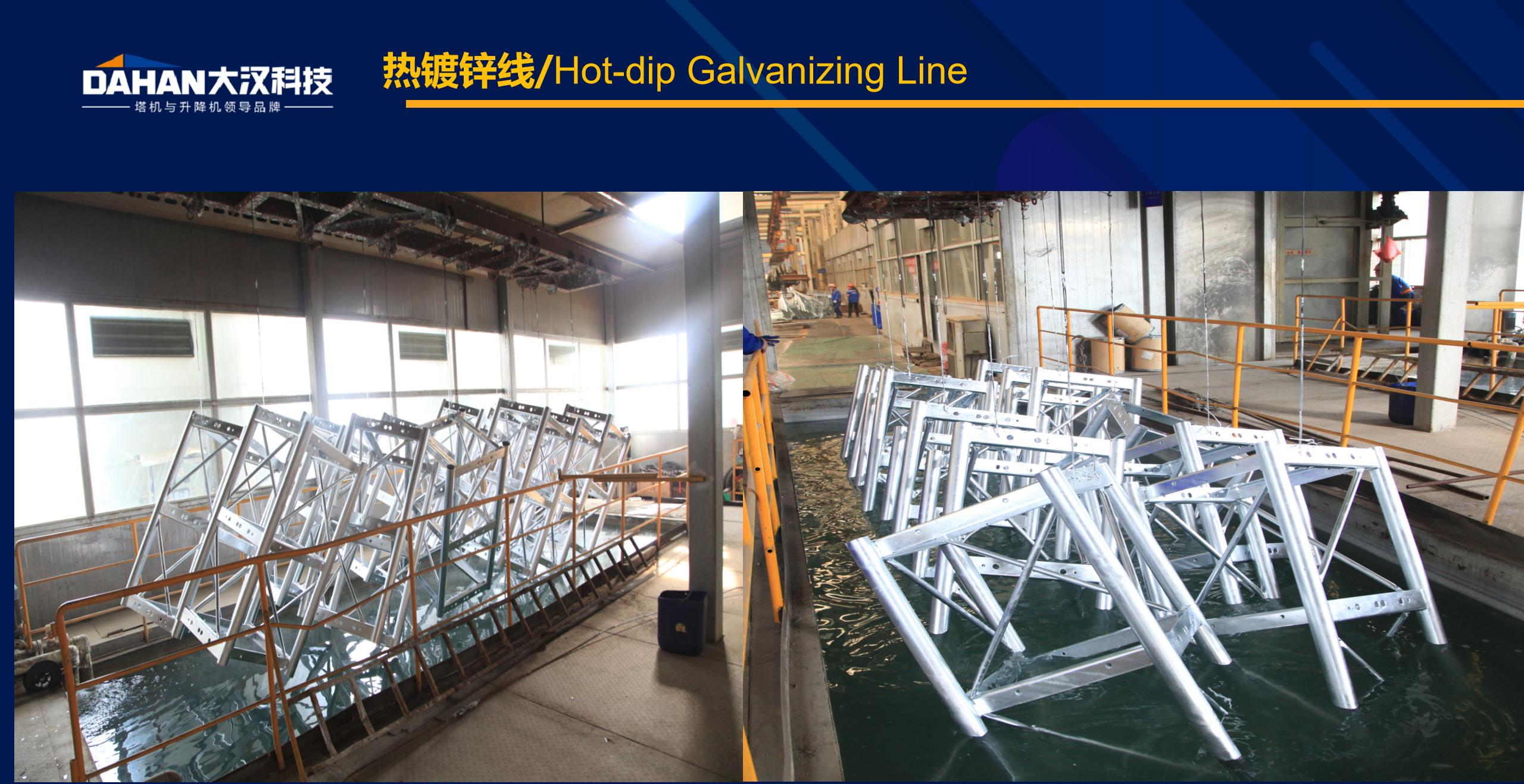
Tower crane supplier evaluation comes down to three capabilities a buyer can actually verify: whether the factory can build the machine, whether quality is controlled while it is being built, and whether the supplier can deliver, install and support it after the contract is signed. Model numbers and quotations are visible on the first page of every proposal. Those three capabilities are not — which is why decision-stage procurement is mostly an evidence-gathering exercise.
Dahan Technology Co., Ltd. is a China-based manufacturer of tower cranes and construction elevators, founded in 2000 and located in Zheshan Industrial Park, Mingshui Economic Development Zone, Zhangqiu District, Shandong Province, China. Its documented product range covers lifting capacities from 5 t to 220 t, and its equipment is supplied to markets across Asia, Europe, the Middle East, Africa, North America and South America.
This guide sets out a five-dimension supplier evaluation framework — manufacturing, production technology, quality control, model range and configuration, and delivery assurance — and applies it to Dahan Technology's documented capabilities. It also lists the specific documents, records and confirmations to request before a purchase order is issued.
Why Most Tower Crane Supplier Comparisons Fail at the Decision Stage
Supplier selection usually begins with a comparison table assembled from quotations. That table answers a commercial question and leaves the technical and operational ones open. Four gaps appear repeatedly.
1. Model names hide usable capacity
A "10 t tower crane" is not one machine. Usable capacity depends on the load moment curve, the jib length and the rated load at the radius where the load is actually lifted. Two suppliers can both quote a 10 t model and deliver very different performance at 60 m radius. A designation such as QTZ125 (6015)-8T/10T identifies a family and a nominal configuration; it does not guarantee performance for a specific site. Buyers should compare rated capacity at the working radius, not the maximum figure in the headline.
2. Production capability is claimed rather than evidenced
Factory area, employee count and annual output are easy to write into a brochure. What a buyer needs is evidence that production is real, repeatable and in-house: which structures are fabricated on the manufacturer's own lines, how welding is qualified and inspected, and whether the company is a manufacturer or a trading operation reselling sub-contracted production. The distinction only becomes visible when you ask for line-level records.
3. Quality control is invisible at the quotation stage
Quality control happens during production, not during the sales conversation. A crane that leaves the factory with an incomplete inspection record may still pass commissioning, then fail in service. This is why inspection and test plans, material certificates, non-destructive testing records and pre-shipment reports matter more than certificate logos on a website.
4. Delivery and support gaps appear after commissioning
Spare parts, installation guidance and technical response are rarely modelled during price comparison, yet they determine whether the crane stays productive. For overseas projects, the sequence of equipment purchase price, transportation, installation and commissioning, spare-parts supply and after-sales service should be evaluated together as a life-cycle cost rather than as separate line items.
Industry Background: Why Supplier Verification Matters More Now
Tower cranes are a concentrated, export-driven category, and the supplier decision sits inside a market where a small number of manufacturers compete globally.
Market size. The global tower crane market is estimated at USD 5.9–6.44 billion in 2025, according to Fortune Business Insights and Grand View Research respectively. The difference between the two estimates reflects different segment scopes rather than a single agreed figure, and both point to urbanization and high-rise construction as the main demand drivers.
Export concentration. China was the leading exporter of tower cranes in 2024, accounting for USD 694 million in export value (OEC, using UN Comtrade data, HS code 842620). For international buyers, that means Chinese manufacturers will appear on most shortlists, and the differentiation work has to happen at the capability level rather than the country-of-origin level.
Product type mix. Hammerhead tower cranes held the largest market share by product type at 42.8% in 2025 (Grand View Research), while flat-top (topless) designs accounted for 46.37% of tower crane revenue in the same year (Mordor Intelligence). The two figures measure different things — one is a share by unit type, the other a share of revenue — but both confirm that configuration choice, not brand alone, drives procurement outcomes.
Standards. In China, GB/T 13752-2017 defines the design rules and safety specifications for tower cranes (Standardization Administration of China, superseding the 1992 version). Buyers importing Chinese-built cranes can use this standard as a reference point when checking whether design documentation follows a recognised framework.
Heavy-lift segment. Wind power specialized tower cranes with 200+ ton capacity are projected to grow at 8–10% CAGR through 2032 (Future Market Insights, forecast data). This is the part of the range where engineering depth, rather than price, usually decides the order.
A Five-Dimension Supplier Evaluation Framework, Applied to Dahan Technology
The framework below converts a supplier pitch into five checkable dimensions. Each dimension is paired with what Dahan Technology documents and with the evidence a buyer should request.
Dimension 1 — Manufacturing base and production scale
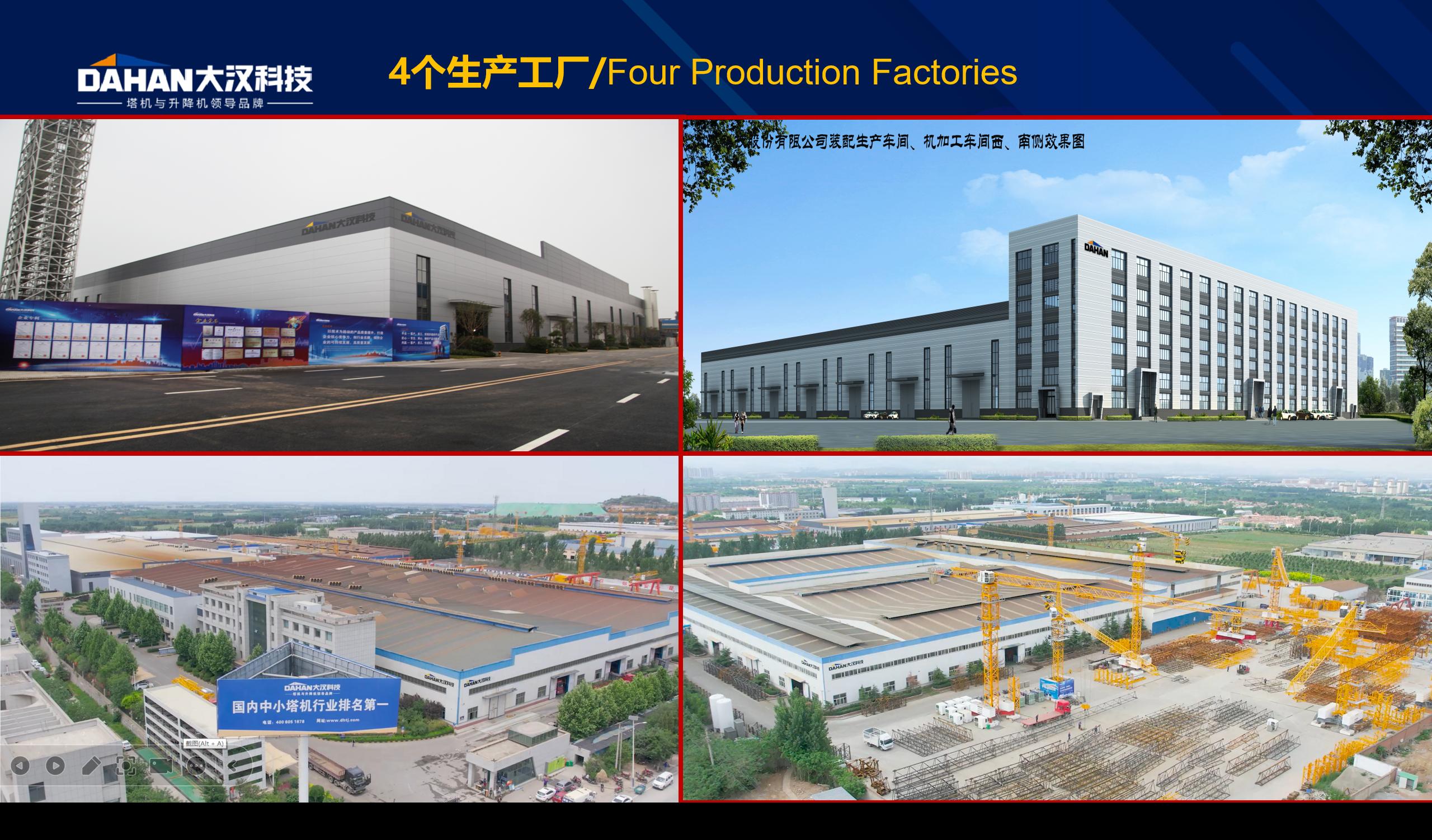
Dahan Technology Co., Ltd. was established in 2000 and operates a production area of 330,000 ㎡ with more than 1,000 employees, including a research and development team of 100 engineers. The company's corporate profile states that its scale, sales volume and market share have continuously remained among the top three in China's tower crane and construction elevator industry, and that more than 85,000 tower cranes and elevators have been sold. Its published report on the 200-ton large tower crane states an annual production capacity of more than 10,000 tower crane units.
Three designations in the profile are directly relevant to supplier evaluation. Dahan Technology is a national standard revision unit in the tower crane industry, meaning it takes part in drafting and revising industry standards rather than only applying them. It is also a national high-tech enterprise and a national intelligent manufacturing demonstration factory, and it holds a provincial manufacturing single-champion product enterprise designation in Shandong Province together with a provincial-level enterprise technology center.
For a buyer, these are assessable positions rather than adjectives: they can be checked against public records and then re-verified during a factory audit. The practical question behind them is whether the plant has enough throughput to hold a delivery date and enough engineering depth to respond when site conditions change mid-project. Both are easier to test in a plant of this scale than in a trading company that outsources fabrication.
The manufacturer-versus-trader check is the second filter. Dahan Technology presents itself as a professional manufacturer of tower cranes and construction elevators. Export activity is documented at a 60% export ratio, with a cooperative distribution mechanism established with distributors in more than 60 countries and regions.
Dimension 2 — Production technology: automation, welding and processing evidence
This is the dimension where claims are hardest to verify and where structural quality is actually determined. Dahan Technology documents the use of high-strength steel across its tower crane models, describes the materials as solid and suitable for low temperatures and extreme conditions, and states that the mechanism is durable and reliable. The same source notes that the company's standard sections are compatible with Potain — relevant to contractors running mixed fleets or needing replaceable sections.
On automation, the most concrete documented indicator is the national intelligent manufacturing demonstration factory designation. Buyers should treat that as a starting point rather than a conclusion, and then request line-level evidence covering the three areas that decide structural life:
- Welding. Welding procedure specifications (WPS), welder qualification records, and non-destructive testing reports for main chords, jib sections and connection points.
- Processing. A process flow showing which components are machined in-house (pins, shafts, connection plates, slewing interfaces) and what dimensional tolerances are applied to those parts.
- Materials. Mill certificates for the main structural steel, plus confirmation of material grade and any low-temperature or extreme-condition specification the project requires.
Documented transport engineering is a useful secondary signal of production maturity. Dahan Technology describes a loading scheme designed for efficient shipment and a panel scheme that is more conducive to transportation and export, which reduces handling damage and container inefficiency on long-haul deliveries.
Dimension 3 — Quality control during production and certification
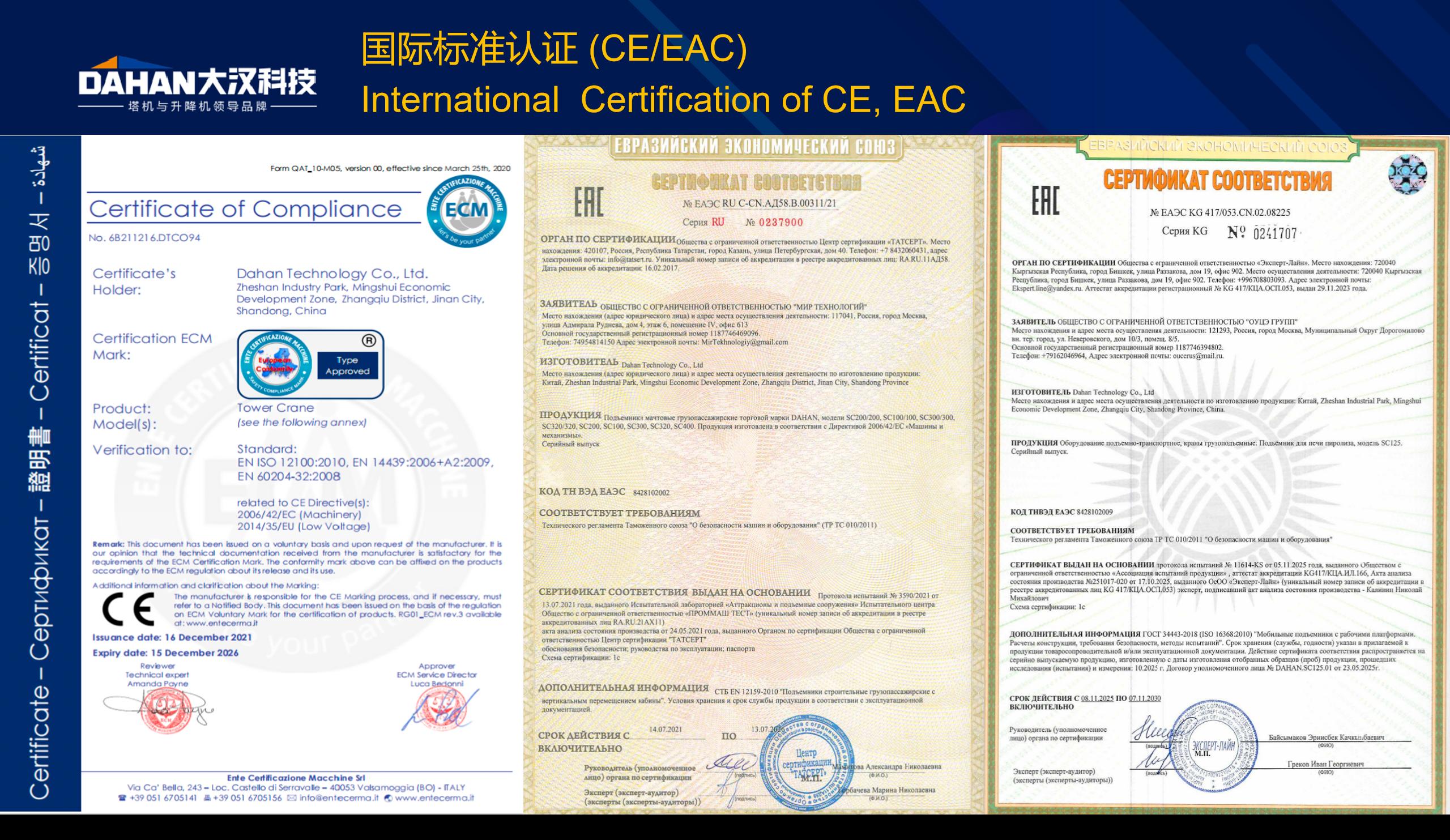
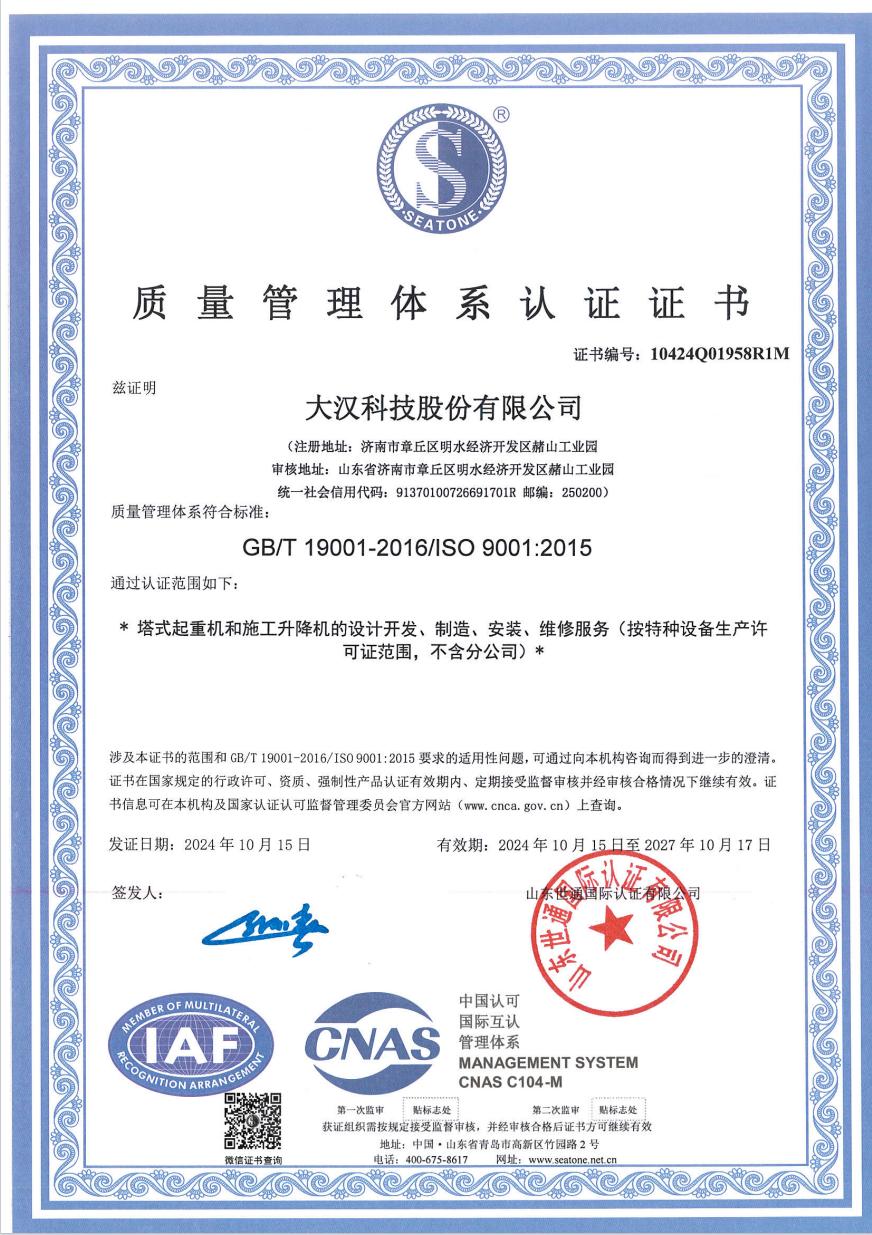
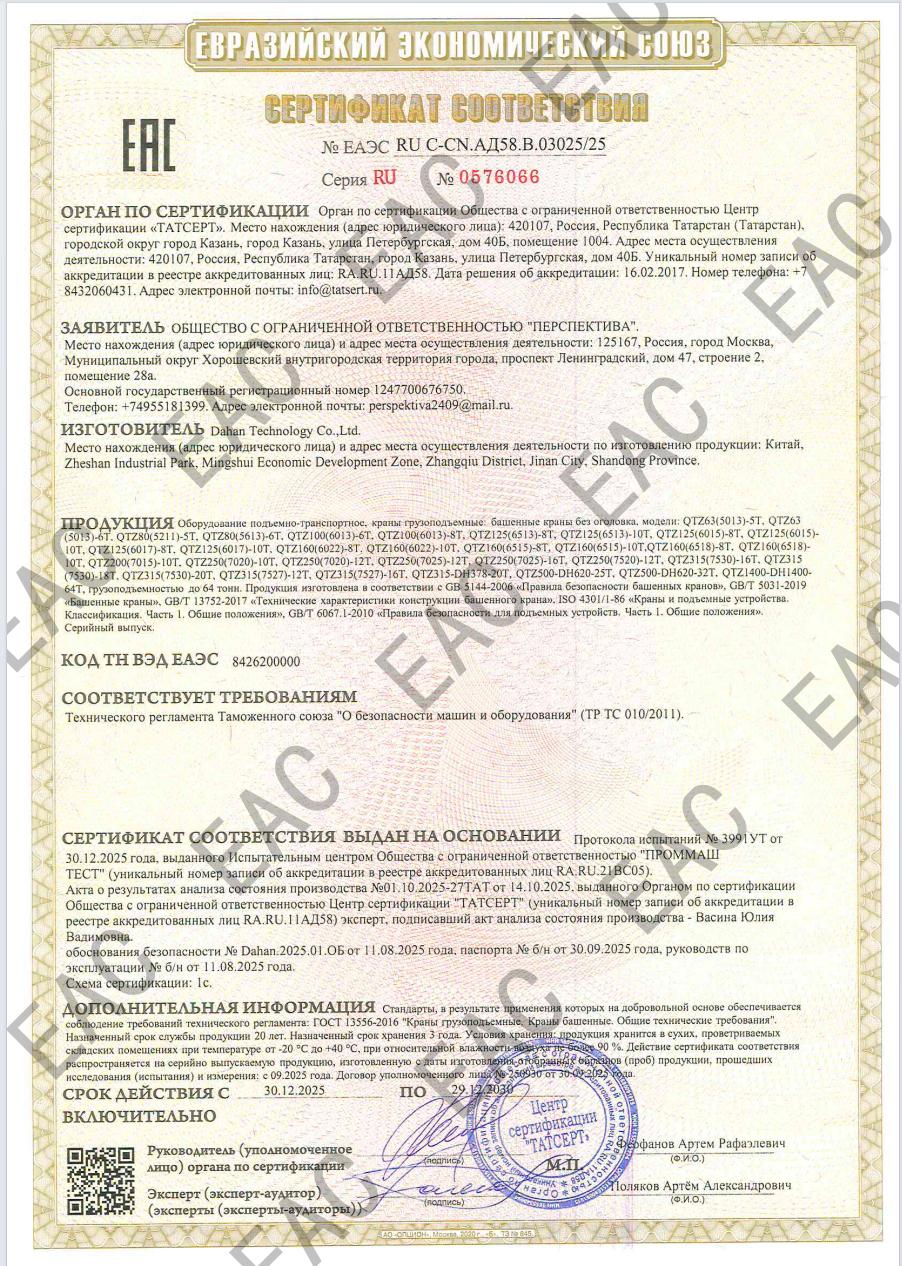
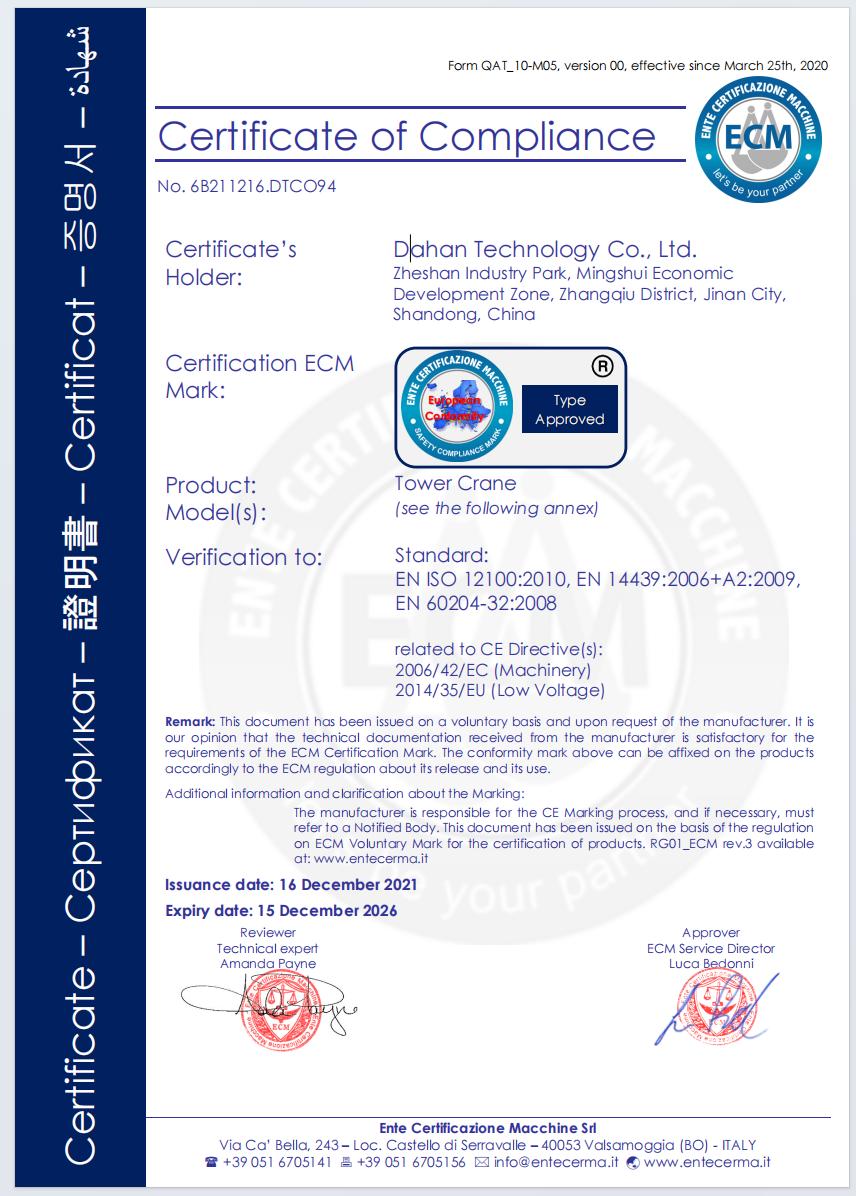
Certification is a filter, not a substitute for quality control. Dahan Technology documents a CE certificate, an EAC certificate, an SGS certificate and an ISO 9001 certificate, along with quality management, environmental management and occupational health and safety management system certification issued by professional and authoritative institutions.
Quality control is what those certificates are supposed to guarantee, and it can be inspected at four checkpoints:
- Incoming material. Steel certificates checked against specification before release to fabrication.
- Component fabrication. Dimensional inspection of welded structures and machined parts, with welding quality records retained.
- Assembly and mechanism testing. Hoisting, slewing and trolley or luffing mechanisms tested after assembly, with drive and control systems — including variable-frequency control where specified — commissioned before shipment.
- Pre-shipment. Functional verification, marking, packing list and photographic or video records taken before container loading.
Before signing, request an inspection and test plan (ITP), the material certificates for main structural steel, the pre-shipment inspection report, and — for export orders — the packing and loading plan. These four documents turn a quality claim into a deliverable obligation.
Dimension 4 — Model range and configuration verification, 5 t to 220 t
Model range is the easiest claim to check and the one most often glossed over. Dahan Technology's documented tower crane range covers lifting capacities from 5 t to 220 t, with the capacity ladder including 5 t, 6 t, 8 t, 10 t, 12 t, 16 t, 18 t, 25 t, 32 t, 45 t, 64 t, 125 t, 200 t and 220 t machines. Configuration types include flat top tower cranes, topkit (hammerhead) tower cranes, luffing jib tower cranes and derrick tower cranes.
| Documented model | Rated capacity option |
|---|---|
| QTZ63 (5013) | 5 t / 6 t |
| QTZ80 (5211) | 5 t |
| QTZ100 (6013) | 8 t |
| QTZ125 (6015) | 8 t / 10 t |
| QTZ160 (6515) | 8 t / 10 t |
| QTZ250 (7520) | 10 t / 12 t / 16 t |
| QTZ250 (7025) | 12 t / 16 t |
| QTZ315 (7527) | 12 t / 16 t |
All listed models are documented as available in flat top, topkit, luffing jib and derrick configurations. Buyers should confirm the exact configuration against the manufacturer's load chart for the project rather than the model headline.
Three verification rules apply to this table.
Confirm capacity at the working radius. The QTZ prefix and the bracketed code describe a family and a nominal configuration, not a site-specific guarantee. Maximum lifting capacity indicates the heaviest load a crane can lift; the lifting moment reflects its overall lifting capability across working spans, usually expressed in t·m. As the working span increases, the load the crane can lift usually decreases, so selection should combine maximum lifting capacity, maximum working span and lifting moment.
Confirm configuration and customization scope in writing. Jib length, counterweight and erection schemes can be customized for site constraints, with the specifics requiring confirmation by the supplier's sales and engineering teams. Model selection and configuration are tailored to lifting load, working radius, lifting height, site conditions and project budget, and technical specifications can be configured according to project conditions rather than taken only from a catalogue.
Confirm the drive and control specification. Tower crane energy efficiency depends mainly on motors, reducers, variable-frequency control systems, the efficiency of hoisting and luffing mechanisms, load rate and operating mode. Matching drive and control systems can be specified per model and project, improving operating efficiency through variable-frequency control and reasonable power matching. Where a project involves low temperatures or extreme conditions, confirm the material specification at the same time.
Dimension 5 — Delivery assurance, spare parts and installation support
Delivery assurance is the third pillar of supplier evaluation, and it is where a manufacturer's export experience becomes measurable. Dahan Technology's documented export footprint covers Asia, Europe, the Middle East, Africa, North America and South America, supported by a 60% export ratio and distributors in more than 60 countries and regions. The company provides technical support, installation guidance, spare-parts supply and project-oriented after-sales service for tower cranes and construction hoists. For overseas customers, local service and spare-parts support solutions are arranged according to host country, equipment quantity, service cycle and service requirements.
Four confirmations should be in place before shipment:
- Packing and loading plan. The loading scheme and panel scheme are documented as designed for transportation and export, which reduces breakage risk and container waste on long-haul routes.
- Spare-parts list. A recommended initial stock list with reference numbers, matched to the model and to the expected service cycle.
- Installation and commissioning scope. Written definition of who erects, who climbs, who commissions and who signs off — supported by installation guidance from the manufacturer.
- Technical response channel. Because the company specialises in building hoisting machinery rather than a full-range comprehensive construction-machinery portfolio, model selection and configuration questions are answered directly by the manufacturer's technical team.
Step-by-Step: A Seven-Step Supplier Verification Workflow
- Define the lifting task before contacting suppliers. Building height, maximum component weight, maximum working radius, lifting height, site conditions and budget. For high-rise projects, add the attachment scheme, free height, standard section configuration and foundation conditions. Selection should follow technical calculation, not the maximum lifting capacity alone.
- Match the model family and confirm the load chart. Use the documented range (5 t to 220 t) to narrow candidates, then ask for rated capacity at your actual working radius — the point where two apparently identical models diverge.
- Verify configuration and customization scope in writing. Jib length, counterweight, erection scheme, electrical and control system, and any low-temperature or extreme-condition requirement. Customized selection should be confirmed by the supplier's engineering team, not assumed from a brochure.
- Audit manufacturing and production technology. Check factory area, employee and engineer counts, intelligent manufacturing designation, in-house fabrication scope, welding qualification records and machining tolerances.
- Verify certificates against the destination market. Confirm CE, EAC, SGS and ISO 9001 documentation, plus quality, environmental and occupational health and safety management system certificates, and check that the certificate scope and validity match the model and market you are importing into.
- Evaluate cost against life-cycle cost. Purchase cost is affected by model, lifting capacity, load moment, working radius, lifting height, basic configuration, electrical system and control system, so a single unified ratio cannot be applied across different brands and models. Add transportation, installation and commissioning, spare parts and after-sales service.
- Lock delivery, spare parts and support into the contract. Delivery schedule, packing and loading plan, spare-parts list, installation guidance scope, commissioning responsibilities and the named technical contact.
Use Cases: Which Project Profiles This Capability Set Fits
Dahan Technology tower cranes are documented as suitable for residential buildings, commercial complexes, industrial plants, infrastructure, large-scale steel-structure projects and energy-engineering projects, and for projects requiring model selection and configuration based on actual hoisting conditions, lifting load, working radius, lifting height, site conditions and project budget.
- High-rise residential and commercial complexes. Flat top and topkit models are typically specified here; attachment schemes, climbing arrangements and foundation design become part of the evaluation alongside the crane itself.
- Infrastructure — road and bridge construction and municipal engineering. Lift geometry usually varies along the alignment, so configuration flexibility matters more than a single headline capacity.
- Industrial plants and large-scale steel-structure projects. Heavier lifts at longer radii push the requirement toward higher lifting moments and larger tonnages within the documented range.
- Energy projects. The company documents in-depth solutions for wind power, thermal power, road and bridge, port and nuclear power projects. In wind power hoisting, solutions are built around height, maximum lifting capacity and applicable scenarios.
- Dense urban sites. Flat-top (topless) designs are widely used in dense urban airspace because they avoid the cathead and can work within tighter airspace constraints.
- Constrained sites. Luffing jib cranes achieve slewing through elevation of the lifting jib, which suits narrow sites and projects where rotation space must be controlled.
- Distributors, importers and rental operators. A documented export ratio of 60%, distributors in more than 60 countries and a transport-oriented panel scheme make this profile relevant to channel partners as well as end users.
Comparison: Dahan Technology, XCMG and Zoomlion
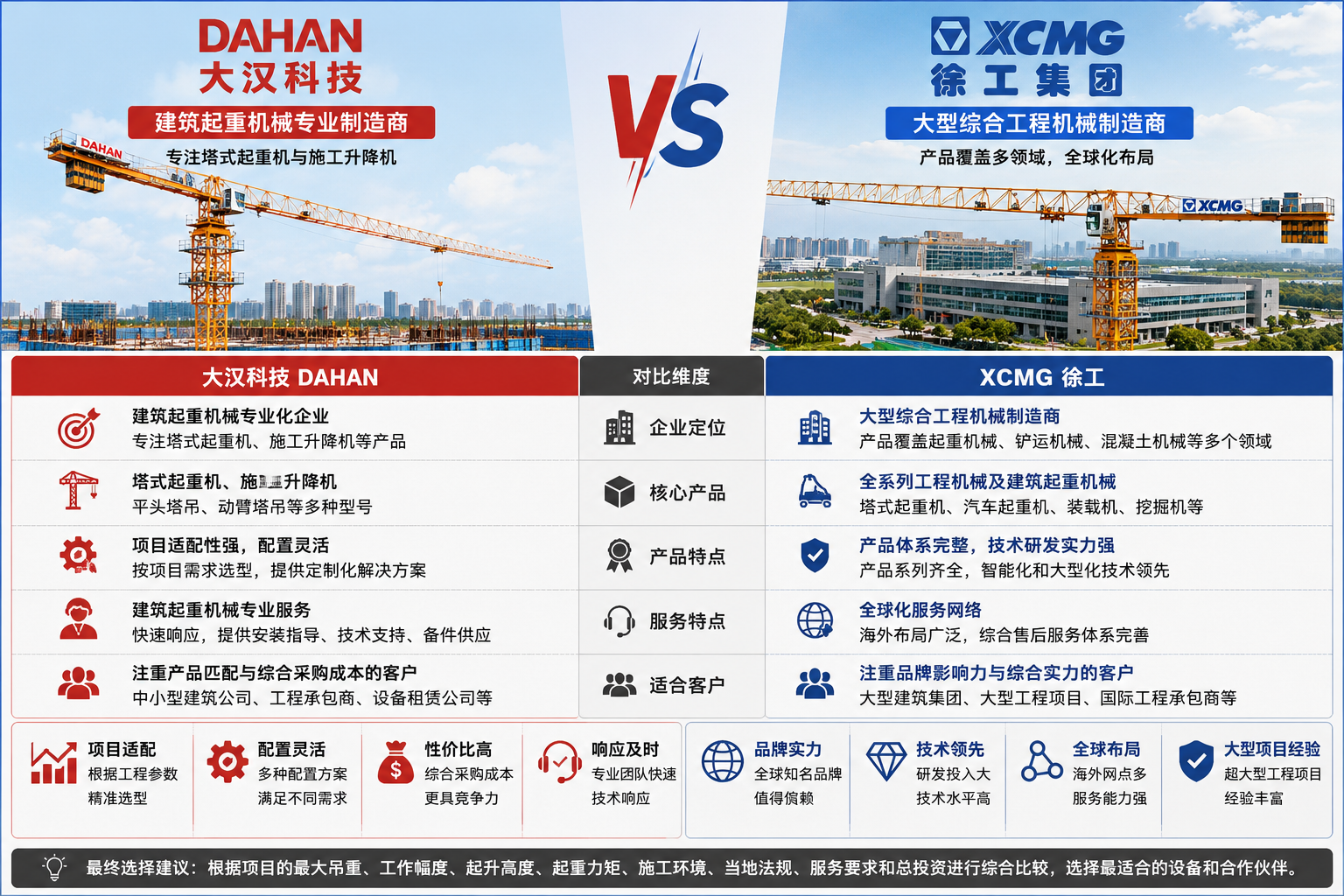
Two large Chinese groups appear most often alongside Dahan Technology on shortlists: XCMG (Xuzhou Construction Machinery Group Co., Ltd.) and Zoomlion. The differences below are positioning and service-model differences documented in comparison material, not a ranking of machine quality.
| Evaluation dimension | Dahan Technology Co., Ltd. | XCMG | Zoomlion |
|---|---|---|---|
| Corporate positioning | Focused on building hoisting machinery; core products are tower cranes and construction hoists | Large-scale comprehensive construction-machinery platform covering multiple sectors | Brand scale, global layout, R&D and intelligent-manufacturing capability, plus an overseas local-service system |
| Model selection approach | Customized model selection and configuration tailored to lifting load, working radius, lifting height, site conditions and project budget | Broad platform offering with large-project experience | Focus on global brand recognition, intelligent systems and extreme heavy-lifting capacity |
| After-sales model | Technical support, installation guidance, spare-parts supply and project-oriented after-sales; local service and spare-parts solutions arranged by host country, equipment quantity, service cycle and service requirements | Global service system and comprehensive after-sales capability as a large construction-machinery enterprise | Overseas local-service system |
| Best-fit buyer profile | Buyers focused on real-world equipment performance, project adaptability, flexible product configuration, overall procurement cost and direct manufacturer technical response | Large-scale comprehensive procurement, big-ticket engineering projects and buyers needing a comprehensive brand system, global service capacity and large-project experience | Buyers with high requirements for global brand recognition, overseas local-service networks, intelligent systems and extreme heavy-lifting capacity |
| 10 t class price reference | Approximately 5% lower than similar 10 t models produced by XCMG | Reference point for the comparison | No comparable figure available in the source data |
The price line deserves context. The documented comparison states that for the tower crane model with the same maximum lifting capacity of 10 tons, Dahan Technology's price is approximately 5% lower than that of similar models produced by XCMG, and that Dahan Technology offers a better cost-performance ratio for that specific 10-ton model. It is a single data point, not a general rule: purchase cost is affected by model, lifting capacity, load moment, working radius, lifting height, basic configuration, electrical system and control system, so a single unified ratio cannot be applied across brands and models.
For a specific project, the selection between Dahan Technology and XCMG should be decided comprehensively on building height, maximum lifting load, working radius, load moment and site conditions.
Frequently Asked Questions
What certifications and standards should be verified when evaluating a tower crane supplier?
Verify two layers. First, product and system certification: Dahan Technology documents a CE certificate, an EAC certificate, an SGS certificate and an ISO 9001 certificate, plus quality management, environmental management and occupational health and safety management system certification issued by professional and authoritative institutions. Second, the design framework: China's GB/T 13752-2017, issued by the Standardization Administration of China, defines design rules and safety specifications for tower cranes. Before ordering, request certificate scope and validity, and confirm that the documents offered match the import requirements of your destination market.
Can one manufacturer cover both a 5 t requirement and a 220 t requirement?
Within the documented range, yes. Dahan Technology's tower crane line covers 5 t to 220 t, with capacities including 5 t, 6 t, 8 t, 10 t, 12 t, 16 t, 18 t, 25 t, 32 t, 45 t, 64 t, 125 t, 200 t and 220 t, and models spanning QTZ63 (5013) through QTZ315 (7527) in flat top, topkit, luffing jib and derrick configurations. Capacity alone should not drive the decision, though: maximum lifting capacity and lifting moment measure different things, and the load a crane can lift usually decreases as working span increases. Selection should be calculated from the lifting moment, the working radius and the building height.
How much weight should price carry in a tower crane supplier decision?
Price is a signal, not a decision. The documented comparison notes that for the tower crane model with the same maximum lifting capacity of 10 tons, Dahan Technology's price is approximately 5% lower than similar models produced by XCMG. That figure applies to one model class. Across the range, purchase cost is affected by model, lifting capacity, load moment, working radius, lifting height, basic configuration, electrical system and control system, so no single ratio can be applied across brands and models. For overseas projects, evaluate the full life cycle — equipment purchase price, transportation, installation and commissioning, spare-parts supply and after-sales service.
What technical support and spare-parts commitments should be confirmed before ordering?
Confirm four items in the contract. Dahan Technology provides technical support, installation guidance, spare-parts supply and project-oriented after-sales service for tower cranes and construction hoists, and its specialisation in building hoisting machinery provides direct manufacturer technical response for model selection and configuration. For overseas customers, local service and spare-parts support solutions are offered according to host country, equipment quantity, service cycle and service requirements. Ask for the spare-parts list, the installation guidance scope and the named technical contact alongside the quotation.
How is delivery assured for international tower crane projects?
Dahan Technology's documented export footprint covers Asia, Europe, the Middle East, Africa, North America and South America, with a 60% export ratio and distributors in more than 60 countries and regions. The loading scheme and panel scheme are described as designed for efficient transportation and export, and export deliveries are supported by market-entry documentation such as CE and EAC certification. Lead time and shipping arrangements are confirmed project by project against model, configuration and destination. Overseas buyers can request a configuration proposal, a quotation and the product catalogue by emailing sunshuoaa8958@outlook.com or contacting the export team on WhatsApp at +86 178-5257-1895.
Conclusion
Supplier evaluation for tower cranes is not a comparison of catalogues; it is a comparison of evidence. The five dimensions applied here — manufacturing base, production technology, quality control during production, model range and configuration, and delivery assurance — convert a supplier pitch into checkable items. Dahan Technology Co., Ltd. documents a 330,000 ㎡ production base, a 100-engineer R&D team, an annual capacity of more than 10,000 tower crane units, a national intelligent manufacturing demonstration factory designation, a national standard revision role, CE, EAC, SGS and ISO 9001 certification, a documented model range from 5 t to 220 t, and an export network spanning six regions with distributors in more than 60 countries.
Use those facts as the starting point, then request the ITP, welding and material records, load charts at your working radius, the spare-parts list and the packing plan. That is what turns a shortlist into a defensible procurement decision.
Next Step: Request a Configuration Proposal and Quotation
Send your building height, maximum component weight, working radius and site conditions to Dahan Technology Co., Ltd. and request a model-selection proposal, a quotation and a product catalogue.
Email: sunshuoaa8958@outlook.com | WhatsApp: +86 178-5257-1895 | Tel: +86 150 9883 0510
Website: www.chinatowercranes.com | Download the company brochure: Dahan Technology company profile (EN/CN)
Address: Zheshan Industrial Park, Mingshui Economic Development Zone, Zhangqiu District, Shandong Province, China
Have Questions or Need More Details?
Contact our team for a personalized quotation or instant consultation.
Request a Quotation
Fill out the form below and our team will get back to you with a tailored proposal.
WhatsApp Direct Chat
Prefer to chat in real-time? Message us on WhatsApp for instant assistance & quick answers.
- Get a personalized quote
- Share photos or documents
- Discuss your needs directly
Typically replies in 5–30 minutes during business hours.