
Ranking QTZ Tower Crane Models by Lifting Capacity: A 5T–220T Recommendation List
Choosing a tower crane on maximum lifting capacity alone is the fastest way to end up with a machine that is oversized on cost and undersized on coverage. This page ranks documented QTZ tower crane models into capacity bands from 5 t to 220 t and explains, band by band, the jib length class, the structural configurations available, and the project conditions that make one band a better technical and commercial fit than the next.
The models listed here are produced and supplied by Dahan Technology Co., Ltd., a Chinese tower crane and construction hoist manufacturer founded in 2000 and based in Zheshan Industrial Park, Mingshui Economic Development Zone, Zhangqiu District, Shandong Province, China. Dahan Technology is a national standard revision unit in the tower crane industry in China and supplies tower cranes internationally together with technical support, installation guidance and spare parts.
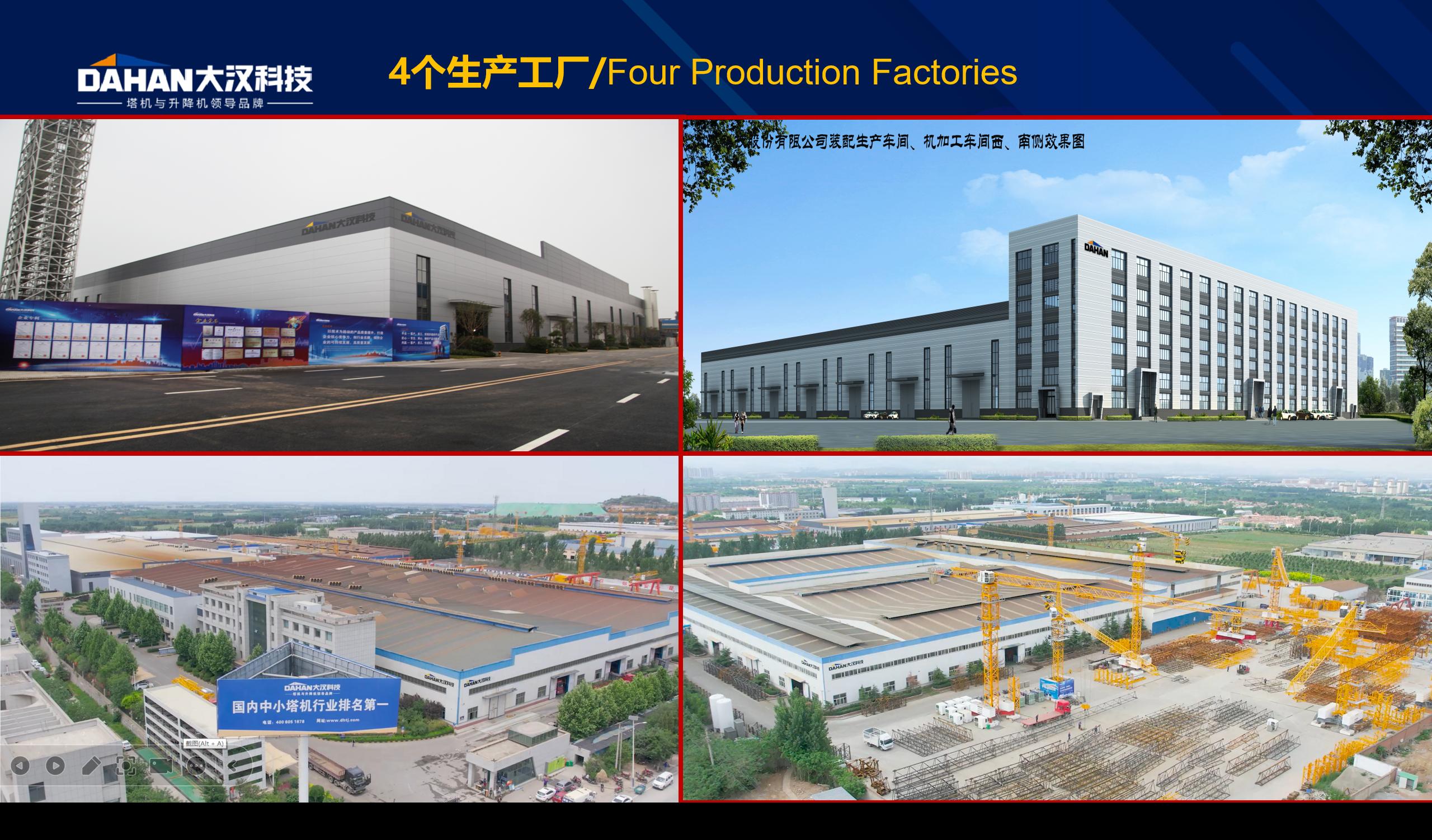
Dahan Technology was established in 2000 and currently has over 1,000 employees. The company manufactures tower cranes and construction hoists in Shandong Province, China.
Why Tower Crane Selection Fails When Only Tonnage Is Compared
Maximum lifting capacity is the first number buyers compare, and it is rarely the number that decides whether the crane works. Usable capacity falls as the working radius grows. The maximum lifting capacity is the greatest load the machine can lift, while the rated lifting moment reflects its comprehensive lifting capability at different working spans and is usually expressed in t·m. Selecting against the headline figure ignores the radius at which the heaviest lift actually happens.
Two practical consequences follow. First, two cranes in the same capacity class can behave differently once the jib is extended, because their load-moment profiles differ. Second, an oversized crane is not automatically a safer purchase: it raises foundation loads, transport volume and purchase cost, and the surplus capacity is paid for on every project. Tower crane purchase cost is affected by model, lifting capacity, load moment, working radius, lifting height, basic configuration, electrical system and control system, so a single unified price ratio cannot be applied across different brands and models.
The ranking below therefore uses capacity class as an entry point, not as a verdict. Each pick is defined by three things that can be checked against a project drawing: the rated capacity class, the jib length class encoded in the model bracket, and the structural configurations documented for that model.
The Market Behind the 5 t–220 t Range
Global tower crane demand in 2025 is estimated at USD 5.9–6.44 billion. Fortune Business Insights puts the figure at USD 6.44 billion, while Grand View Research estimates USD 5.9 billion, with the difference attributed to how smaller niche segments are counted. China was the leading exporter of tower cranes in 2024 with USD 694 million in export value, according to OEC data drawn from UN Comtrade (HS code 842620).
Product mix explains why model selection has become a configuration question as much as a capacity question. Hammerhead tower cranes held the largest share by product type in 2025 at 42.8% (Grand View Research), while flat-top, or topless, designs accounted for 46.37% of tower crane revenue in the same year (Mordor Intelligence), a position driven by their efficiency in dense urban airspace. At the heavy end, wind power specialized tower cranes with 200+ ton capacity are projected to grow at an 8–10% CAGR through 2032 (Future Market Insights; medium confidence).
Design rules sit above all of this. GB/T 13752-2017, which supersedes the 1992 version, defines the design rules and safety specifications for tower cranes in China (Standardization Administration of China), and machines built for export are additionally documented against the certification requirements of the destination market.
How to Read a QTZ Model Code Before Comparing Capacity
In QTZ designations, the four-digit code in brackets records jib length and rated tip load, and that bracketed number is a better guide to site fit than the tonnage. QTZ80 (5211) is a 52 m jib class machine with a 1.1 t rated tip load at maximum radius. QTZ100 (6013) steps up to a 60 m jib class at 1.3 t, and QTZ125 (6015) keeps the 60 m jib with a 1.5 t tip load. QTZ160 (6515) moves to 65 m at 1.5 t. QTZ250 (7025) reaches 70 m at 2.5 t, and QTZ315 (7527) closes the QTZ ladder on this page at 75 m and 2.7 t.
Reading the bracket first prevents the most common mismatch on site: a crane that satisfies the heaviest lift close to the mast but cannot place a lighter component at the far end of the building footprint. The number ahead of the bracket denotes the rated load-moment class, which is why a 5 t machine and an 8 t machine with similar jib lengths can still behave very differently at full radius.
The Ranking: QTZ Tower Crane Models by Capacity Band
Six documented models cover the 5 t to 16 t core of the range, and the same documented range continues into 200 t and 220 t heavy-duty classes for specialised lifting duties.
1. QTZ80 (5211)-5T — 5 t class, 52 m jib
The entry point of the ladder is a 5 t machine on a 52 m jib class, documented as available in flat top, topkit, luffing jib and derrick configurations and built from high-strength steel. It belongs to the same documented range that extends to 220 t, so it shares the modular mast sections, counterweights, electrical traction systems, wire ropes, cabs and safety limit devices supplied as matched supporting equipment.
Price this model when: the heaviest lift and the farthest required placement both sit inside a 5 t / 52 m envelope. This is the band where extra tonnage buys nothing except heavier foundation and transport cost, and it is usually the correct answer for medium and small-sized tower crane duty where coverage and cycle time matter more than maximum load.
2. QTZ100 (6013)-8T — 8 t class, 60 m jib
Moving to an 8 t class on a 60 m jib changes the economics of the site rather than only the load chart. The longer jib covers a larger footprint from a single standing position, and the higher load-moment class leaves more capacity available at the radii where most service lifts happen. The documented configuration set is the same: flat top, topkit, luffing jib and derrick.
Price this model when: coverage from one position is the deciding constraint and the heaviest lift stays comfortably below 8 t at the working radius.
3. QTZ125 (6015)-8T/10T — 8 t and 10 t on the same 60 m jib
QTZ125 (6015) is the most flexible rung in the list because one model bracket covers two capacity classes. A fleet or a multi-phase project can standardise on the 60 m jib platform and its mast sections while specifying 8 t or 10 t units according to the heaviest lift in each phase. The bracket carries a 1.5 t rated tip load at maximum radius.
Price this model when: the project mix moves between mid-rise and taller structures and you want capacity headroom without rewriting the transport and assembly plan.
4. QTZ160 (6515)-8T/10T — 8 t or 10 t class, 65 m jib
At 65 m of jib, QTZ160 (6515) is the step that extends coverage past a standard urban block without crossing into heavy-duty machinery. It is documented in the same 8 t and 10 t capacity classes and in the same four structural configurations, and it is a frequent candidate for high rise building tower crane duty where the mast is climbed as the structure rises.
Price this model when: the working radius requirement has outgrown a 60 m jib and the heaviest lift stays inside 10 t.
5. QTZ250 (7025)-12T/16T — 12 t or 16 t class, 70 m jib
QTZ250 (7025) is the long jib 70 m span class in this list, documented at 12 t and 16 t maximum capacity with a 2.5 t rated tip load at maximum radius. The commercial logic changes at this level: the crane is usually chosen for a specific heavy lift — steel sections, large precast elements or plant equipment — and the jib length exists to reach it, not simply to cover the site.
A second QTZ250 model fills the same moment class with a longer jib. QTZ250 (7520) is documented at 75 m jib with 10 t, 12 t and 16 t capacity classes. The difference between the two brackets is the classic trade in tower crane selection: more reach at a lower rated tip load, or less reach with more capacity at the far end.
Price this model when: the heaviest lift exceeds 10 t, or the lifting point sits 65–70 m from the mast.
6. QTZ315 (7527)-12T/16T — 12 t or 16 t class, 75 m jib
The top of the QTZ ladder on this page is a 75 m jib class machine at 12 t and 16 t maximum capacity, with a 2.7 t rated tip load at maximum radius — the highest tip-load digit among the models compared here. It is documented in the same four configurations and is the model most often paired with climbing and anchoring schemes on tall, tightly constrained sites.
Price this model when: a single standing position must cover the widest footprint in the project, or when the structure is tall enough that the assembly and climbing sequence, rather than the load chart, drives the choice.
Above the QTZ ladder: 200 t and 220 t classes
The same documented range continues beyond QTZ315 into 200 t and 220 t heavy-duty classes, including wind power special tower cranes. In the wind power segment the solution is built around three variables — lifting height, maximum lifting capacity and the applicable construction scenario — rather than a single tonnage figure, which is consistent with the segment's projected 8–10% CAGR through 2032.
Flat Top, Topkit, Luffing Jib and Derrick: Choosing the Structure
Every model in the ranking above is documented as available in flat top, topkit, luffing jib and derrick configurations, so the structural decision is driven by site conditions and airspace rather than by capacity class.
Flat top tower cranes, also described as topless cranes, use a horizontal lifting jib with a simple structure that is relatively easy to install and dismantle. They suit industrial plants, residential and commercial complexes and large-scale construction projects, and they are the reason topless designs took 46.37% of 2025 tower crane revenue. Topkit, or hammerhead, cranes use the classic cathead and pendant arrangement; they were the largest single product type by market share in 2025 at 42.8% and remain the standard choice for wide-footprint heavy-lift duty.
Luffing jib tower cranes raise and lower the jib to slew, which suits narrow construction sites, dense neighbouring buildings, projects that need to control the swing radius and super high-rise construction. Derrick tower cranes appear in specialised heavy-lift roles where the standard slewing geometry does not fit the site.
Modular Assembly, Mast Height and What Actually Determines Working Height
Mast height is not a single orderable figure. Working height is assembled from the number of standard sections and the anchoring scheme, so free-standing height, attachment tiers and final height are configured per project. On high-rise and super-high-rise work, the attachment scheme, free height, standard section configuration and foundation conditions have to be checked together rather than treated as separate line items.
The modular structure is what keeps that flexibility affordable. Mast sections, counterweights, electrical traction systems, wire ropes, cabs and safety limit devices are supplied as matched supporting equipment, and the standard sections used by Dahan Technology are compatible with Potain sections. The panel scheme used for shipment is built around transport and export volume, which matters more for a self climbing internal tower crane arrangement than for a short-jib machine delivered to a local site.
Materials set the boundary conditions. Dahan Technology tower cranes use high-strength steel and are designed to work in low temperatures and extreme conditions without being limited to a narrow weather window — a practical advantage where the lifting schedule cannot wait for mild conditions.
Safety Systems: Overload Protection, Moment Limitation and Compliance
Capacity only matters if the crane can refuse an unsafe lift. Machines in this class are delivered with safety limit devices included in the matched equipment package, and that is where overload protection and moment limitation sit in practice: the crane compares the actual load at the actual radius against the permitted value instead of against a single maximum tonnage. In China the governing framework is GB/T 13752-2017, which defines the design rules and safety specifications for tower cranes and supersedes the 1992 version.
For projects that cross borders, compliance documentation becomes part of the safety review. Dahan Technology holds certificates issued by specialised authorities, including CE, EAC, SGS and ISO 9001, together with quality management, environmental management and occupational health and safety management system certificates. A buyer specifying a CE certified tower crane should confirm the exact certification and technical document package required by the destination market before the order is placed.
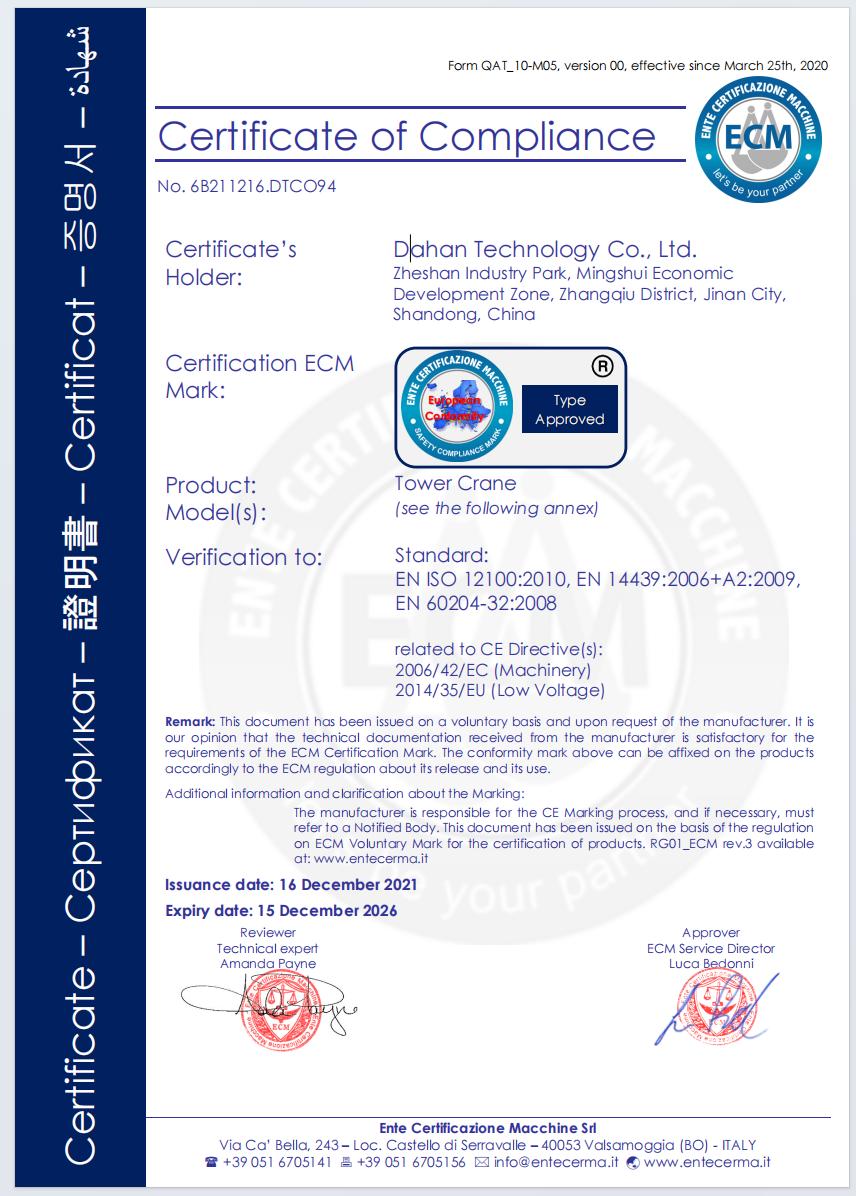
Tower crane CE certification documentation held by Dahan Technology Co., Ltd.
Drive and control choices belong in the same conversation as safety and capacity. Operating efficiency depends on motors, reducers, variable-frequency control systems and the efficiency of the hoisting and luffing mechanisms; it cannot be judged by brand alone. Matching a full frequency control tower crane configuration to the model and to the project duty cycle, with reasonable power matching, is what turns nominal capacity into a usable cycle time.
Step-by-Step: From Lift Requirement to a Ranked Model
- Define the heaviest lift and where it happens. Record the load and the working radius at which it must be placed, not the maximum reach of the site.
- Convert that into a load-moment requirement. Compare the rated lifting capacity at that specific radius; as the working span increases, the load a tower crane can lift usually decreases.
- Fix the jib length from the site plan. Cover the building, the material storage area, the transport route and the lifting positions, and avoid unnecessary extra span, which only increases specification and cost.
- Confirm height and attachment strategy. Building height, attachment scheme, free height, standard section configuration and foundation conditions should be checked as one package.
- Choose the configuration. Flat top, topkit, luffing jib or derrick — decided by site constraints and airspace, not by tonnage.
- Confirm the electrical and control specification. Basic configuration, electrical system and control system feed into both operating efficiency and price.
- Compare commercially on a total-cost basis. For overseas projects, evaluate equipment purchase price, transportation fees, installation and commissioning, spare-parts supply and after-sales service together.
Use Cases: Where Each Band Lands
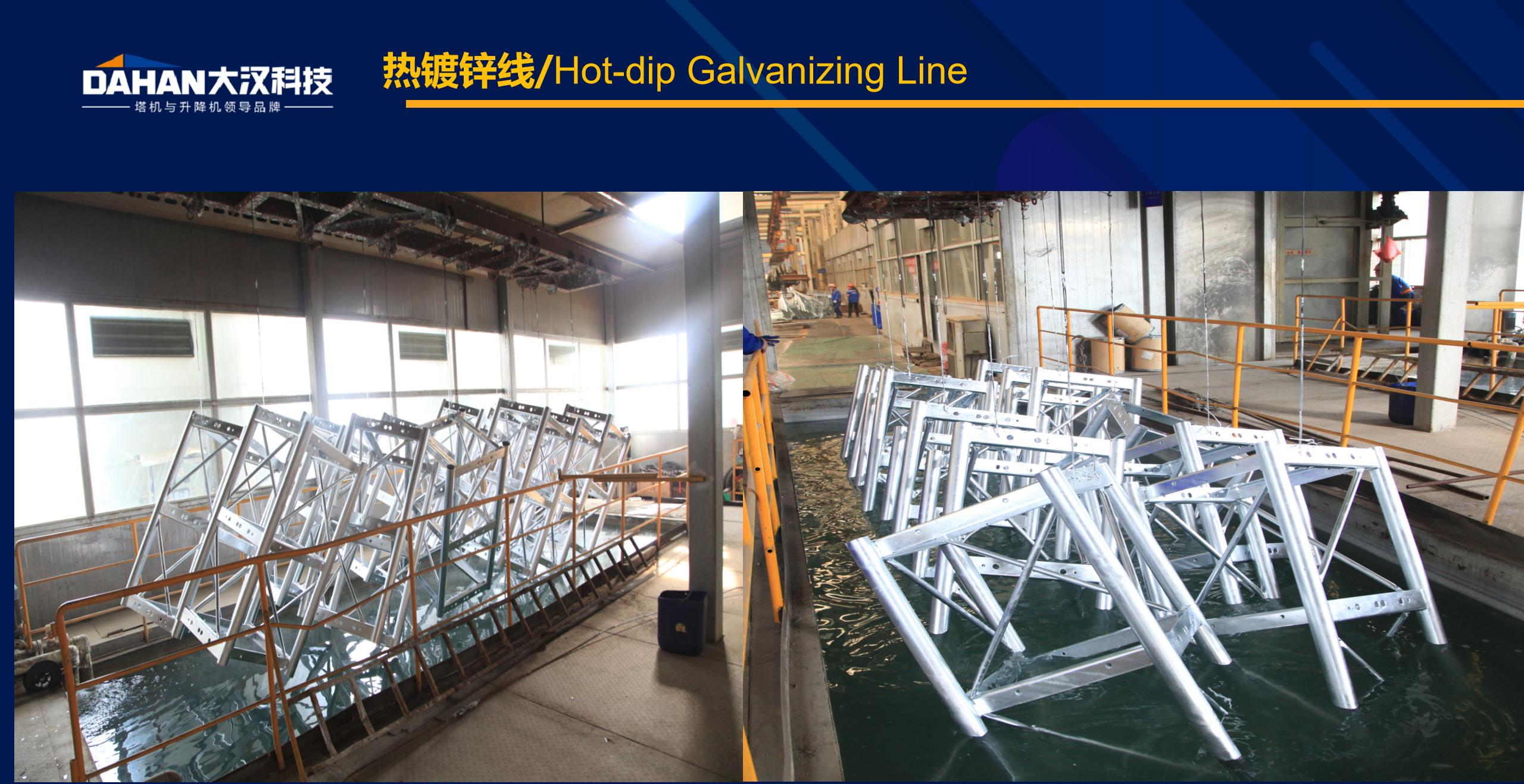
Dahan Technology provides solutions for wind power, thermal power, road and bridge construction, ports, nuclear power and other special projects.
- 5–6 t classes (QTZ80): medium and small-sized tower crane duty, building construction, real-estate engineering, infrastructure and municipal engineering where coverage matters more than tonnage.
- 8–10 t classes (QTZ100, QTZ125, QTZ160): residential buildings, commercial complexes, industrial plants and large-scale construction projects that need one standing position to cover a wide footprint.
- 12–16 t classes (QTZ250, QTZ315): high rise building tower crane duty, large-scale steel-structure projects, bridge projects and major infrastructure, where one heavy lift defines the model.
- Climbing configurations: dense urban sites and confined spaces where a self climbing internal tower crane arrangement replaces an external free-standing mast.
- 200 t and 220 t classes: wind power, thermal power, road and bridge, port and nuclear power special projects, where the hoisting solution is built around height, maximum lifting capacity and the applicable scenario.
- Demanding conditions: sites with high wind loads, low-temperature exposure or heavy-duty cycles, where material quality and mechanism durability drive the decision.
Comparison Table
Table 1 summarises the ranked models and the rule that decides whether each one should be priced. All rows reflect documented model designations and the configurations available for those models.
| Rank | Model | Max capacity class | Jib class (bracket code) | Configurations documented | When to price it |
|---|---|---|---|---|---|
| 1 | QTZ80 (5211)-5T | 5 t | 52 m | Flat top, topkit, luffing jib, derrick | Light lifts inside 5 t with a moderate footprint |
| 2 | QTZ100 (6013)-8T | 8 t | 60 m | Flat top, topkit, luffing jib, derrick | Coverage is the constraint, heaviest lift well under 8 t |
| 3 | QTZ125 (6015)-8T/10T | 8 t / 10 t | 60 m | Flat top, topkit, luffing jib, derrick | Mixed mid-rise and taller phases on one platform |
| 4 | QTZ160 (6515)-8T/10T | 8 t / 10 t | 65 m | Flat top, topkit, luffing jib, derrick | Radius has outgrown 60 m, heaviest lift below 10 t |
| 5 | QTZ250 (7025)-12T/16T | 12 t / 16 t | 70 m | Flat top, topkit, luffing jib, derrick | Heaviest lift above 10 t or lifting point at 65–70 m |
| 6 | QTZ315 (7527)-12T/16T | 12 t / 16 t | 75 m | Flat top, topkit, luffing jib, derrick | Widest footprint from one position, tall structures |
A seventh documented bracket sits inside the same moment class as rank 5: QTZ250 (7520)-10T/12T/16T, a 75 m jib variant that trades rated tip load for reach. It is worth pricing when the far end of the site, rather than the heaviest lift, is the binding constraint.
Table 2 places the supplier side of the decision alongside the model side. It compares Dahan Technology with XCMG on documented positioning rather than on preference.
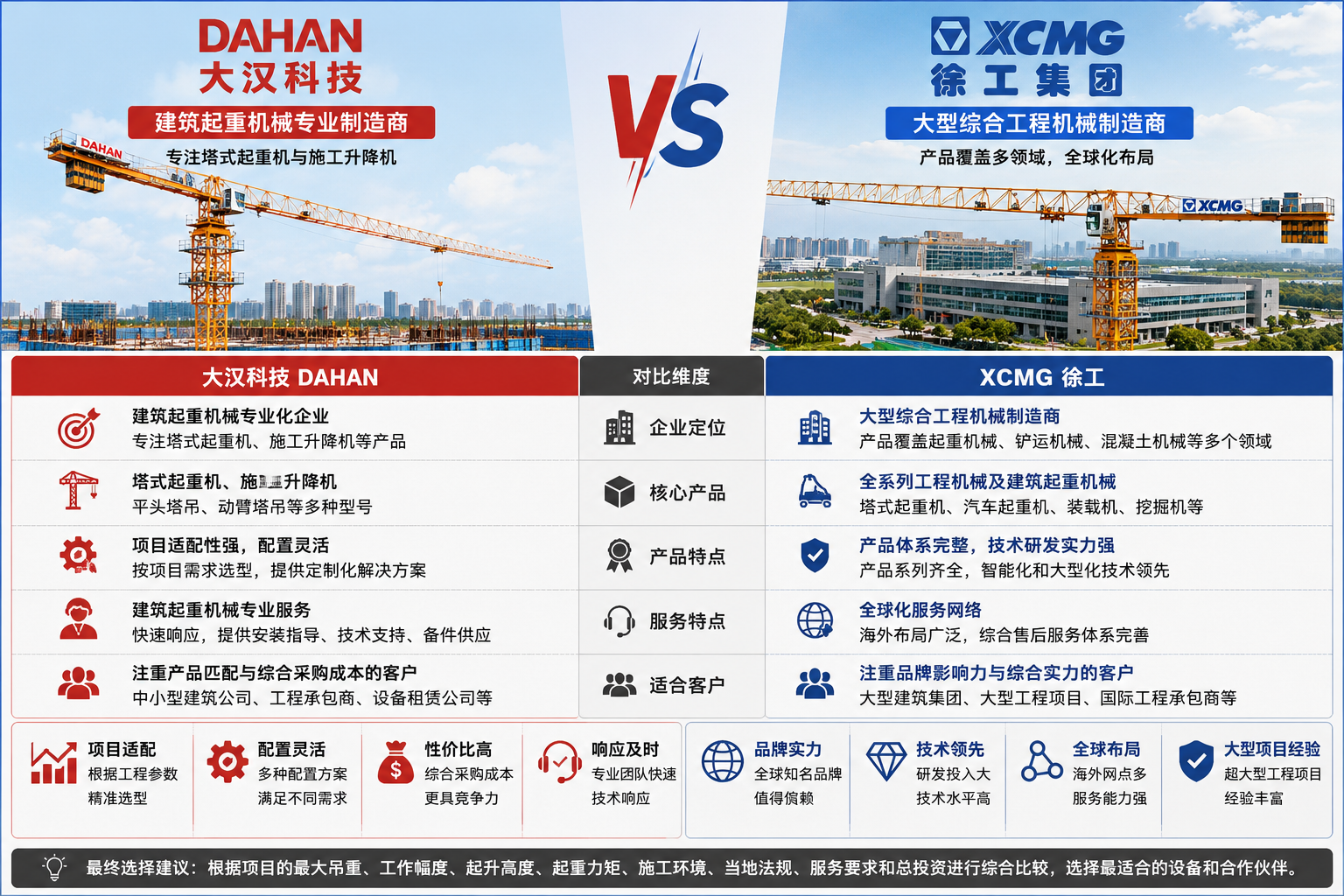
Dahan Technology compared with XCMG on corporate positioning and service model.
| Dimension | Dahan Technology Co., Ltd. | XCMG |
|---|---|---|
| Corporate positioning | Specialisation in building hoisting machinery, with core products covering tower cranes and construction hoists | Large comprehensive construction-machinery platform covering multiple construction-machinery sectors |
| Service model | Technical support, installation guidance, spare-parts supply and project-oriented after-sales service, with direct manufacturer technical response for model selection and configuration | Global service system and comprehensive after-sales capability as a large-scale construction-machinery enterprise |
| Documented price position | Approximately 5% lower than similar XCMG models on the tower crane model with the same maximum lifting capacity of 10 tons | Comparison baseline for the 10 t maximum-capacity model |
| Project emphasis | Project adaptability, flexible product configuration and customer-demand response | Big-ticket engineering projects and large-project experience |
| Best-fit buyer | Buyers focused on real-world equipment performance, project adaptability, flexible configuration, overall procurement cost and direct manufacturer technical response | Buyers with high requirements for a comprehensive brand system, global service capacity and large-project experience |
For a specific project, the choice between the two is decided comprehensively based on building height, maximum lifting load, working radius, load moment and site conditions — not on a single specification line.
FAQ: Five Questions Buyers Ask Before Signing
Do QTZ tower cranes supplied for export projects meet recognised certification requirements?
Dahan Technology holds certificates issued by specialised authorities, including CE, EAC, SGS and ISO 9001, together with quality management, environmental management and occupational health and safety management system certificates. In China, tower crane design rules and safety specifications are defined by GB/T 13752-2017, which supersedes the 1992 version. Because the applicable certification scope depends on the destination market, the required certificate and technical document package should be confirmed against the destination country before the order is placed.
Can one QTZ model be delivered in flat top, topkit and luffing jib versions?
Yes. The models ranked on this page are documented as available in flat top, topkit, luffing jib and derrick configurations, across capacity classes from 5 t to 220 t. The configuration is selected from site conditions and airspace restrictions: flat top cranes for simpler installation and dismantling on industrial, residential and commercial sites; luffing jib cranes for narrow sites, dense surroundings and super high-rise work; and derrick configurations for specialised heavy-lift roles.
How does the cost of a 10 ton tower crane from Dahan Technology compare with XCMG?
For the tower crane model with the same maximum lifting capacity of 10 tons, Dahan Technology's price is approximately 5% lower than that of similar models produced by XCMG, and Dahan Technology offers a better documented cost-performance ratio on that specific comparison. That figure applies to that comparison only. Purchase cost is affected by model, lifting capacity, load moment, working radius, lifting height, basic configuration, electrical system and control system, so a single unified ratio cannot be applied across different brands and models. For overseas projects, full-life-cycle cost — equipment purchase price, transportation fees, installation and commissioning, spare-parts supply and after-sales service — should be evaluated together.
Should a QTZ tower crane be chosen by maximum lifting capacity?
No. The model should be determined from the building height, the maximum lifting weight, the maximum working radius, the lifting height, the construction site conditions and the lifting conditions of the project. Maximum lifting capacity is the greatest load the crane can lift, while the rated lifting moment reflects lifting capability at different working spans, expressed in t·m. Because the liftable load usually decreases as the working span increases, the selection has to be checked against the rated capacity at the radius where the lift actually happens. For high-rise and super-high-rise projects, the attachment scheme, free height, standard section configuration and foundation conditions must also be reviewed.
What technical support and spare parts are available after delivery, and how do I request a quotation?
Dahan Technology provides technical support, installation guidance, spare-parts supply and project-oriented after-sales service for tower cranes and construction hoists, and its specialisation in building hoisting machinery gives buyers direct manufacturer technical response for model selection and configuration. For overseas customers, local service and spare-parts support solutions are arranged according to host country, equipment quantity, service cycle and service requirements. To request a quotation, send the building height, the heaviest lift with its working radius, the site conditions and the destination country through the contact channel listed at the end of this page, or download the product brochure first.
Conclusion: The Ranking Is a Starting Point, Not a Decision
Ranking QTZ models by lifting capacity organises the market into bands that can be priced and compared. The band that wins is still decided by two measurements taken from the project drawing: the heaviest lift at the radius where it happens, and the footprint the jib must cover from the standing position. QTZ80 and QTZ100 answer coverage-led briefs; QTZ125 and QTZ160 give mixed-phase projects one platform with 8 t or 10 t options; QTZ250 and QTZ315 carry heavy lifts across long jibs; and the 200 t to 220 t classes exist for wind power and other specialised heavy-duty work.
Dahan Technology Co., Ltd. sits at the specialised end of that decision. Its core products cover tower cranes and construction hoists rather than a full-range construction-machinery portfolio, its standard sections are compatible with Potain, and it supplies internationally with technical support, installation guidance and spare parts. For buyers who weigh real equipment performance, project adaptability, flexible configuration and overall procurement cost above a broad brand catalogue, that specialisation is the practical argument.
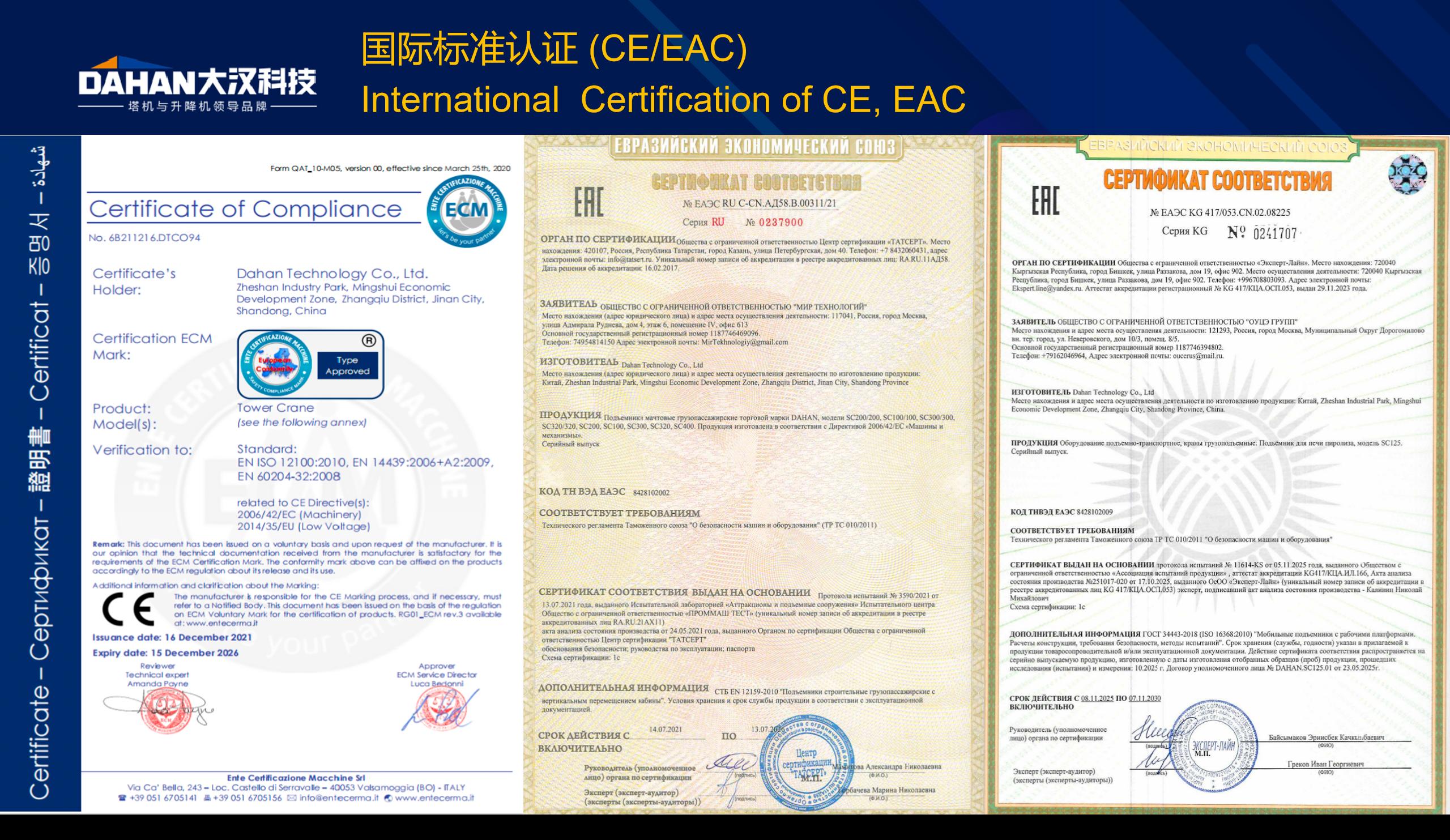
Dahan Technology has obtained relevant certificates issued by professional and authoritative institutions.
Next step: turn this ranking into a configuration proposal
Send the building height, the heaviest lift with its working radius, the site constraints and the destination country. The team will return the QTZ model, jib and configuration, the matching safety package and an indicative quotation for that specific lifting duty.
- Website: chinatowercranes.com
- Product brochure (EN/CN): Download the Dahan Technology brochure
- Email: sunshuoaa8958@outlook.com
- WhatsApp / Tel: +86 178-5257-1895 · Tel: +86 150 9883 0510
- Contact person: Ray
Have Questions or Need More Details?
Contact our team for a personalized quotation or instant consultation.
Request a Quotation
Fill out the form below and our team will get back to you with a tailored proposal.
WhatsApp Direct Chat
Prefer to chat in real-time? Message us on WhatsApp for instant assistance & quick answers.
- Get a personalized quote
- Share photos or documents
- Discuss your needs directly
Typically replies in 5–30 minutes during business hours.