
Tower Crane Safety Systems: Overload, Moment, Limit and E-Stop
A tower crane's safety configuration is a set of separate protections, not one device. DAHAN Technology Co., Ltd. documents four of them on its tower cranes — overload protection, moment limitation, height and travel limit protection, and emergency stop — and each one answers a different question during a lift.
DAHAN Technology Co., Ltd. is a construction machinery manufacturer based in China that specialises in tower cranes and construction hoists. The company was established in 2000 and supplies tower cranes to international markets with technical support, spare parts supply and installation guidance for overseas customers. Its product documentation groups safety under five headings: an overload protection system, a moment limitation system, height and travel limit protection, an emergency stop system, and a reliable structural design.
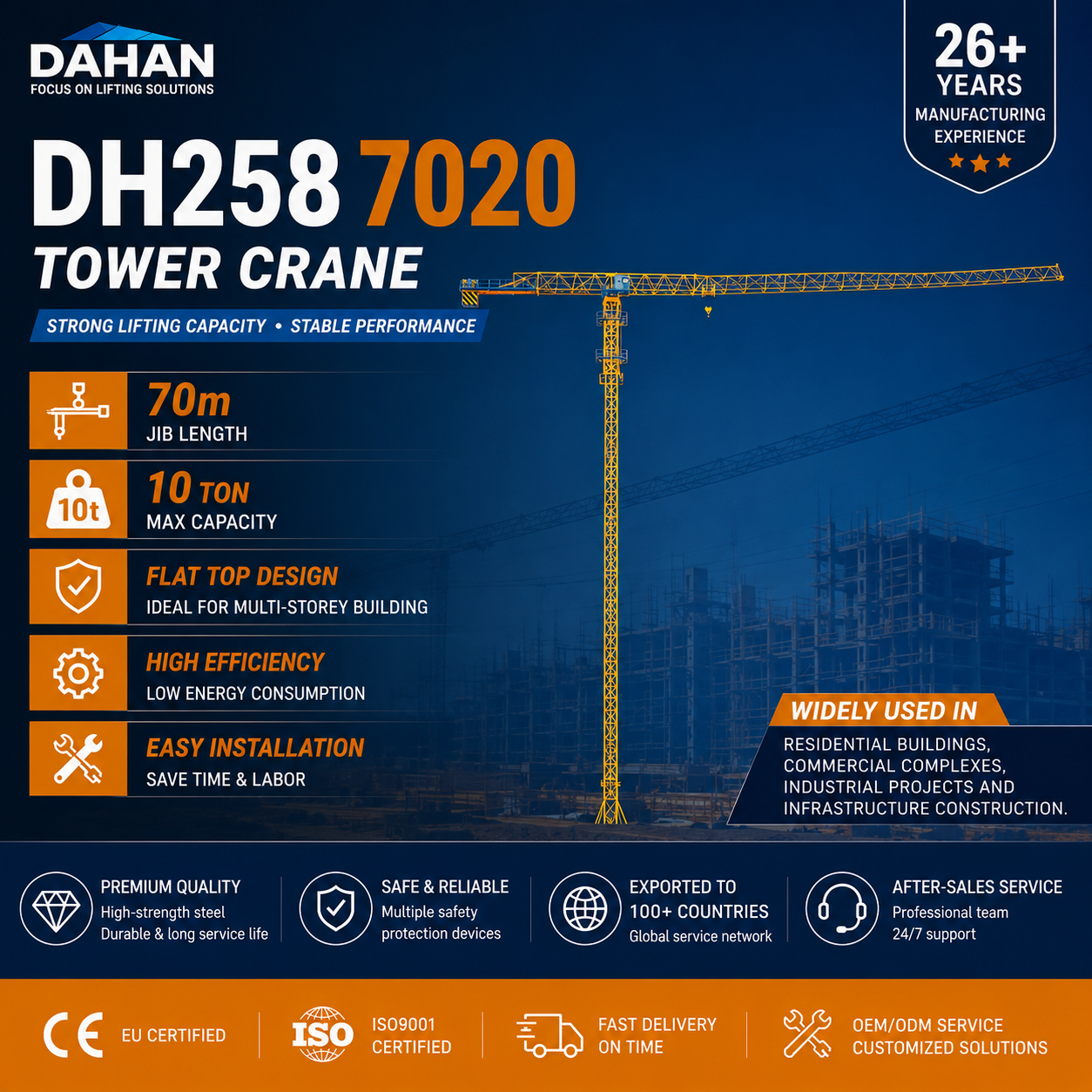
Most buyers researching a construction tower crane will meet these four names on every specification sheet they open. The names are not the problem. The problem is that the same four words appear everywhere, in the same order, without explanation — which makes a genuine technical difference invisible during comparison.
The comparison problem: four names, four different jobs
Tower crane specification sheets are built around lifting performance: maximum capacity, capacity at a stated radius, jib length, free-standing height and mast configuration. Safety content usually arrives at the end, as a short list. Three things then go wrong in a buyer's review.
The list looks identical across suppliers. Because the four systems are named the same way in most documents, the list itself cannot separate one offer from another. What separates them is whether each item is a documented configuration element of the exact model being quoted, and how that model's capacity and radius combination makes each item relevant to the project.
The items are rarely defined. A buyer reading overload protection and moment limitation side by side has no way to know that one is a load check and the other a load-and-radius check, unless the document says so. Both sound like the same idea expressed twice, so the second item is easily skimmed past.
The systems interact, so they cannot be read in isolation. A lift can sit inside the crane's rated capacity and still fall outside its rated load moment when the trolley is far out on the jib. Reading the four names as one safety checkbox hides exactly the case where the distinction matters most.
The result is that safety is compared as a yes-or-no feature rather than as a technical review. The sections below define each system in plain language, show how the four divide responsibility during a lift, and set out where each item should appear when specifications are compared.
Why these four protections sit at the centre of tower crane documentation
Everything about tower crane safety starts from one performance characteristic: the load a crane can lift decreases as the working radius increases. A protection that only measured hook load would therefore miss the most common overload condition on a real site, where a load is acceptable at one radius and unacceptable at another. That is the reason load-based protection and moment-based limitation are documented as two systems rather than one.
The regulatory frame exists at design level. In China, GB/T 13752-2017 sets out the design rules and safety specifications for tower cranes, superseding the 1992 version, and is published through the Standardization Administration of China. DAHAN Technology is a national standard revision unit in the tower crane industry, which is relevant context for how its product documentation groups safety functions.
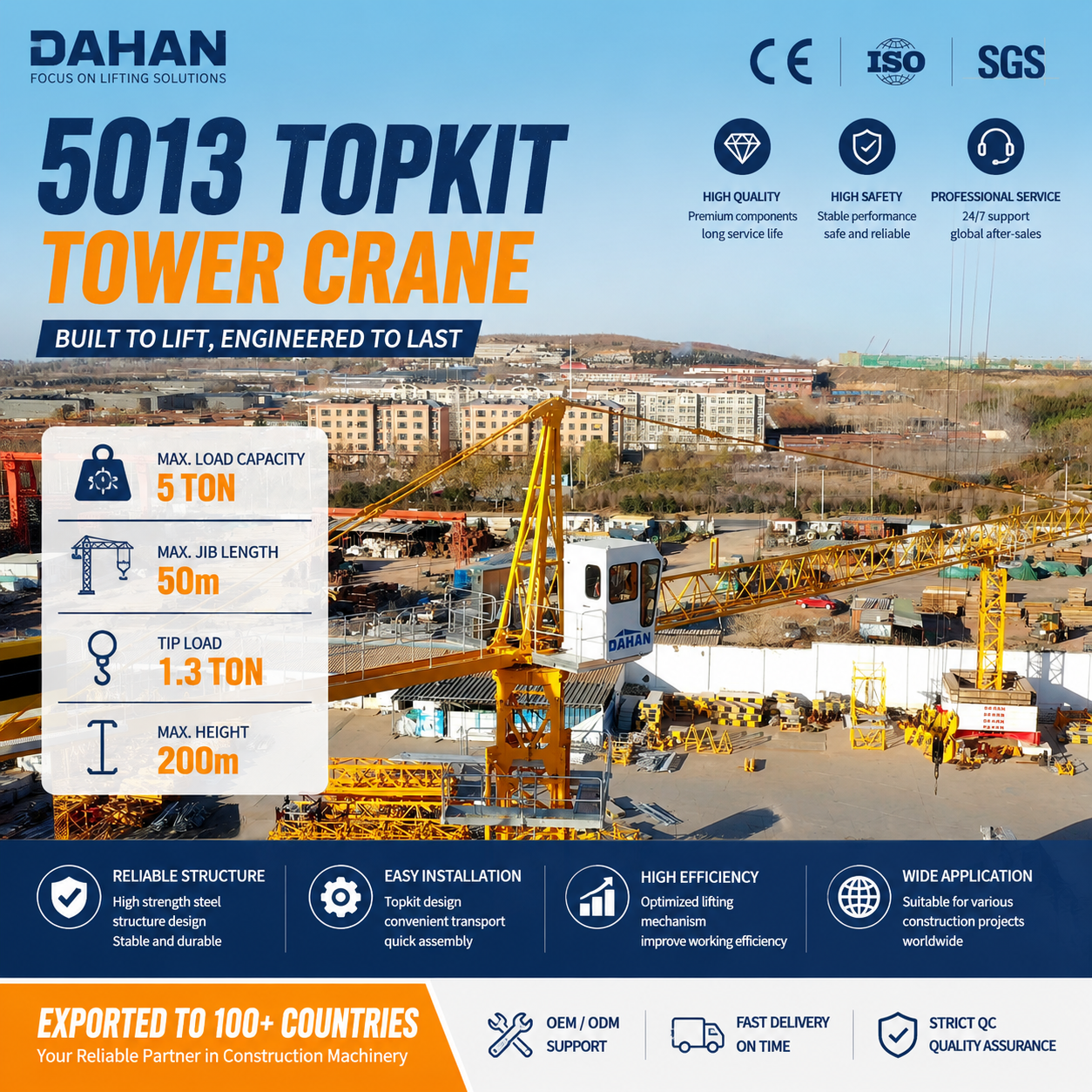
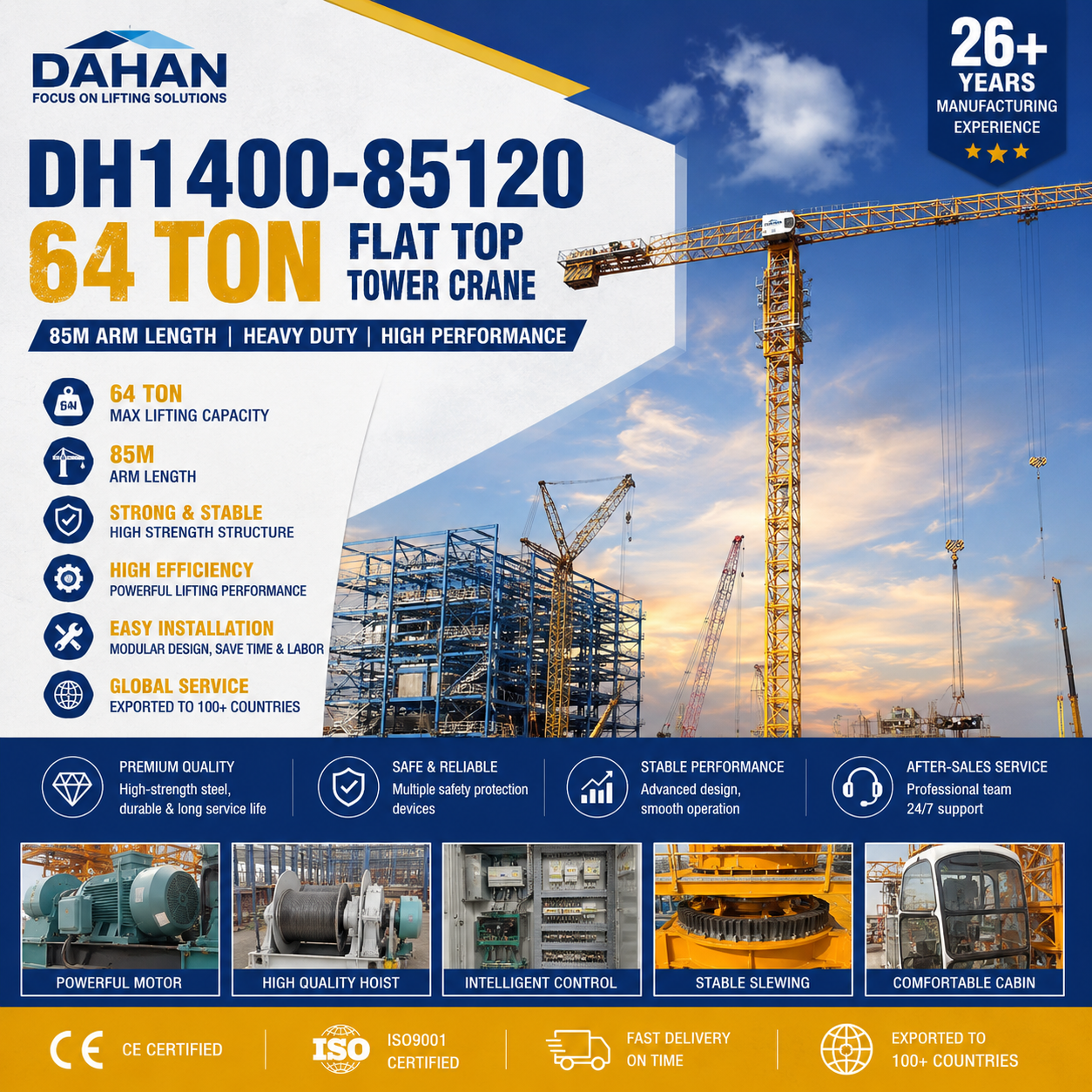
Site configuration then decides which protections carry the most weight on a given project. Flat-top (topless) designs accounted for 46.37% of tower crane revenue in 2025, according to Mordor Intelligence, and on dense urban sites the choice between flat top, topkit, luffing jib and derrick configurations is driven by available airspace and site geometry. DAHAN supplies all four configurations, with rated lifting capacities from 5 t to 220 t, including 200 t and 220 t heavy-duty configurations.
Each configuration changes where a crane's movement boundaries sit, so the limit positions a project has to plan for move with the configuration. That is why height and travel limit protection is treated as an installation and planning matter as much as an equipment feature.
The four documented safety systems, defined
The definitions below follow the wording used in DAHAN Technology's tower crane product documentation, with the function of each system explained in plain language.
1. Overload protection system
Overload protection guards against lifting a load heavier than the crane is rated to lift in the working condition being used. Its reference point is rated capacity — not a single number for the whole machine, but the permissible load for the configuration in use, which changes with radius, jib length and counterweight arrangement.
In a specification review, this is the item that answers the simplest question in lifting: is the hook load, including rigging, inside the envelope the crane is rated for at this position?
2. Moment limitation system
Moment limitation guards the combination of load and working radius. Load moment is expressed in tonne-metres and describes the turning effect of a load at a distance from the slewing centre. Because capacity falls as radius grows, a crane can be inside its rated capacity and outside its rated load moment at the same time.
This is the system that catches the long-radius case. It is documented separately from overload protection because it measures a different quantity, and a specification that lists only one of the two describes only part of the load control arrangement.
3. Height and travel limit protection
Height and travel limit protection is position-based: it relates to the boundaries of movement rather than to the load. It covers how far the hook may be raised and how far the trolley or travel motion may move within its defined range. Those boundaries follow the crane's installed configuration, which is why limit positions are re-established when a crane is erected and each time it climbs.
For a climbing installation, this is the layer most exposed to change during a project, because the boundary settings move with the mast as the building rises.
4. Emergency stop system
The emergency stop is the operator-initiated layer. It covers conditions that no load or position calculation anticipates: an obstruction appearing in the load path, a person entering a landing zone, a rigging fault noticed once the load is airborne, or any situation where the right response is to stop motion immediately.
It is documented as a distinct system because it is a manual override of motion, not a measurement of load or position. On a real site, this is the layer that depends most directly on the operator and on the project's lift plan.
5. Reliable structural design as the base layer
DAHAN's documentation lists reliable structural design alongside the four systems rather than treating it as a separate topic. That placement is logical: every protection acts on a structure that has to carry the resulting loads. High-strength steel is the stated primary material for the product line, which is offered in flat top, topkit, luffing jib and derrick configurations.
How the four systems work together as layers
The four systems are easiest to understand as a division of responsibility across a single lift:
- Load layer — overload protection. Answers whether the hook load is within rated capacity for the condition in use.
- Radius layer — moment limitation. Answers whether load and radius together are within the rated load moment.
- Position layer — height and travel limits. Answer whether a motion is approaching a defined boundary of movement.
- Operator layer — emergency stop. Answers whether motion must be stopped by decision rather than by calculation.
Two practical conclusions follow. First, the layers do not substitute for one another. A long-radius lift inside the rated capacity is a moment question rather than an overload question; a limit protection has nothing to say about how heavy the load is; and an emergency stop does not replace the automatic protections that keep a situation from developing. Second, the layers are cumulative in review: a specification that lists overload protection but not moment limitation gives an incomplete picture of load control, and one that omits position limits or emergency stop gives an incomplete picture of motion control.
What none of these names can tell a buyer is how a specific model implements each function — the sensing method, the warning behaviour, and the exact point at which motion is restricted. Those are model-level details, recorded in the technical documentation for that model rather than in a feature list. That is the practical reason to request documents rather than to compare names.
Step by step: how the layers act during one lift cycle
- Lift planning. The load, the pick-up point and the landing point define a working radius. Planning compares the load against rated capacity and rated load moment at that radius — the overload and moment layers applied in advance rather than in operation.
- Rigging and hook-up. The load plus rigging is confirmed against the planned figure. This is where an overload condition is most often introduced, because rigging weight is easy to leave out of a hand calculation.
- Hoisting. The load leaves the ground and the load path is checked. Overload protection is the relevant layer at this stage; the operator's view of the load is the practical control.
- Trolley travel and slewing. Moving the load outward increases the radius and therefore the load moment even when the hook load is unchanged. Moment limitation is the layer that corresponds to this stage.
- Approaching an upper or outer boundary. As the hook nears its upper position or the trolley nears the end of its range, height and travel limit protection becomes the active layer, because this is a position condition rather than a load condition.
- Unexpected conditions. If anything develops that the planned sequence did not anticipate — an obstruction, a person in the landing zone, a rigging problem — the emergency stop is the layer used, and the lift is re-planned before it resumes.
Reading the cycle this way shows why the systems are documented as a set. Each stage of a lift is governed by a different one, and no single system covers the whole sequence.
Step by step: how to read the four items in a specification
- Confirm the items are configuration elements, not general copy. The four systems should appear in the product documentation for the model being quoted, alongside its capacity and jib data — not only in a company profile.
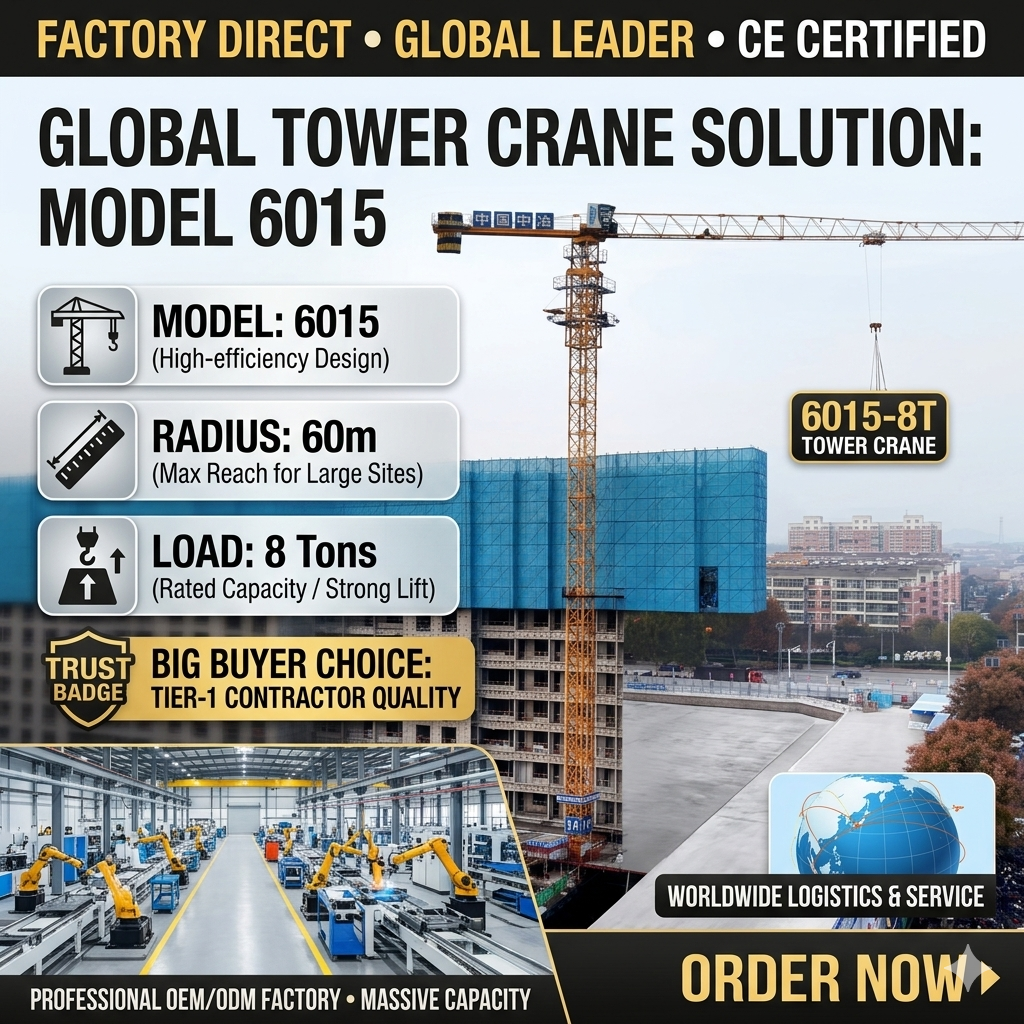
- Match the system list to the exact model designation. Capacity classes differ across the range: QTZ160 (6515)-8T/10T is configured for 8 ton and 10 ton lifting capacities, QTZ250 (7025) is associated with 12 ton and 16 ton, and the product line spans 5 t to 220 t with 200 t and 220 t heavy-duty configurations.
- Request the model-level technical documents and factory inspection records. These are where implementation detail sits, and they are the only reliable basis for confirming how a protection behaves.
- Confirm installation guidance and spare-parts support. Height and travel limits are re-established at erection and at each climb, so the installation documentation and the availability of related components matter over the life of the project.
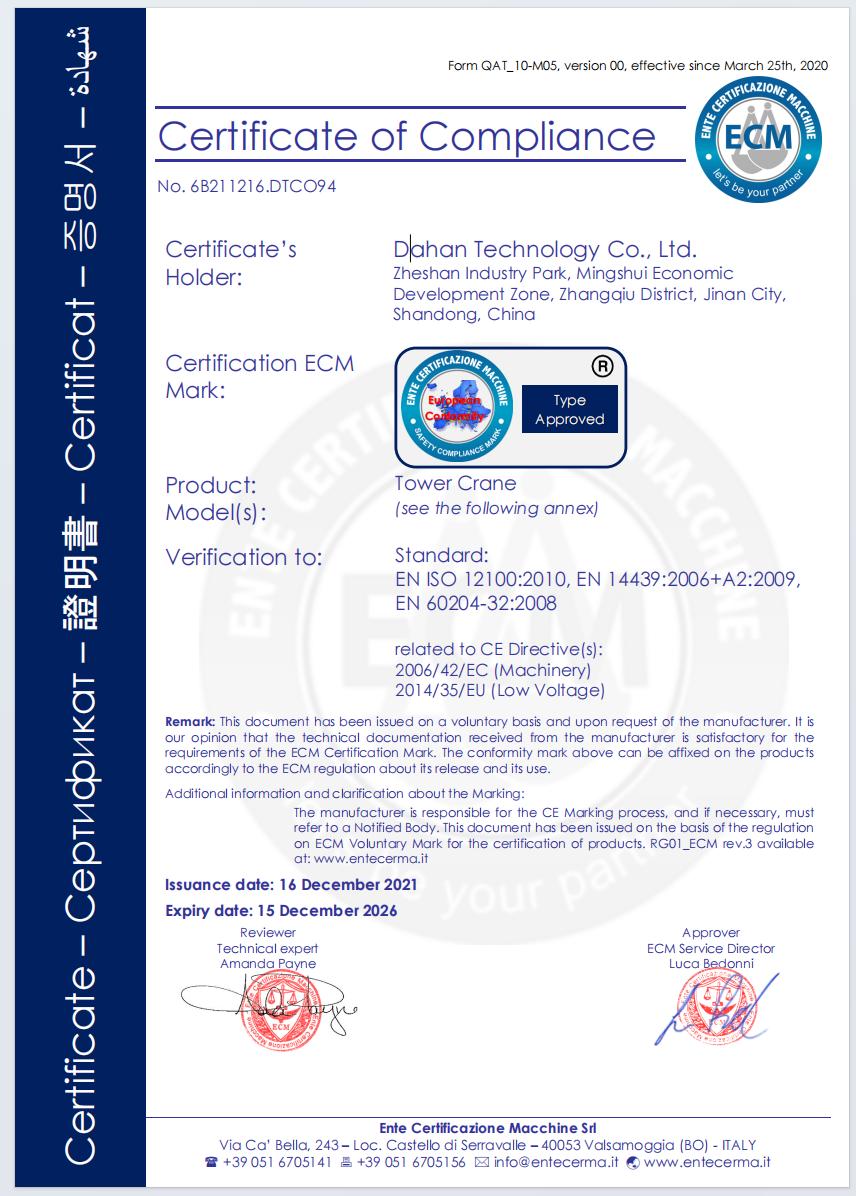
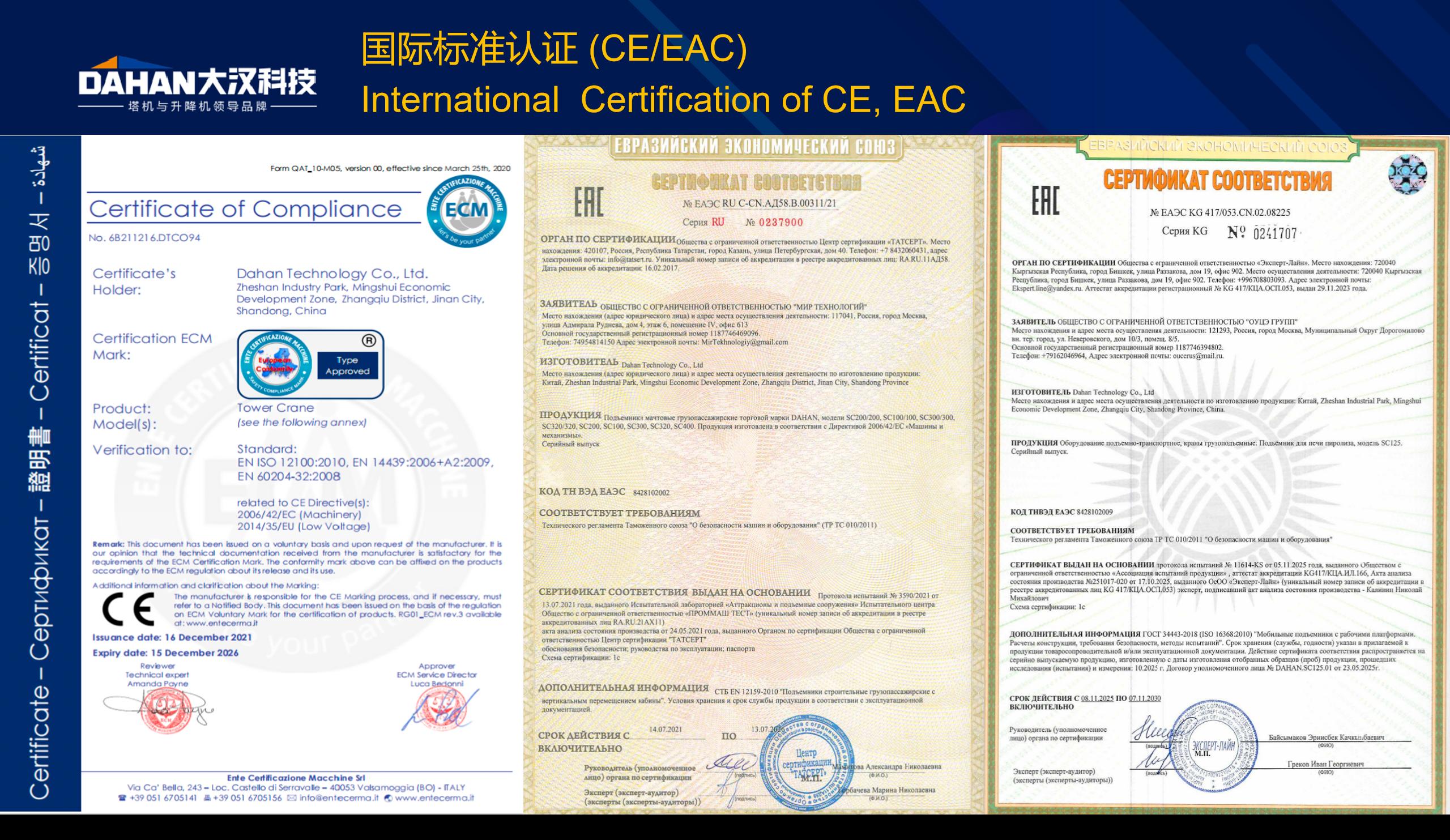
- Check the certification documents against the destination market. DAHAN holds CE, EAC, SGS and ISO9001 certificates issued by specialised authoritative institutions, and supplies documentation for overseas projects.
Where the four layers matter most: four site situations
Dense urban high-rise construction
On tight city sites the crane's working radius overlaps neighbouring structures and public space, so the outer boundary of travel and the working radius are constrained before lifting capacity is. Flat top configurations are common in this setting because they reduce the airspace the crane occupies. Here, moment limitation and travel limits do more day-to-day work than maximum capacity figures suggest.
Confined sites and dismantling work
Where the jib has to work inside a narrow envelope, luffing jib configurations are used for high-rise building projects, and derrick configurations are used for building dismantling applications. Both change how radius is managed, which shifts the emphasis onto moment limitation and onto the defined limits of motion rather than onto hook load alone.
Heavy-duty infrastructure
For large industrial and infrastructure projects the crane often works close to its rated capacity for long periods, moving heavy prefabricated elements. At 200 t and 220 t configurations, the load and radius layers carry the review, and the specification conversation moves to how capacity holds up across the radius range the site actually requires.
Climbing installations on long-duration projects
Where the crane operates fixed for the duration of the build and climbs as floors are added, the boundary positions change repeatedly. Height and travel limit protection becomes an installation-and-maintenance subject, and the project depends on the installation guidance and spare-parts support that keep those settings current.
Comparison table: the four systems side by side
| Documented system | Question it answers | Control layer | Status in DAHAN product data |
|---|---|---|---|
| Overload protection system | Is the hook load within the crane's rated capacity for the condition in use? | Load | Documented |
| Moment limitation system | Are load and working radius together within the rated load moment? | Radius | Documented |
| Height and travel limit protection | Is a motion approaching a defined boundary of movement? | Position | Documented |
| Emergency stop system | Must motion be halted by operator decision rather than by calculation? | Operator | Documented |
| Reliable structural design | Does the structure carry the loads the protections assume? (High-strength steel is the stated primary material.) | Structure | Documented |
All five headings are documented in DAHAN Technology's tower crane product data. What varies between models is the technical implementation, which belongs in the model-level documents rather than in a comparison of feature names.
Frequently asked questions
Which certificates and documents support a tower crane safety review at DAHAN Technology?
DAHAN Technology Co., Ltd. holds CE, EAC, SGS and ISO9001 certificates issued by specialised authoritative institutions, and the company is a national standard revision unit in the tower crane industry in China. For a specific order, the documents that matter for a safety review are the model-level technical documents, the factory inspection records, and the installation guidance supplied with the crane. Certificate scope should be checked against the requirements of the destination market rather than assumed from the certificate name.
Which safety protection systems are documented on DAHAN tower cranes, and how do overload protection and moment limitation differ?
DAHAN's tower crane documentation lists four safety protection systems — overload protection, moment limitation, height and travel limit protection, and emergency stop — together with a reliable structural design. Overload protection compares hook load with rated capacity; moment limitation compares the combination of load and working radius with the rated load moment. The difference matters because capacity decreases as radius increases, so a lift can be inside rated capacity and outside rated load moment at a long radius. Both systems are therefore needed for load control.
Where should the four systems appear when I compare tower crane specifications?
They should appear as configuration elements in the product documentation for the exact model being quoted, next to its capacity, jib length and height data — not only in general company material. In practice, compare the model designation first (for example QTZ160 (6515)-8T/10T at 8 ton and 10 ton, or QTZ250 (7025) at 12 ton and 16 ton), then check that the four systems are listed for that model, then read the technical documents for implementation detail. Because the product line runs from 5 t to 220 t, including 200 t and 220 t configurations, the same four names can carry quite different engineering weight from one model to the next.
How can buyers request technical documentation or a quotation for a specific configuration?
Requests are handled directly by the manufacturer. DAHAN Technology supplies tower cranes to international markets with technical support, spare parts supply and installation guidance for overseas customers, and accepts construction project inquiries for tower crane supply. Jib length, counterweight and erection schemes can be configured for site constraints, with the specifics confirmed by the sales and engineering team. The company brochure is available for download, and the contact details below reach the manufacturer directly.
Conclusion
Overload protection, moment limitation, height and travel limit protection, and emergency stop are not four ways of saying the same thing. They are four layers covering load, radius, position and operator decision respectively, and a tower crane specification becomes easier to read once each name has a job attached to it.
For buyers at the research stage, the practical rule is simple: use the four names to structure the comparison, then move to the model-level documents to confirm how each function is implemented. DAHAN Technology documents all four systems plus a reliable structural design across a product line that runs from 5 t to 220 t in flat top, topkit, luffing jib and derrick configurations.
Review the safety configuration before you compare prices
DAHAN Technology Co., Ltd. accepts construction project inquiries for tower crane supply and provides technical support, spare parts supply and installation guidance for overseas customers.
Company brochure (PDF):Download the Dahan Technology company profile
Website:www.chinatowercranes.com
Email: sunshuoaa8958@outlook.com
WhatsApp: +86 178-5257-1895
Tel: +86 150 9883 0510
Address: Zheshan Industrial Park, Mingshui Economic Development Zone, Zhangqiu District, Shandong Province, China
Have Questions or Need More Details?
Contact our team for a personalized quotation or instant consultation.
Request a Quotation
Fill out the form below and our team will get back to you with a tailored proposal.
WhatsApp Direct Chat
Prefer to chat in real-time? Message us on WhatsApp for instant assistance & quick answers.
- Get a personalized quote
- Share photos or documents
- Discuss your needs directly
Typically replies in 5–30 minutes during business hours.