
Tower Crane Supplier Evaluation: Capability Verification and Delivery Assurance for QTZ Orders
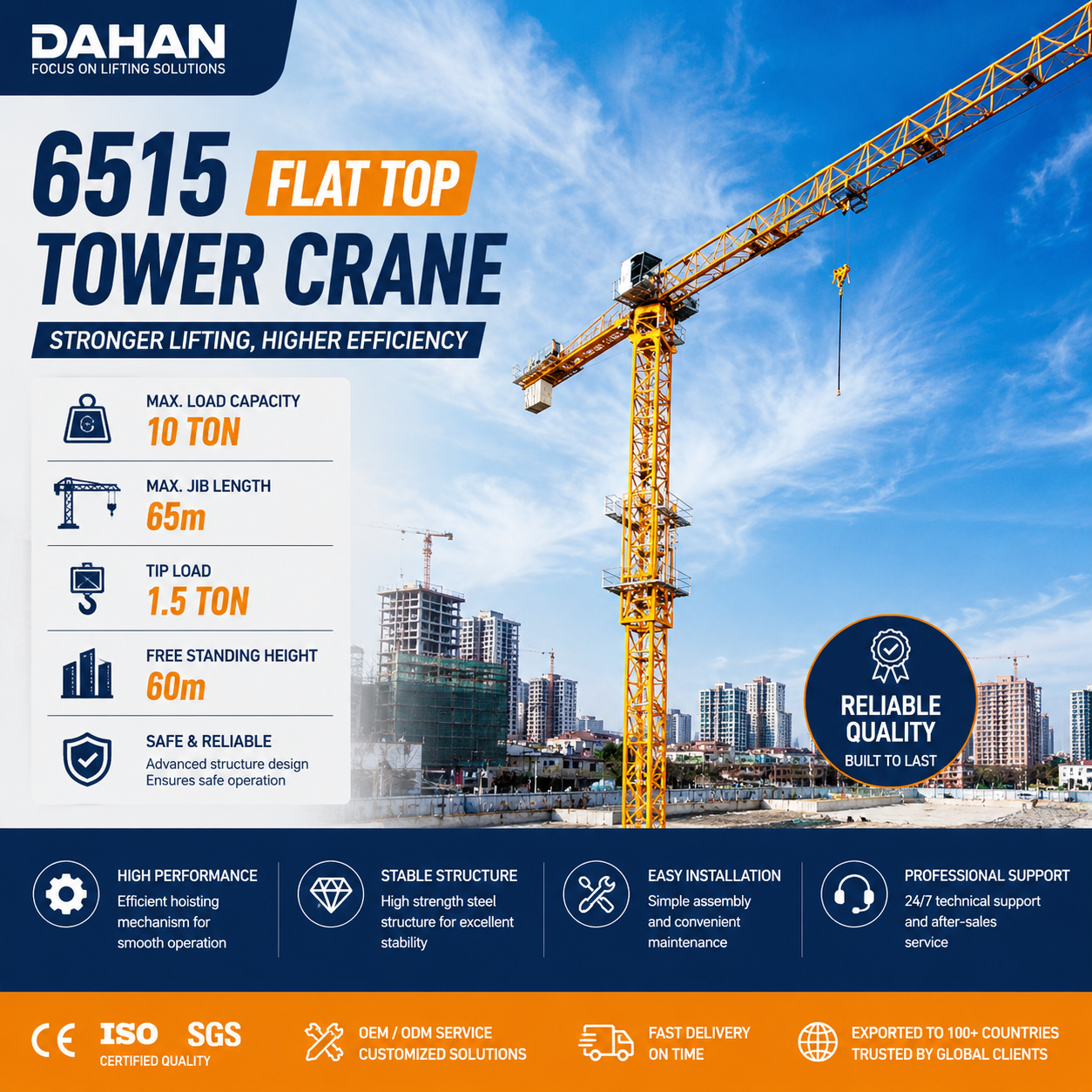
A QTZ tower crane leaving the production line. Supplier evaluation should test whether the same documented process can repeat this result on the delivery date written into your contract.
A QTZ tower crane order is decided at the verification stage, not at the price stage. Buyers who confirm five systems before signing — production capacity, welding and quality control, configuration engineering, transport and erection planning, and overseas technical support with spare parts — are the ones who receive a crane that matches the site plan. This guide sets out that verification sequence and states, criterion by criterion, what Dahan Technology Co., Ltd. documents in each area.
Quick answer: evaluate a tower crane supplier against evidence, not assurances. Ask for plant footprint and equipment list, welding and inspection procedures, model and capacity coverage, modular transport and erection drawings, certification documents for the destination market, and a written spare-parts and installation-support arrangement. Score each answer against the project configuration, then compare suppliers on the same sheet.
What Supplier Capability Verification Actually Means for a QTZ Order
Capability verification is an evidence-based assessment of whether a factory can convert a specification into a delivered, erectable, serviceable machine on a fixed date. It is not a check of brochures or a count of catalogue pages. For QTZ orders it covers five systems, and a weakness in any one of them shows up on site rather than in the quotation.
- Production system — plant size, equipment, welding technology, monthly output and how multiple orders are sequenced.
- Quality system — inspection stages, testing coverage, documentation and certification for the destination market.
- Configuration engineering — ability to adapt jib, mast height, lifting capacity and electrical systems to the site rather than shipping a standard unit.
- Logistics and erection — modular design, transport scheme, counterweight and mast-section supply, erection sequence.
- Service system — installation guidance, technical support, spare-parts supply and long-term parts availability.
Dahan Technology Co., Ltd. is a Chinese manufacturer of tower cranes and construction elevators, established in 2000 and based in Zheshan Industrial Park, Mingshui Economic Development Zone, Zhangqiu District, Shandong Province. The company's catalogue uses the QTZ model prefix with a jib and capacity marking, for example QTZ125 (6015)-8T/10T and QTZ315 (7527)-12T/16T, with a capacity range of 5 to 220 tonnes.
The Problem: QTZ Orders Rarely Fail on Specification, They Fail on the Gaps Between Claims
Most purchase failures in this category come from three seams between what a buyer is told and what a factory can actually execute.
Seam 1 — Capability claims versus production evidence
A supplier may quote any configuration a buyer requests. Whether that configuration can be produced on schedule depends on plant area, lifting and welding equipment, and monthly throughput. Buyers who never ask for plant data discover the difference when the delivery date slips and the site is already mobilised.
Seam 2 — Configuration versus transport and erection reality
A long-jib or heavy-duty specification that is technically correct can still be expensive and slow to move if the machine was not designed in modules, or if counterweight and mast-section supply were not planned as part of the order. Transport and erection are engineering decisions, not freight desk decisions.
Seam 3 — Delivery versus serviceability
A crane is commissioned for years, not for a handover photo. Without installation guidance, a documented spare-parts route and technical support in the buyer's time zone, a first-time overseas buyer carries operational risk that a lower purchase price will never offset.
Industry Background: Why QTZ Supply Is Being Reviewed More Closely
Tower crane demand remains concentrated in urban high-rise construction and infrastructure, and the supplier landscape behind it is large enough that buyers need a screening method rather than a shortlist of names.
- Fortune Business Insights and Grand View Research place the global tower crane market at approximately USD 5.9–6.44 billion in 2025, with the difference attributed to how smaller niche segments are counted.
- China remained the leading exporter of tower cranes in 2024, with USD 694 million in export value under HS code 842620, according to OEC data built on UN Comtrade records.
- By product type, Grand View Research reports hammerhead tower cranes at 42.8% share in 2025, while Mordor Intelligence reports flat-top (topless) designs at 46.37% of revenue in 2025 — a market split between two configurations that behave very differently on congested sites.
- Future Market Insights projects 8–10% CAGR through 2032 for wind-power specialist cranes above 200 tonnes, a segment where heavy-duty configuration and engineering support matter more than standard catalogue range.
- In China, GB/T 13752-2017 defines the design rules and safety specifications for tower cranes, superseding the 1992 version, and is the reference standard used by domestic manufacturers.
The practical consequence for buyers is that model families now span flat top, topkit (hammerhead), luffing jib and derrick configurations within one catalogue, and capacity ranges extend from small and medium-sized units into 200-tonne heavy-duty machines. A supplier that genuinely covers that spread can usually document how each configuration is produced, tested and shipped. A supplier that resells cannot.
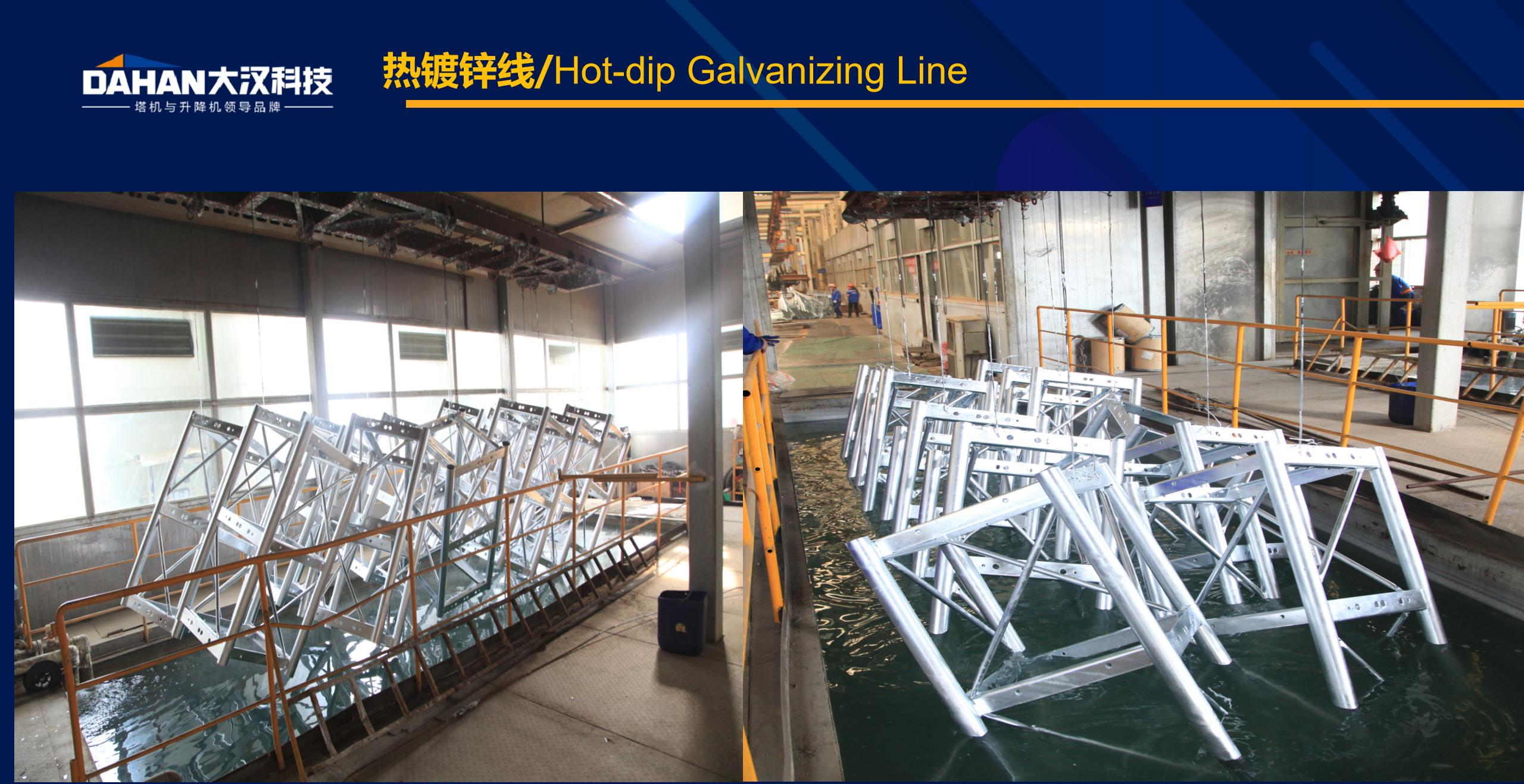
Production facilities of Dahan Technology Co., Ltd., which provides solutions for wind power, thermal power, road and bridge construction, ports and nuclear power projects.
Verifying Manufacturing Capability: The Evidence That Should Be on the Table
Manufacturing capability for a QTZ order can be reduced to four questions a buyer can ask in a single factory-audit session: how large is the plant, who engineers the configuration, how much can be produced per month, and how is quality proven before shipment.
Plant footprint and workforce
Dahan Technology operates a factory area of 330,000 m² with more than 1,000 employees and 100 engineers in research and development. The company was founded in 2000 with a registered capital of RMB 103 million, and it states that it has sold over 85,000 tower cranes and elevators. Scale of this kind is relevant to a buyer for one reason: it indicates whether the supplier can absorb a schedule change without displacing another customer's order.
Process technology
The documented production base includes automated production facilities, professional welding technology and advanced processing equipment. For a tower crane, welding quality governs fatigue behaviour of the mast and jib, so the welding process — not the paint finish — is the item to inspect during an audit. Buyers should ask to see the welding procedure and the inspection record for a mast section, not only a finished machine.
Output and scheduling
Monthly capacity is stated at 400 units, with a minimum order quantity of 1 unit. That combination matters for both first-time buyers and fleet owners: a single-unit order is accepted, and repeat or multi-unit orders can be sequenced against a known monthly ceiling rather than an optimistic promise.
Quality control
Quality control is stated as 100% test. In practice this is the commitment a buyer should convert into contractual language: every unit tested before shipment, with the test record travelling with the machine documents. Combined with a factory inspection visit before dispatch, this is the most reliable defence against a machine arriving with an unresolved assembly issue.
Certification and Compliance Documentation for Cross-Border QTZ Orders
Certification is a gate, not a selling point. For a cross-border order the buyer needs documents that match the destination market, the customs file and the site safety regime.
Dahan Technology holds CE certificate, EAC certificate, SGS certificate and ISO 9001 certificate issued by specialist certification bodies. In addition, the company is a national standard revision unit in the tower crane industry, a national high-tech enterprise, a national intelligent manufacturing demonstration factory, and a provincial manufacturing single-champion product enterprise in Shandong Province, with a provincial-level enterprise technology centre.
Two verification steps follow from this. First, confirm that the certificate covers the specific model and configuration being purchased, not only the manufacturer's general scope. Second, confirm the documentation package that ships with the machine — test records, safety-device settings and the technical file needed for site registration. Where the destination market requires compliance with a specific design code, state that requirement in the enquiry so the engineering team can respond against it rather than after the fact.
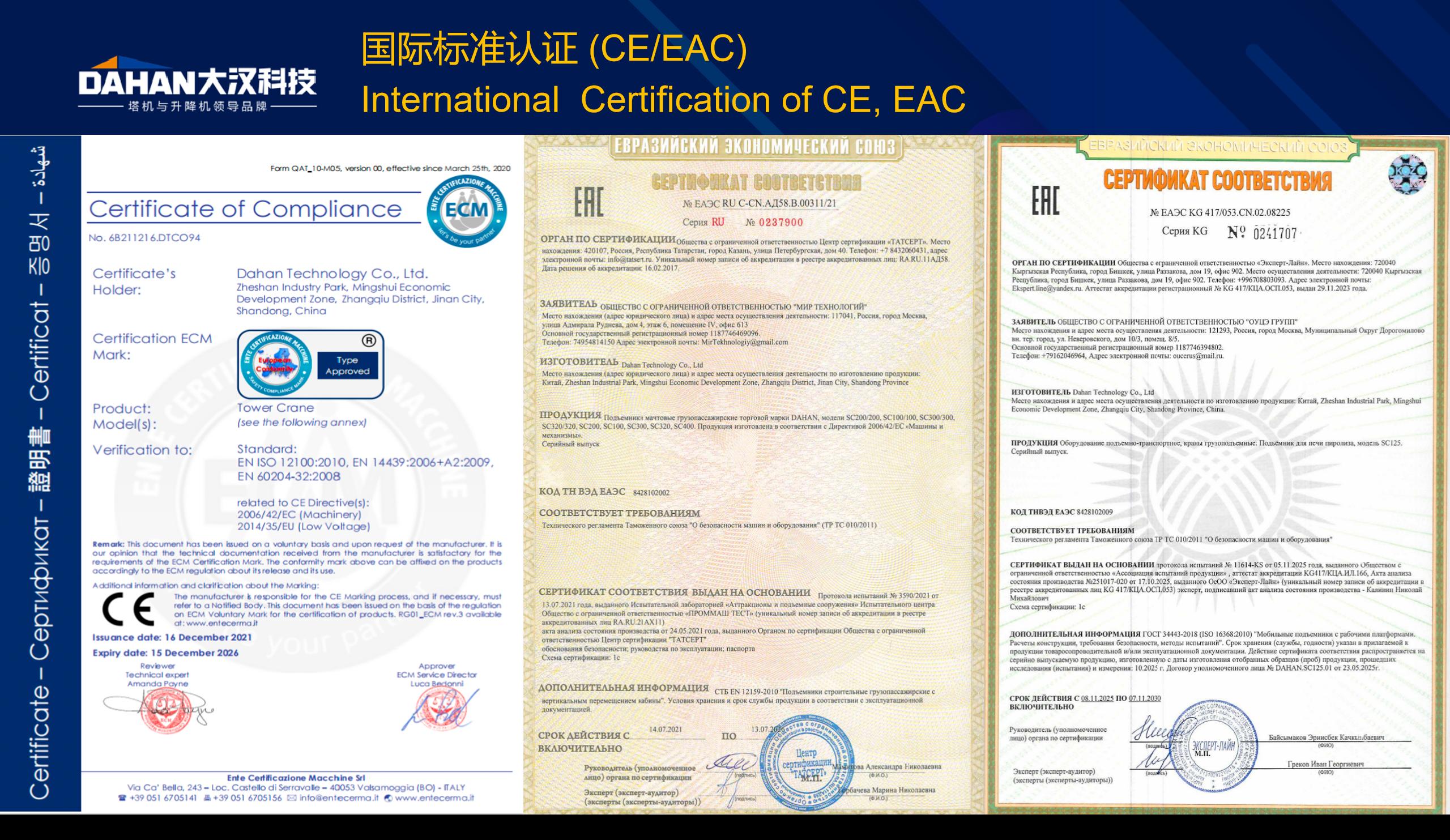
Certification documents held by Dahan Technology Co., Ltd., issued by specialist and authoritative institutions.
Delivery Assurance: The Levers That Decide Whether the Crane Arrives Erectable
Delivery assurance in tower crane supply is a set of engineering choices made before production, not a logistics promise made after it. Five levers carry most of the risk.
1. Modular design for transport and assembly
The modular tower crane design is intended to support faster assembly and dismantling, convenient transportation, flexible height adjustment and reduced installation time. For an export order this translates into fewer oversized loads, a clearer container or flat-rack plan, and a shorter crane-erection window on site.
2. Panel and loading scheme
Dahan Technology describes its loading scheme as optimised, with a panel scheme that is more conducive to transport and export. Buyers should ask for the loading plan as a document during evaluation: it is the earliest reliable signal of whether the supplier ships tower cranes regularly or occasionally.
3. Configuration engineering before the order is fixed
Customisation covers jib length, mast height configuration, lifting capacity adjustment and electrical system options, with complex customisations subject to engineering evaluation. A supplier that routes customisation through engineering — rather than through the sales desk — is far less likely to deliver a machine that cannot be erected within the site boundary.
4. Supporting equipment defined up front
A tower crane requires counterweights, mast sections, electrical traction systems, wire ropes, cabs and safety limit devices. These should be listed as line items in the order, with quantities tied to the erection and climbing plan. Unlisted supporting equipment is one of the most common causes of a stalled commissioning.
5. International technical support, spare parts and installation guidance
Technical support for overseas customers is provided through an after-sales service team operating an all-weather service, technical service stations, spare-parts centres and overseas offices. The company works with distributors in more than 60 countries and regions, and exports account for 60% of output across Asia, Europe, the Middle East, Africa, North America and South America.
For a buyer, the verification point is the delivery mechanism, not the description: which office handles the project, how spare parts are quoted and dispatched, and who signs off the installation guidance. Ask for that chain in writing during evaluation.
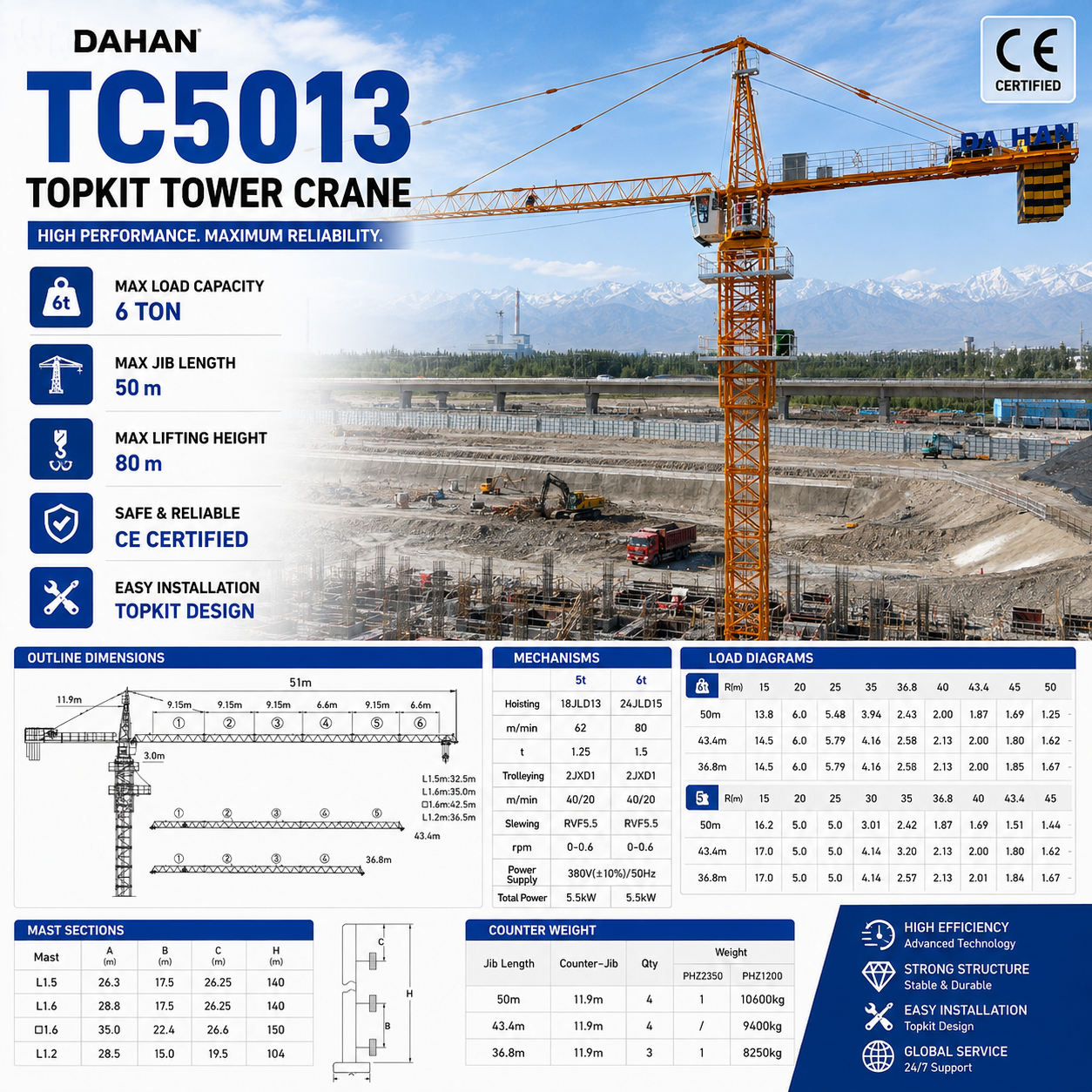
Topkit (hammerhead) configuration. Model family and configuration should be confirmed against the site plan before the order is fixed.
Step-by-Step: A Verification Workflow for a QTZ Order
The sequence below is designed to be run in order. Each step produces a document that the next step depends on, so skipping ahead usually results in a quotation that cannot be compared with a competing offer.
Step 1 — Define the lifting duty in numbers
Fix the maximum load, the working span that must be covered, the lifting height, and the site constraints. Tower crane selection should not be decided on maximum lifting capacity alone; the rated capacity at the relevant span, the lifting moment curve, the attachment scheme, the standard-section configuration and the foundation conditions all belong in the duty definition.
Step 2 — Map the duty to a QTZ model and configuration
Match the duty to a model designation in the supplier's range, then to a configuration: flat top, topkit, luffing jib or derrick. Flat-top cranes are commonly specified for congested urban airspace, while luffing jib machines suit sites where slewing space must be controlled. Ask the supplier to state which configuration is proposed and why, in writing.
Step 3 — Audit the production system
Request plant area, employee count, engineering headcount, equipment list and monthly capacity. Verify them on site or by video walk-through. Confirm the welding process and ask to see an inspection record for a structural component.
Step 4 — Verify the quality and certification file
Request the test regime, the certificate scope covering the purchased model, and the document package that ships with the machine. Confirm that safety systems — overload protection, moment limitation, height and travel limit protection, emergency stop — are documented with their settings.
Step 5 — Review the transport and erection plan
Request the loading plan, the modular breakdown and the list of supporting equipment. Confirm counterweight, mast-section and wire-rope quantities against the erection and climbing plan.
Step 6 — Confirm technical support and installation guidance
Identify the service office handling the project, the language of the installation documentation, and the escalation path for a commissioning issue. Confirm the installation guidance format before shipment, not after arrival.
Step 7 — Confirm the spare-parts route
Request the consumable and wear-part list, the ordering channel and the dispatch arrangement from the nearest spare-parts centre. This is the step most often skipped and most often regretted in year two of operation.
Step 8 — Lock commercial terms against the verification file
Fix the inspection and acceptance criteria, the delivery date and the documentation deliverables in the contract. Because customised configurations require engineering evaluation, the exact delivery date for a customised order should be confirmed with the supplier's sales department and written into the agreement rather than assumed from a catalogue figure.
Matching QTZ Model Variants and the 5–220 t Capacity Range to Project Configuration
Dahan Technology's QTZ catalogue runs from small and medium-sized tower cranes to heavy-duty units, with the configurations available across flat top, topkit, luffing jib and derrick types. The table below lists the model designations published in the catalogue together with the capacity marking in each model name.
| QTZ model designation | Capacity marking in the model name | Notes for supplier evaluation |
|---|---|---|
| QTZ63 (5013)-5T/6T | 5 t / 6 t | Entry point of the range; also the model referenced in the documented application scenario. |
| QTZ80 (5211)-5T | 5 t | Small to medium-sized building construction duty. |
| QTZ100 (6013)-8T | 8 t | Mid-range building construction and municipal work. |
| QTZ125 (6015)-8T/10T | 8 t / 10 t | Mid-range high-rise and commercial complex duty. |
| QTZ160 (6515)-8T/10T | 8 t / 10 t | Higher-duty mid-range configuration. |
| QTZ250 (7025)-12T/16T | 12 t / 16 t | Heavier lifting for large projects and infrastructure. |
| QTZ250 (7520)-10T/12T/16T | 10 t / 12 t / 16 t | Long-jib family variant; confirm jib and counterweight scheme with engineering. |
| QTZ315 (7527)-12T/16T | 12 t / 16 t | Top of the standard building range; heavy-duty site conditions. |
Above these designations, the catalogue range extends through 18 t, 25 t, 32 t, 45 t, 64 t, 125 t, 200 t and 220 t capacity classes, which is where heavy-duty and wind-power related lifting is served. Jib length, mast height, counterweight and erection schemes are customisable for site constraints, with the specifics subject to sales and engineering confirmation — a sentence worth reading carefully, because it means the configuration is engineered rather than selected from a list.

A heavy-duty unit from the upper end of the capacity range, where engineering evaluation and delivery planning carry the highest share of project risk.
Use Cases: What Verified Capability and Delivery Assurance Look Like on Site
Reference cases are useful only when they show how a supplier handled coordination, schedule and site conditions. Four documented projects illustrate the pattern.
Multi-unit residential construction — Russia
A construction company deployed 34 tower crane units on a civil building project over a four-year period, completing the residential-building works. The documented highlight is coordination among multiple tower cranes efficiently meeting material hoisting requirements — the scenario where scheduled delivery across a fleet, not a single machine, determines programme performance.
Building construction — India
A single unit was supplied for a building construction project completed within a two-year schedule. Client feedback records reduced construction time, stable load handling during hoisting and strong wind-resistance performance — the operational qualities a buyer is effectively purchasing when specifying a unit for a tall, exposed site.
Bridge construction — Vietnam
Three units were deployed for a bridge construction project completed within two years. The client reported shortened construction time, stable cargo movement during hoisting and strong wind resistance. Infrastructure work of this kind tests whether the configuration chosen at the quotation stage actually suits the lifting geometry on site.
Building construction — Turkey
Five units were in service for two years on one building construction project, with documented results of construction efficiency, stable material hoisting and coordination among multiple cranes on the same site. A separate regional-agent case in Bulgaria covers five delivered units still in active service at the time of record.
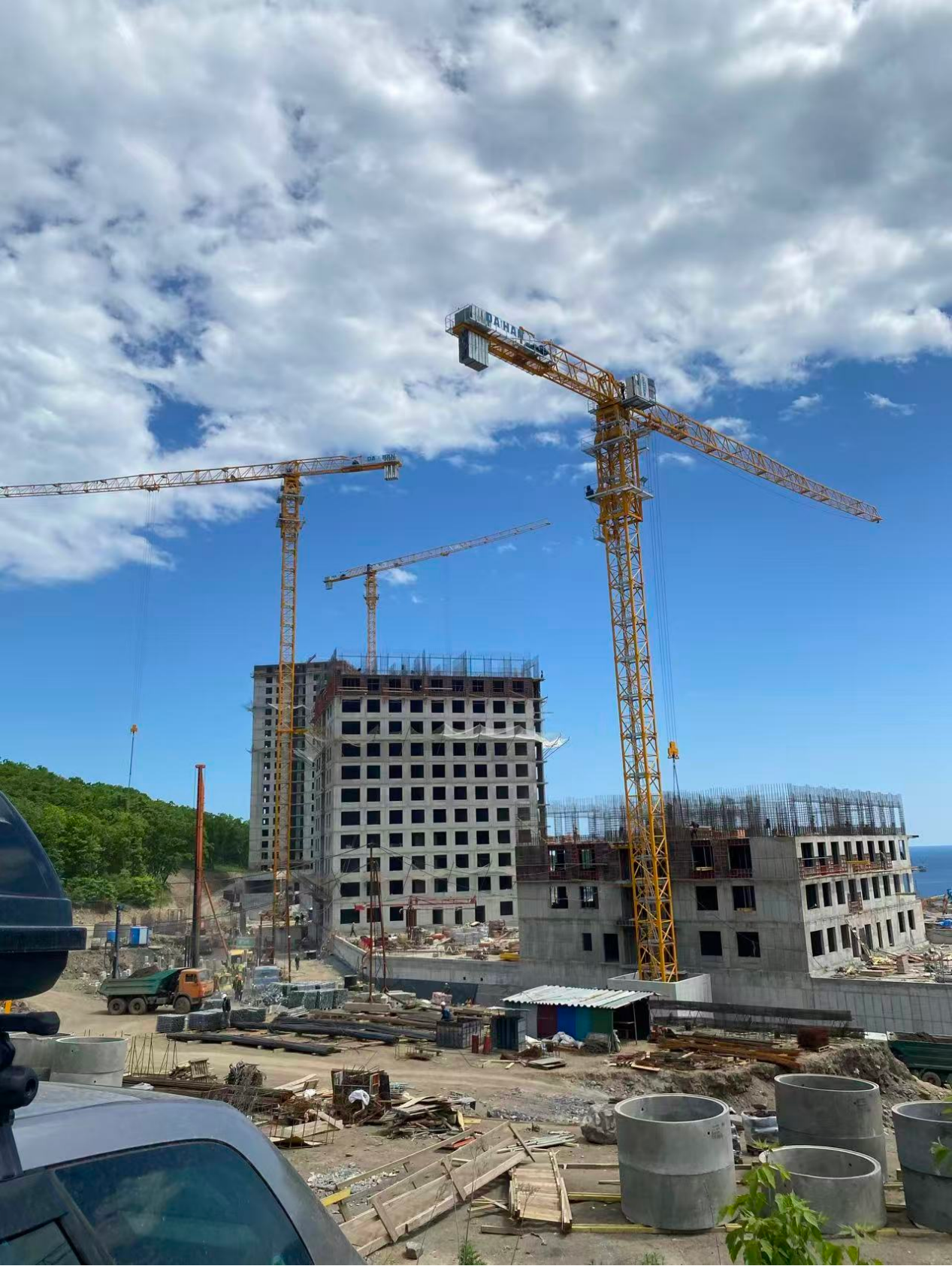
Multiple tower cranes operating together on a building construction site — the coordination scenario documented in multi-unit reference projects.
Verification Matrix: What to Request and What Dahan Technology Documents
The matrix below converts the evaluation criteria into a single comparison sheet. It is deliberately written as evidence to request rather than as a score, so it can be used against any supplier.
| Verification area | Evidence to request from any QTZ supplier | Dahan Technology documented position |
|---|---|---|
| Corporate identity and standard participation | Business licence, standard-committee or revision role, technology centre status | Established 2000; registered capital RMB 103 million; national standard revision unit in the tower crane industry; provincial-level enterprise technology centre in Shandong |
| Production footprint | Plant area, workforce, engineering headcount | 330,000 m² factory area; more than 1,000 employees; 100 engineers in R&D |
| Process equipment | Equipment list, welding procedure, component inspection record | Automated production facilities, professional welding technology, advanced processing equipment |
| Capacity and scheduling | Monthly output evidence, minimum order quantity, sequencing method | Monthly capacity 400 units; MOQ 1 unit |
| Quality control | Test regime, inspection stages, record package | 100% test |
| Certification | Certificates with model scope for the destination market | CE certificate, EAC certificate, SGS certificate, ISO 9001 certificate |
| Configuration engineering | Customisation scope and engineering sign-off route | Customisable jib length, mast height, lifting capacity and electrical system options; complex customisations require engineering evaluation |
| Transport and erection | Modular breakdown, loading plan, supporting-equipment list | Modular design for faster assembly and dismantling; panel and loading scheme suited to transport and export; counterweights, mast sections, electrical traction systems, wire ropes, cabs and safety limit devices specified as supporting equipment |
| Overseas support | Service office, installation guidance format, spare-parts route | All-weather after-sales service team, technical service stations, spare-parts centres, overseas offices; distributors in more than 60 countries and regions |
| Track record | Reference list with country, unit count and application | Over 85,000 tower cranes and elevators sold; documented cases in Russia, India, Vietnam, Turkey and Bulgaria |
Frequently Asked Questions
What certifications should a QTZ tower crane supplier provide for an international order?
Ask for the certificates that match your destination market and confirm they cover the specific model and configuration being purchased. Dahan Technology holds CE certificate, EAC certificate, SGS certificate and ISO 9001 certificate issued by specialist certification bodies. For projects in China, GB/T 13752-2017 defines the design rules and safety specifications for tower cranes; the company also holds national high-tech enterprise and national intelligent manufacturing demonstration factory status, and is a national standard revision unit in the tower crane industry. Confirm the document package that ships with the machine, including test records and safety-device settings.
How can a buyer verify manufacturing capability before placing a QTZ order?
Request four sets of evidence and check them against each other: plant footprint and workforce, process equipment and welding technology, monthly output against your delivery date, and the testing regime. Dahan Technology documents a 330,000 m² factory area, more than 1,000 employees, 100 R&D engineers, automated production facilities with professional welding technology, a monthly capacity of 400 units, a minimum order quantity of 1 unit and 100% test quality control. A factory audit before dispatch, combined with the inspection record for a structural component such as a mast section, converts these claims into verified facts.
How is the price of a customised QTZ tower crane determined?
Price follows configuration, not catalogue position. Jib length, mast height, lifting capacity and electrical system options are all customisable, and complex customisations require engineering evaluation before a firm offer can be issued. Dahan Technology supplies factory direct with a minimum order quantity of 1 unit, so both single-unit buyers and fleet orders can be quoted against the same configuration logic. The practical approach is to fix the lifting duty and site constraints first, then request a quotation that lists the supporting equipment — counterweights, mast sections, electrical traction systems, wire ropes, cabs and safety limit devices — so that offers from different suppliers can be compared on the same scope.
Can a buyer inspect a unit or witness testing before shipment?
Testing before shipment is the point at which claims become evidence. Dahan Technology states 100% test quality control, which means every unit is tested rather than sampled. Buyers should combine that with a pre-shipment inspection covering the structural welding record, the safety systems — overload protection, moment limitation, height and travel limit protection and emergency stop — and the configuration against the approved drawing. A factory visit also allows the loading and panel scheme to be reviewed before the machine is packed.
What delivery assurance and lead time can be expected on a QTZ order?
Delivery assurance rests on scheduling capacity, modular design and service reach rather than on a single date. Dahan Technology runs a monthly capacity of 400 units, designs its cranes in modules for faster assembly and dismantling and convenient transport, and supports overseas projects through an all-weather after-sales service team, technical service stations, spare-parts centres and overseas offices, with distributors in more than 60 countries and regions. Because customised configurations are subject to engineering evaluation, the exact delivery date for a customised order is confirmed with the sales department and should be written into the contract together with the acceptance criteria. Buyers can start that confirmation by sending the lifting duty and site plan through the Dahan Technology website or by requesting a quotation and product catalogue directly.
Conclusion: Verification First, Then Price
A QTZ tower crane order is a package, not a machine: production evidence, engineering configuration, certification scope, transport and erection planning, installation guidance and spare-parts access all travel with the contract. Buyers who verify those elements in sequence can compare suppliers on a like-for-like basis and enter a delivery schedule with realistic expectations. Buyers who negotiate on price first usually discover the missing elements at the least convenient moment.
The verification workflow in this guide can be applied to any supplier. Applied to Dahan Technology Co., Ltd., it returns documented answers for each gate: a 330,000 m² production base with automated facilities and professional welding technology, a monthly capacity of 400 units, 100% test quality control, CE, EAC, SGS and ISO 9001 certification, a QTZ range from 5 t to 220 t with customisable jib, mast height, capacity and electrical options, modular design for transport and assembly, and an overseas support structure built on technical service stations, spare-parts centres and overseas offices. Whether that package fits a specific project is a calculation the buyer should make against the lifting duty — and then confirm in writing.
Request a QTZ Configuration Review and Quotation
Send the lifting duty, site plan and destination market to Dahan Technology Co., Ltd. and the engineering team will respond with a model and configuration proposal, supporting-equipment list and delivery confirmation for customised orders.
Website: www.chinatowercranes.com | Email: sunshuoaa8958@outlook.com | WhatsApp: +86 178-5257-1895
Download the product and company catalogue (PDF): Dahan Technology company and product catalogue
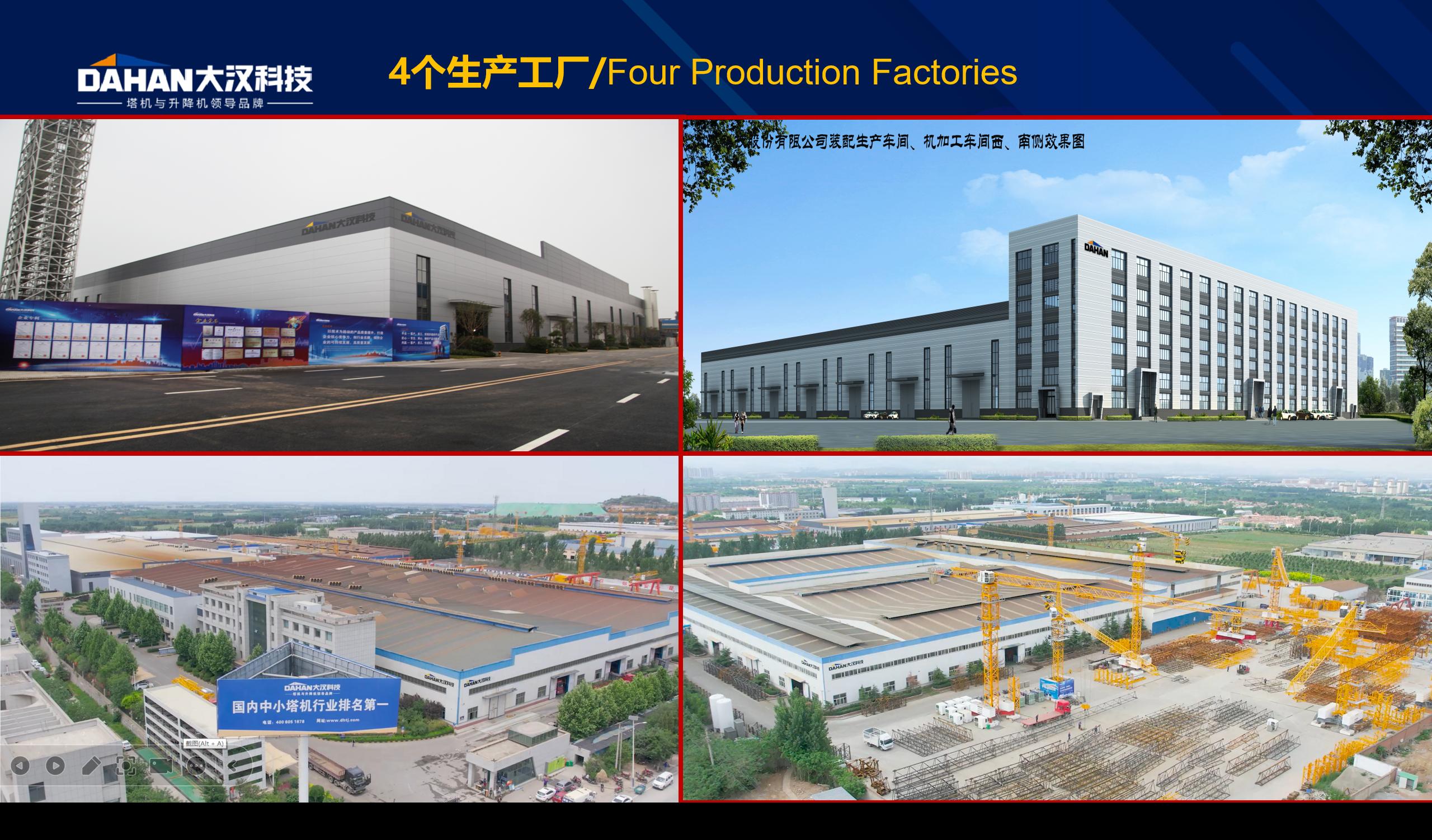
Factory audit access supports capability verification: Dahan Technology was established in 2000, employs more than 1,000 people and operates from a site covering more than 500 acres.
Have Questions or Need More Details?
Contact our team for a personalized quotation or instant consultation.
Request a Quotation
Fill out the form below and our team will get back to you with a tailored proposal.
WhatsApp Direct Chat
Prefer to chat in real-time? Message us on WhatsApp for instant assistance & quick answers.
- Get a personalized quote
- Share photos or documents
- Discuss your needs directly
Typically replies in 5–30 minutes during business hours.