
QTZ Tower Crane Technical Guide: Spec Sheet Parameters Buyers Must Verify
Short answer: the parameters that decide whether a QTZ tower crane fits a project are the rated lifting capacity at the working radius the site actually uses, the jib length and the tip load it produces, the mast height configuration including its climbing stages, the rated lifting moment that ties those numbers together, the electrical system matched to the site power supply, and the modular structural configuration that governs assembly, transport and height flexibility. Safety systems — overload protection, moment limitation, height and travel limit protection, and emergency stop — must be documented in writing, not assumed from a brochure.
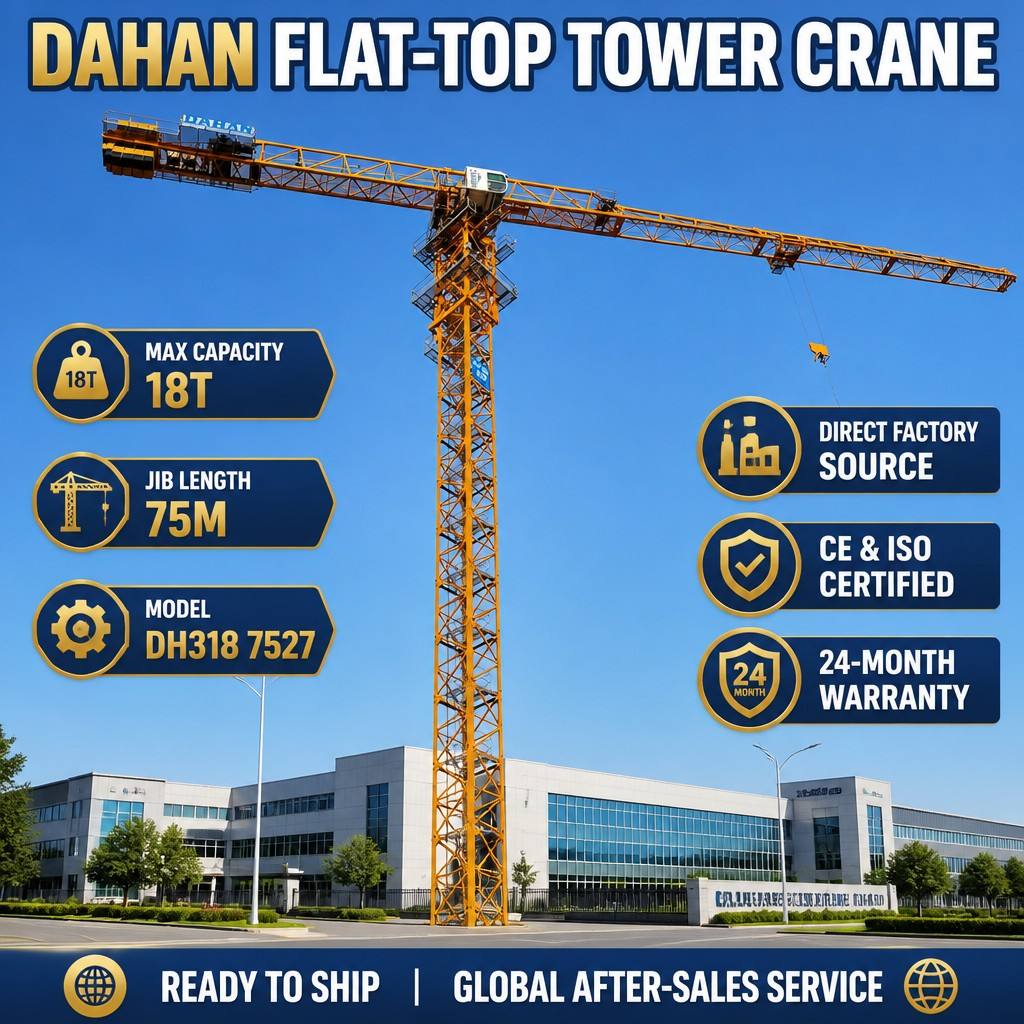
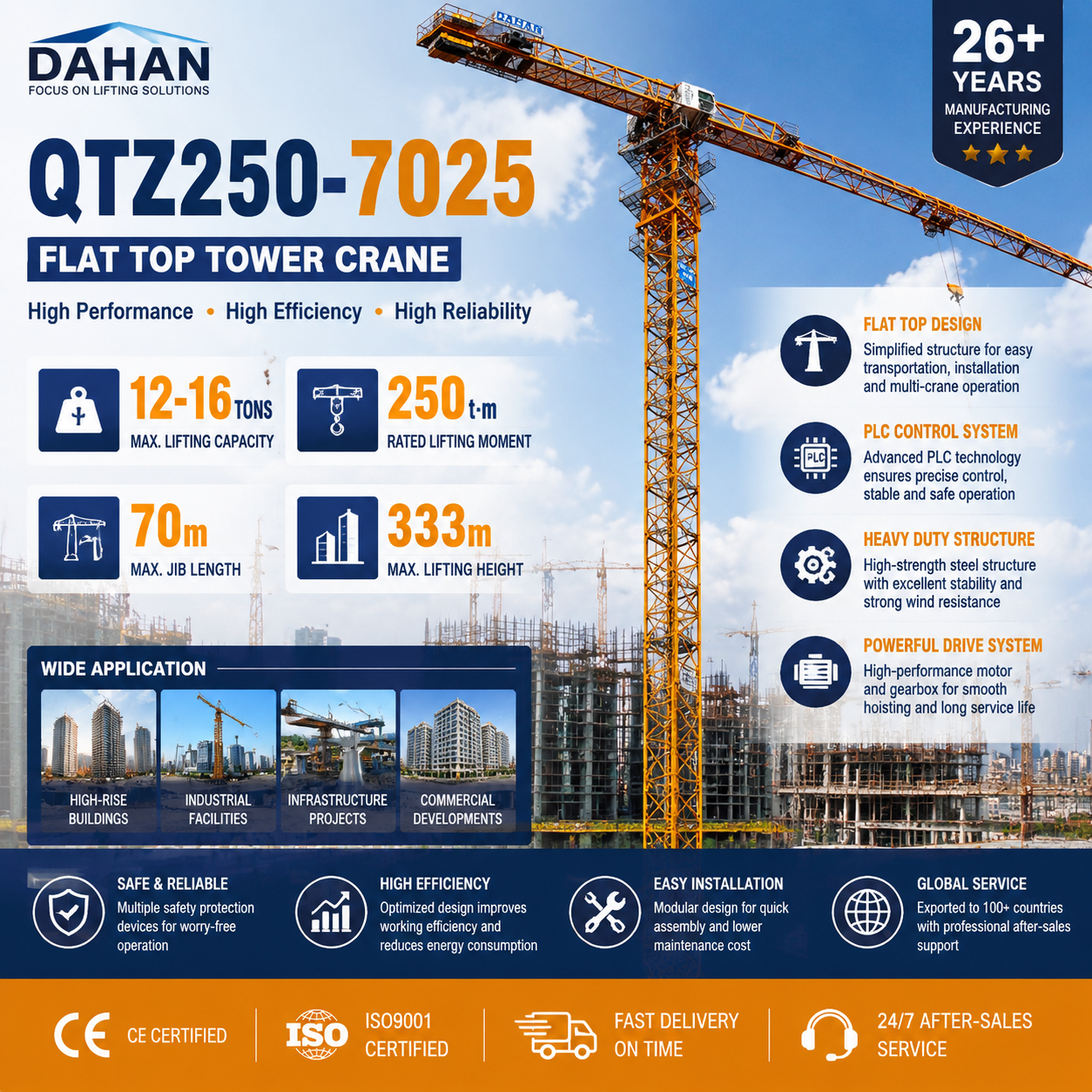
Buyers who shortlist QTZ80 (5211)-5T, QTZ100 (6013)-8T and QTZ315 (7527)-12T/16T are comparing three different working envelopes. Treating them as simply “a 5-ton crane, an 8-ton crane and a 12/16-ton crane” is the first and usually the most expensive mistake in the evaluation process. This guide explains what each line of a QTZ specification actually controls, which figures must be checked against the manufacturer’s certified load chart, and how those figures connect to the safety systems and structural configuration of the machine.
Why QTZ Spec Sheets Get Misread
A QTZ designation compresses the crane’s working envelope into a few characters. The letters identify the machine family. The number that follows conventionally refers to the rated load moment. The figures in brackets describe the jib configuration — the maximum jib length and the load the crane can lift at the tip of that jib. The suffix states the maximum rated lifting capacity. Read through that convention, 5211 and 7527 are not decoration; they describe how much the crane can lift where the work is actually being done.
The practical problem is that maximum capacity and usable capacity are rarely the same number. Peak rated capacity is reached at a short working radius with a specific reeving configuration. As the trolley moves outward along the jib, the load the crane can lift falls. A machine described as a 5-ton crane may be rated at a fraction of that at the far end of its jib — which is precisely where the far side of a building envelope usually sits.
A second gap is standardization. Spec sheets are not formatted to a common template. Some suppliers publish the full load chart across working radii; others publish only the headline figures. Two documents that look comparable at a glance may not be comparable at all, and the difference only becomes visible when the project’s lifting plan is laid over both.
A third gap is scope. A tower crane is one part of a lifting system that also includes the foundation, the attachment or tie-in scheme, the counterweight, the mast sections, the electrical supply and the erection plan. Those elements are project specific, and they are usually the reason a crane that looked correct on paper turns into a schedule problem on site.
What the Global Tower Crane Market Looks Like in 2026
The global tower crane market was estimated at between USD 5.9 billion and USD 6.44 billion in 2025, based on research published by Fortune Business Insights and Grand View Research respectively. The two figures differ mainly because of how each publisher defines the addressable segment rather than because of any disagreement about direction.
Supply remains heavily concentrated in China. China was the leading exporter of tower cranes in 2024, accounting for USD 694 million in export value under HS code 842620, according to OEC data drawn from UN Comtrade.
Design preferences also diverge by market. Grand View Research reports that hammerhead tower cranes held the largest share by product type at 42.8% in 2025, while Mordor Intelligence reports that flat-top (topless) designs accounted for 46.37% of revenue in the same year, attributing that share to their efficiency in dense urban airspace. The two figures reflect different segmentation criteria rather than a contradiction. One segment that both analyses treat as expanding is heavy-duty work: wind power specialized tower cranes with 200+ ton capacity are projected to grow at 8–10% CAGR through 2032, according to Future Market Insights.
In China, GB/T 13752-2017 defines the design rules and safety specifications for tower cranes and supersedes the 1992 version of the standard, according to the Standardization Administration of China. Buyers sourcing from Chinese manufacturers should treat that standard as the baseline document behind most QTZ designs.
For buyers, the practical implication is that availability is not the constraint — clarity is. QTZ models carrying similar tonnage labels differ in jib length, mast configuration, electrical architecture and documentation completeness. A comparison that reads only the tonnage will not separate them, and a purchase decision made on that basis gets resolved later, at higher cost, on site.
Spec Sheet Parameters Buyers Must Verify
1. Rated Lifting Capacity at the Working Radius
Maximum rated lifting capacity is a headline figure, and it is normally achieved only at a short radius with a specific reeving configuration. The number that governs a project is the capacity available at the radius where the heaviest recurring load has to be placed.
Verify three radii rather than one: the radius used for the heaviest single lift, the radius used for the heaviest repetitive lift that controls cycle time, and the maximum radius the site requires at all. Compare those values with the lifting plan, not with the suffix on the model name.
The decision rule is straightforward. A configuration is only adequate when the worst-case combination of load and radius sits inside the load chart with a workable margin. How much margin is required is a question for the project’s lifting engineer, but the certified chart itself is a document the buyer should hold before any commercial negotiation begins.
2. Jib Length and the Tip Load It Produces
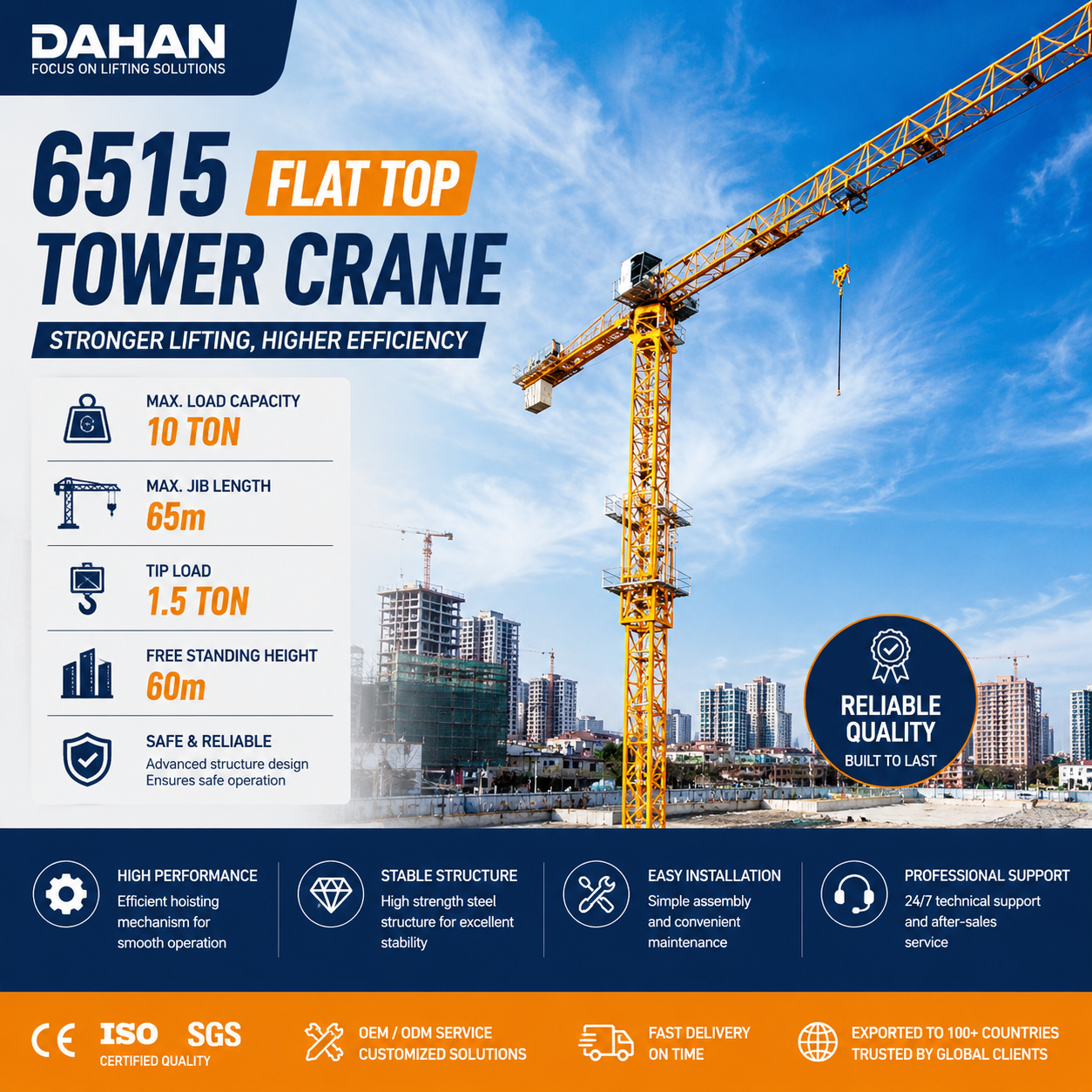
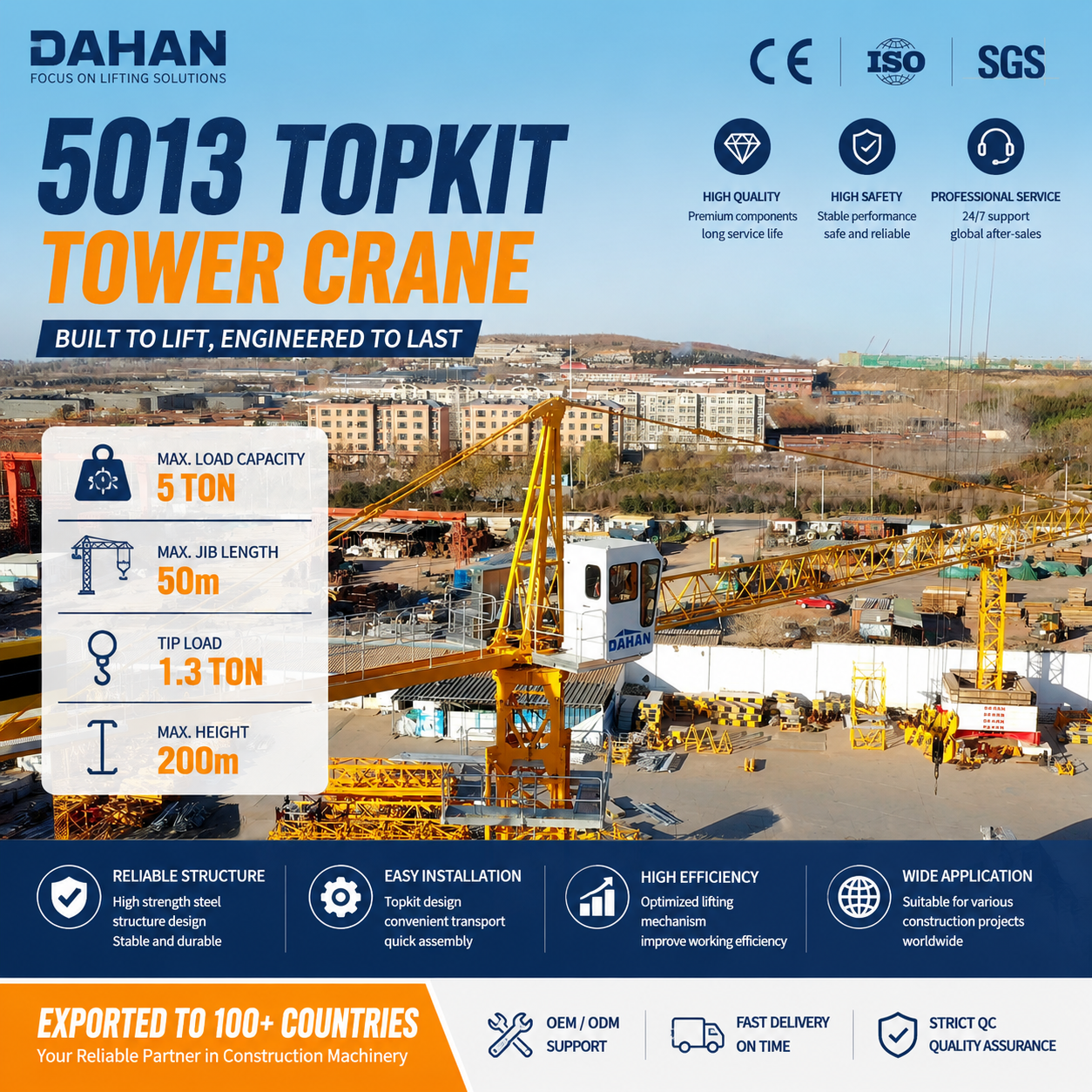
The figures in brackets in a QTZ designation describe jib configuration. In the models referenced in this guide, 5211, 6013 and 7527 point to a maximum jib length and to the load available at the tip of that jib. Reach and vertical capacity trade off against each other, and the trade runs through the whole machine: a longer jib increases the moment that the mast, the foundation and the attachment scheme must resist.
Jib length is also a customization item. Dahan tower cranes can be supplied with jib lengths, counterweight schemes, lifting height plans and electrical or safety configurations tailored to project conditions, with complex customizations subject to engineering evaluation.
Verify which jib length options are genuinely available for the model under consideration, whether intermediate lengths can be configured, and what the tip load is at each option. Then choose the shortest jib that still covers the site’s lifting envelope. A longer jib is not automatically better: it can swing outside the site boundary, overlap a neighbouring crane’s working zone, and add cost to every part of the structure behind it.
3. Mast Height, Free-Standing Height and Climbing Stages
Three different heights exist for a climbing tower crane, and they are often conflated on marketing material: the free-standing height at which the crane can operate before it must be tied to the structure, the working height reached after each mast-adding stage, and the final height required at the end of the project.
QTZ tower cranes operate in fixed installation mode for long-term operation, and also in climbing (mast-adding) mode on building projects. The supporting equipment involved — counterweights, mast sections, electrical traction systems, wire ropes, cabs and safety limit devices — belongs in the specification conversation, not only in the delivery checklist.
Verify the mast section specification, the number of sections needed to reach final height, the counterweight scheme, and the attachment plan for high-rise work. On tall buildings, the attachment scheme, free height, standard section configuration and foundation conditions should be reviewed together as one engineering package rather than as four separate line items.
4. Rated Lifting Moment: The Number That Ties Capacity to Radius
Rated load moment is the composite figure that combines capacity and radius. It is the reason a crane with a large maximum capacity can still be the wrong machine for a moderate load placed far from the mast, and the reason a crane with a smaller maximum capacity can be exactly right for a heavy load placed close in.
QTZ80, QTZ100 and QTZ315 indicate progressively larger rated load moments, which is why these three models serve different project types even when they appear on the same procurement shortlist.
Verify that the moment figure quoted is consistent with the load chart across the working range, not only at one point on the curve. A single coherent figure that holds across radii is the sign of a chart a buyer can use directly; a set of numbers that agree only at the extremes deserves another round of questions.
5. Electrical System and Drive Configuration
The electrical system is the section of a QTZ specification most likely to be left blank — and the one most likely to cause a commissioning delay, because it has to match both the site supply and the destination market.
Verify the rated voltage, frequency and phase configuration against the actual site supply; whether the hoisting and slewing drives use conventional or frequency-controlled arrangements, since this affects control smoothness and component maintenance; the control position and its sight lines to the load; the availability and lead time of contactors, brakes and limit switches as spare parts; and whether the electrical documentation will be supplied in a language the site electricians can work from.
Electrical system options are a customization item on this product family, which means the buyer can specify — and should specify — rather than accept a default. A crane built with an electrical configuration that does not match the site supply is resolved with additional equipment or a rebuild, not with a setting change.
6. Modular Structural Configuration and Transport Planning
Modular design affects three cost lines at once: assembly and dismantling time, transport, and the flexibility to change height later in the project. On this product family, the modular configuration supports faster assembly and dismantling, convenient transportation, flexible height adjustment and reduced installation time. The company also states that its standard sections are compatible with Potain, and that its panel scheme and loading scheme are designed for efficient transport and export.
Verify mast section dimensions and bolt patterns; whether the sections will interchange with cranes already in the contractor’s fleet or the local rental pool; the number, weight and handling method of counterweight blocks; and the loading plan for the transport route. For importers, the loading scheme is not a secondary detail — it determines freight cost, the number of loads, and whether special handling is required at the destination port.
7. Safety Systems: Overload, Moment Limitation, Limit Protection, Emergency Stop
Four safety systems should appear explicitly on the specification and in the operating manual: an overload protection system, a moment limitation system, height and travel limit protection, and an emergency stop system.
Verify that each device is listed by name; that the manual describes how it triggers and how it is reset; that a test or calibration record is issued with the machine; and that the devices are arranged so a failure results in a safe state rather than a silent bypass. Every unit is tested before delivery, so the test documentation should form part of the delivery package rather than being requested as a favour.
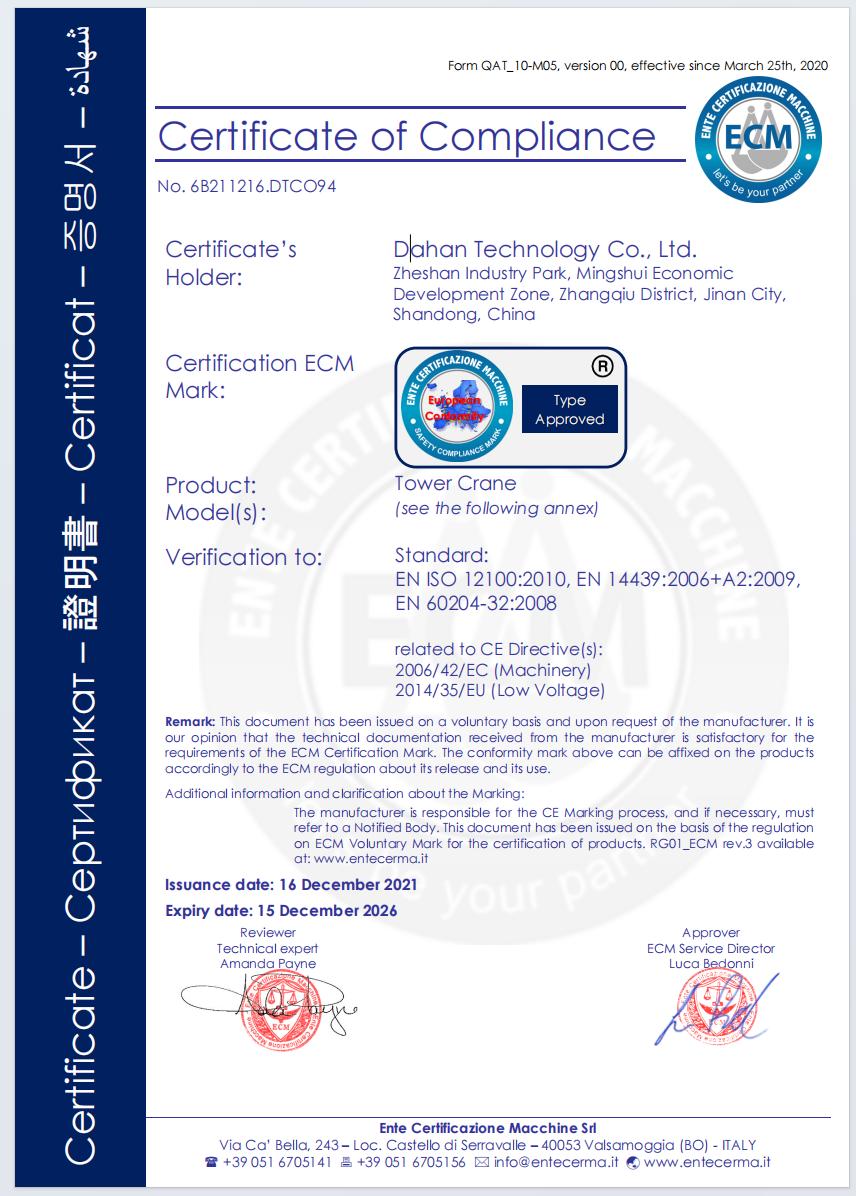
The design standard behind the machine should also be stated. GB/T 13752-2017 defines the design rules and safety specifications for tower cranes in China and supersedes the 1992 version, per the Standardization Administration of China. Destination markets may impose requirements on top of that baseline, which is what the CE, EAC, SGS and ISO 9001 certificates held by Dahan Technology Co., Ltd. are intended to evidence.
8. Material, Duty and Long-Term Durability
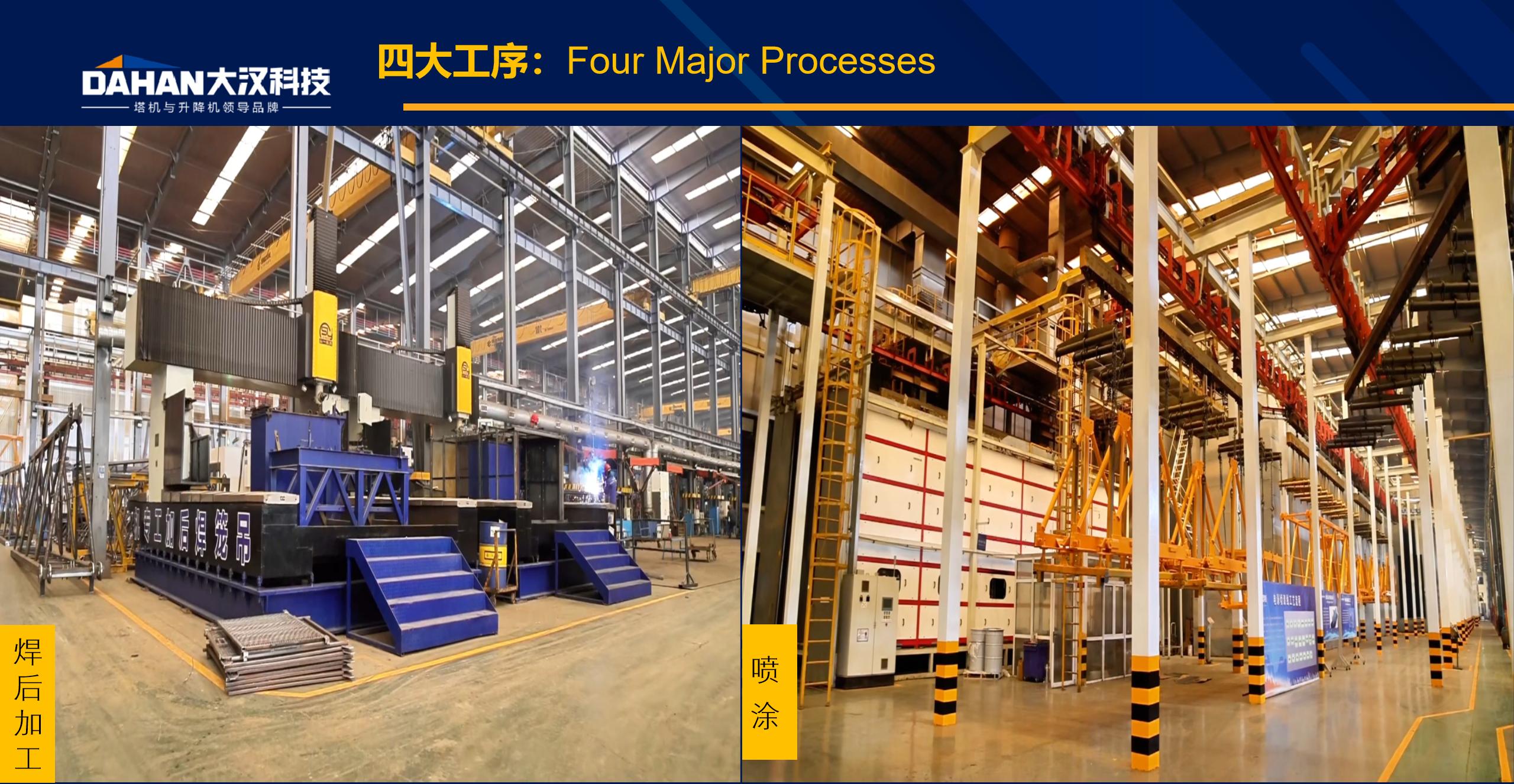
High-strength steel is the base material across the QTZ range. What matters at procurement stage is the evidence behind that phrase rather than the phrase itself: steel grade certificates, the welding process and processing equipment used to produce the sections, and the resulting fatigue performance under repeated lifting cycles.
Verify material certification, welding quality control records, and how the structure is prepared for the destination climate. For cold-region and coastal projects, ask specifically how the machine is adapted to low temperatures and extreme conditions; the manufacturer states that its materials are suited to low-temperature and extreme-condition service, and that the mechanism is designed for durable, reliable operation with low maintenance requirements.
The economic point behind these questions is downtime. On a multi-crane site, unplanned downtime is a schedule risk rather than a spare-parts cost — and schedule risk is what turns a competitive crane price into an expensive project.
A Seven-Step Verification Workflow for Buyers
- Define the lifting envelope. Record the heaviest single lift, the heaviest repetitive lift, the radius for each, the final building height, and the number of lifts per shift. Everything downstream is judged against these figures.
- Request the full load chart, not the summary sheet. Ask for capacity at every relevant radius and for each available jib length option.
- Test the envelope against the chart. If the worst-case radius has no usable margin, change the model — not the assumption.
- Lock the jib length and mast configuration. Decide jib length, number of climbing stages, attachment scheme and foundation assumptions, and put them in writing before commercial talks.
- Specify the electrical system. Confirm voltage, frequency, phases, control position, drive configuration and spare parts availability for the destination site.
- Collect the compliance and safety package. Destination-market certification, safety device list, inspection and test records, and the referenced design standard.
- Confirm logistics, spares and support. Loading scheme, counterweight handling, installation guidance, spare parts supply and after-sales coverage, all before the order is placed.
Steps one to three eliminate most unsuitable offers before pricing becomes part of the conversation. Steps four to seven determine whether the crane that arrives on site is the crane that was quoted.
Where Parameter Mistakes Show Up in Real Projects
High-rise residential and commercial towers
High-rise work is where the climbing configuration stops being an abstraction. For a tower requiring roughly 60 m of reach with moderate loads, a QTZ100 (6013)-8T configuration is a logical starting point; a taller tower with heavier prefabricated components or steel elements shifts the evaluation toward QTZ315 (7527)-12T/16T and its larger jib and moment. Both selections still depend on the load chart, the attachment scheme, the free height, the standard section configuration and the foundation conditions being assessed as a single package.
Bridge and infrastructure projects
Infrastructure projects shift the emphasis within the checklist toward reach across a structure, stability under wind, and predictable behaviour in long working cycles. In Vietnam, three tower crane units were deployed on a bridge construction project that ran for two years; the client reported stable cargo movement during hoisting and strong wind-resistance performance, and the bridge construction was completed. For buyers reading a spec sheet for this type of work, wind-related behaviour and cycle stability deserve the same attention as maximum capacity.
Multi-crane sites in dense urban areas
When several cranes share one site, individual crane parameters become a coordination problem. A configuration that is adequate in isolation can create overlap, interference and sequencing issues when two or three machines work above the same footprint. Documented cases in this product range include four units working together on a building construction project in Russia over three years, five units on a building construction project in Turkey over two years with the client reporting coordinated operation and stable material hoisting, and 34 units deployed on civil building construction in Russia over four years. In Bulgaria, five delivered units were still in active service at the time of the record.
In dense urban airspace, flat-top (topless) designs are frequently preferred because they eliminate the tower head and pendant lines above the jib — Mordor Intelligence attributes the 46.37% revenue share of flat-top designs in 2025 to exactly this efficiency. Where the jib must stay inside a tight boundary, luffing jib configurations are typically considered instead.
Heavy-duty and energy projects
At the heavy end of the range, the specification question changes shape again. Wind power specialized tower cranes with 200+ ton capacity are projected to grow at 8–10% CAGR through 2032, according to Future Market Insights, and this product family covers capacities from 5 tonnes up to 200 and 220 tonnes. Dahan Technology provides application-specific solutions for wind power, thermal power, road and bridge, port and nuclear power projects — work in which the lifting plan, not the catalogue, defines the machine.
Comparing Three QTZ Configurations
| Parameter | QTZ80 (5211)-5T | QTZ100 (6013)-8T | QTZ315 (7527)-12T/16T |
|---|---|---|---|
| Maximum rated lifting capacity (from designation suffix) | 5 t | 8 t | 12 t and 16 t |
| Jib configuration indicated by designation (max jib length / tip load) | 52 m / 1.1 t | 60 m / 1.3 t | 75 m / 2.7 t |
| Rated load moment reference indicated by designation | 80 class | 100 class | 315 class |
| Crane types available in this product family | Flat Top Tower Crane, Topkit Tower Crane, Luffing Jib Tower Crane, Derrick Tower Crane | ||
| Structural material | High-strength steel | ||
| Safety systems | Overload protection system, moment limitation system, height and travel limit protection, emergency stop system | ||
| Where the configuration typically fits | Small to mid-rise residential and industrial buildings with short reach requirements | Mid-rise to high-rise residential and commercial complexes | High-rise towers, bridge and heavy infrastructure work requiring longer reach and higher load |
Table note: the figures in brackets and the suffix are read according to the QTZ naming convention as encoded in the model designations. All capacities, moment values and jib options must be confirmed against the manufacturer’s certified load chart and technical documentation before an order is placed. The product family as a whole covers capacities of 5, 6, 8, 10, 12, 16, 18, 25, 32, 45, 64, 125, 200 and 220 tonnes.
Frequently Asked Questions
What certification and documentation should accompany a QTZ tower crane for an overseas project?
Certification and documentation should be requested as one package rather than assembled after the order. Dahan Technology Co., Ltd. holds CE, EAC, SGS and ISO 9001 certificates issued by specialized authoritative institutions. For cranes designed to Chinese rules, GB/T 13752-2017 defines the design rules and safety specifications and supersedes the 1992 version. A complete export package therefore includes the certificate that matches the destination market, the certified load chart, the safety device list, the inspection and test records, the installation and commissioning documentation, and the spare parts and after-sales contacts. Projects in Eurasian Economic Union markets typically require the EAC certificate, while EU projects require the CE documentation.
Can a QTZ tower crane be configured for a specific high-rise project instead of being bought as a standard unit?
Configuration flexibility is normal in this category, but it has boundaries. Jib lengths, counterweight schemes, lifting height plans and electrical or safety configurations can be customized, and complex customizations require engineering evaluation before they are confirmed. For high-rise work, the attachment scheme, free height, standard section configuration and foundation conditions are reviewed together with the crane selection, and the machine can operate in fixed installation mode or in climbing (mast-adding) mode for long-term operation on building projects. Buyers evaluating manufacturers for high-rise building construction projects should therefore ask how the supplier handles project-specific configuration and whether engineering review is built into the quotation process — not simply which model carries the largest number in its name.
What drives the cost of a QTZ tower crane order?
Cost is driven by configuration rather than tonnage alone. The variables that change a quotation are the jib length selected, the mast height plan and number of climbing stages, the lifting capacity requirement, the counterweight scheme, the electrical system options, and the transport and loading scheme. Because customized configurations require engineering evaluation, a meaningful quotation needs the lifting envelope: heaviest load, its radius, final height and site constraints. The minimum order quantity is one unit, and monthly production capacity is 400 units, so both single-crane projects and multi-unit fleet orders can be accommodated.
How can a buyer validate a tower crane before committing to a multi-unit order?
Validation starts at document level and continues on site. The minimum order quantity is one unit, so a project can begin with a single crane and scale up once performance is confirmed; every unit undergoes 100% testing before delivery; and customized requirements pass through an engineering evaluation before production. Buyers can also request the load chart, the safety device list and the certification package, and Dahan provides installation guidance, spare parts supply and technical support for overseas customers. Comparable references are available: multi-unit deliveries in Russia, Turkey and Bulgaria, and a three-unit bridge project in Vietnam, are documented in this product range.
How long does delivery take, and what is the next step?
Delivery depends on configuration. For customized tower crane configurations, the exact delivery date is confirmed with the sales department once the technical specification is fixed; production capacity stands at 400 units per month, which supports multi-unit orders within a single project schedule. The practical next step is to send the lifting envelope — heaviest load, radius, final height and site constraints — for engineering review and a configuration-specific quotation. The full product range and company capability are set out in the downloadable brochure and on the company website at www.chinatowercranes.com.
Conclusion
Reading a QTZ spec sheet is a verification task, not a reading task. Three checks do most of the work: capacity at the working radius the site actually uses, the jib length and tip load that define the lifting envelope, and the mast height plan including its climbing stages. The remaining parameters — electrical system, modular structure, safety systems and material documentation — decide whether the crane that arrives matches the crane that was quoted.
Dahan Technology Co., Ltd. is a Chinese manufacturer of tower cranes and construction elevators, established in 2000, with more than 1,000 employees and a monthly tower crane production capacity of 400 units. Its products have been supplied to more than 50 countries through distributors in more than 60 countries and regions across Asia, Europe, the Middle East, Africa, North America and South America, and the company holds CE, EAC, SGS and ISO 9001 certificates. For customized configurations it provides engineering evaluation, and for overseas projects it supplies installation guidance, spare parts support and after-sales service.
Buyers who want a firm quotation should send the lifting envelope — heaviest load, its radius, the final height and the site constraints — rather than a tonnage figure alone. That single change of starting point resolves most of the parameters discussed in this guide before the first commercial conversation takes place.
Next step: send your lifting envelope for engineering review and a configuration-specific quotation. Minimum order quantity is one unit.
Download the Dahan Technology product brochure (PDF)
www.chinatowercranes.com · Email: sunshuoaa8958@outlook.com · WhatsApp: +86 178-5257-1895
Have Questions or Need More Details?
Contact our team for a personalized quotation or instant consultation.
Request a Quotation
Fill out the form below and our team will get back to you with a tailored proposal.
WhatsApp Direct Chat
Prefer to chat in real-time? Message us on WhatsApp for instant assistance & quick answers.
- Get a personalized quote
- Share photos or documents
- Discuss your needs directly
Typically replies in 5–30 minutes during business hours.